
AI for Financial Controllers: What Changes in 2026?

Finance teams are under pressure to close faster, explain numbers sooner, and give the business better financial visibility. At the same time, transaction volumes, pricing models, systems, and reporting requirements are becoming more complex. Controllers are still expected to reconcile transactions, review journal entries, investigate exceptions, and coordinate the close, even as CFOs increasingly expect them to provide deeper analysis and strategic guidance.
AI is starting to change that balance. AI agents can handle repetitive workflows such as reconciliations, journal preparation, anomaly detection, and close coordination, while surfacing exceptions that need human judgment.
This does not make the controller less important. It changes where their expertise is applied. Instead of spending most of their time processing financial activity, controllers can increasingly design workflows, define controls, set intervention thresholds, and govern how AI operates across finance.
What is slowing controllers down today?
Controllers lose time when financial work depends on manual handoffs, spreadsheets, and repeated checks across systems. A revenue variance may require tracing billing, usage, contract terms, and accounting entries before the controller can determine whether there is a real issue.
The pressure grows with usage-based pricing, contract amendments, multiple entities, and more frequent reporting. Journal entries, GL preparation and reconciliation can become recurring close bottlenecks, while controllers still need time for certification, audit questions, controls, and business analysis.
EY's 2024 Global DNA of the Financial Controller survey found that 86% of controllers expect their role to change significantly within five years, while 40% expect it to shift toward value creation. That shift is already changing what finance leaders should automate first.
How is AI for financial controllers changing work?
AI is changing controllership by moving routine work toward exception-based review. Instead of checking every transaction or rebuilding every reconciliation, controllers can increasingly review the items that fall outside defined rules.
The important distinction is that AI does not become the accounting policy owner. The controller remains responsible for the control environment, accounting conclusions, approvals, and the evidence supporting financial statements.
For an experienced controller, this is less about adopting another AI tool and more about changing the operating model. The useful question becomes: which decisions require professional judgment, and which steps are simply moving information between systems?
💡KPMG describes the shift as moving the financial close from a reactive, period-end sprint toward a more continuous, governed process, with AI agents monitoring transactions, automating reconciliations, and surfacing exceptions for finance teams.
What can AI actually automate for controllers?
AI can automate or assist with reconciliation, journal preparation, anomaly detection, and workflow coordination, but the safest applications have clear rules and escalation points.
- Reconciliation: AI can match billing, usage, payments, and accounting records and surface exceptions. The controller investigates material or unusual differences.
- Journal preparation: AI can prepare revenue-recognition journal entries from defined events and supporting data. The controller reviews the accounting treatment, approvals, and evidence before posting where required.
- Anomaly detection: AI can identify unusual movements, missing events, duplicate activity, or changes outside expected patterns. The controller decides whether the anomaly represents an error, a business event, or an accounting issue.
- Close orchestration: AI can track dependencies, identify blockers, and prompt owners. The controller retains responsibility for the close and final sign-off.
For revenue teams, this distinction matters. AI accounting workflows can support reconciliation, journal preparation, and reporting while keeping controller review in the process.
The revenue-side use cases are especially relevant: billing versus usage versus revenue reconciliation, revenue-recognition journal entries pushed to the ERP, and contract-change exceptions. The goal is not to imply that AI is replacing the general ledger close.
How is agentic AI different from traditional finance automation?
Traditional RPA follows predefined steps. Agentic AI can interpret context, choose from permitted actions, and escalate when a condition falls outside its operating boundaries. That makes it more flexible, but it also makes governance more important.
A human-in-the-loop model gives the agent defined authority while preserving controller oversight. For example, an agent may identify a revenue variance, gather the contract and usage evidence, prepare the proposed entry, and route it for approval rather than posting it automatically.
The difference is not simply AI versus automation. It is whether the system can reason across a workflow while remaining constrained by deterministic financial rules, access controls, segregation of duties, and approval thresholds.
This is the same operating principle behind AI-native finance architecture: AI can coordinate actions while deterministic rules handle financial calculations and humans approve the cases that require judgment.
How should controllers govern AI-prepared financial work?
Controllers should define what AI can execute, what it can recommend, and what must always require human approval. That includes intervention thresholds, segregation of duties, audit trails, and clear no-go zones.
This matters for SOX controls and financial statement certification. If an AI-prepared journal or reconciliation supports a reported balance, the controller needs evidence of the source data, logic applied, changes made, and human approvals. External auditors should be able to follow that trail without relying on an opaque model output.
ASC 606 and IFRS 15 add another layer. AI can help apply established revenue rules to contract and usage events, but it should not independently decide accounting policy or replace professional judgment on complex contract terms.
A practical rule is: agents execute within defined boundaries, humans supervise exceptions, and financial calculations remain deterministic.
For a practical example of finance controls around AI actions, see AI tasks that should not be approved autonomously.
What does continuous controllership look like in practice?
Continuous controllership means moving financial review closer to the underlying transaction instead of concentrating every control activity at month-end. The workflow becomes transaction, validation, reconciliation, exception, controller review, and reporting.
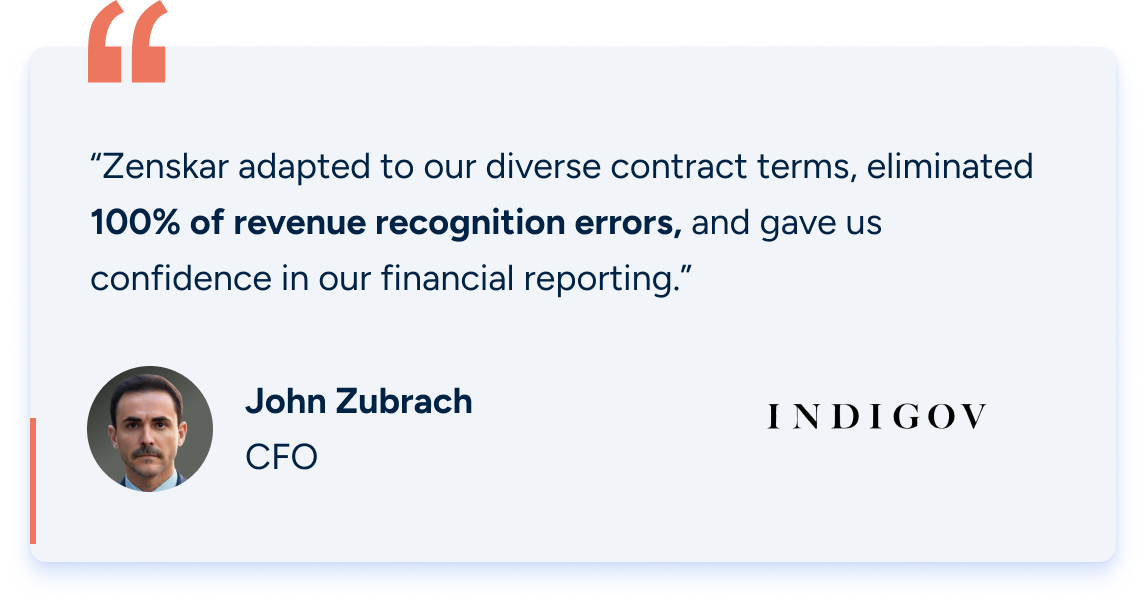
Indigov offers a practical example. Its finance team was maintaining revenue-recognition schedules in Excel, dealing with contract amendments, delayed service starts, and manual payment reconciliation. With Zenskar, the team automated revenue recognition, generated journal entries with audit trails, and reviewed entries before posting to QuickBooks. Month-end close time fell by 80%, with 40+ hours saved monthly.
Indigov CFO John Zurbach described revenue recognition as “probably the biggest issue” because it was very manual. The case study shows how the workflow moved from spreadsheet maintenance toward review-ready automation.
Yembo faced a different revenue-side problem. Its prepaid usage, postpaid overages, and managed services were tracked across systems. Zenskar connected usage to billing and revenue recognition, allowing revenue events and journal entries to reflect actual usage rather than invoice timing. The company saved 90% of finance-team time on billing and revenue recognition, collected 50% of revenue a month earlier, and eliminated revenue leakage.
These examples show the more useful goal for AI for financial controllers: not a zero-day close, but fewer manual steps between a commercial event, the accounting outcome, and the controller's review.
What skills will controllers need as AI adoption increases?
The core accounting skills do not disappear. Controllers also need enough AI literacy to evaluate outputs, design workflows, interpret data, and govern autonomous actions.
1. AI literacy: understand capabilities, limitations, and failure modes.
2. Workflow design: separate repeatable rules from judgment.
3. AI governance: define thresholds, approvals, access, and auditability.
4. Data interpretation: connect financial movements to operational events.
5. Exception-based judgment: focus human attention where context matters.
EY's findings reinforce the direction: controllers are already being pulled toward value creation, with 88% of surveyed respondents saying data insights to recommend strategic opportunities are an important part of their role.
How should controllers prepare for AI-first controllership?
Start with the last few closes, not with a vendor demo. Identify recurring work that follows the same pattern, document the rules behind it, and separate those rules from decisions that require judgment.
1. Map repetitive workflows.
2. Separate deterministic rules from judgment.
3. Set intervention and approval thresholds.
4. Build exception-first workflows.
5. Connect the financial data and systems involved.
6. Start with one controlled use case and measure the result.
A controller should also test whether an AI system can explain its actions, preserve an audit trail, respect segregation of duties, and hand uncertain cases to a human.
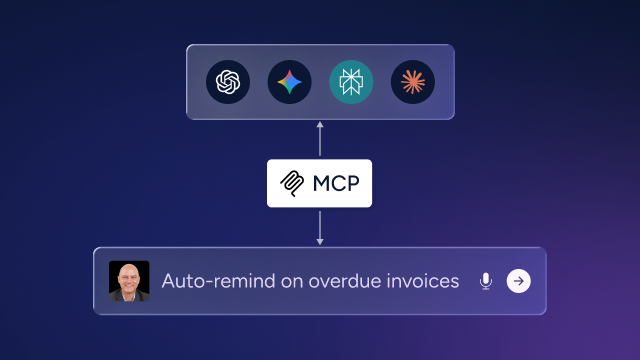
Zenskar's MCP provides a practical example of this connected model. It gives AI access to live billing, contracts, usage, collections, and accounting data, allowing finance teams to ask questions or assign defined tasks without exporting data into separate AI tools.
Where does AI-native controllership fit in the finance stack?
AI-native controllership works best when it sits on top of connected financial workflows rather than replacing the ERP. A practical architecture is CRM or CPQ → revenue automation layer → ERP.
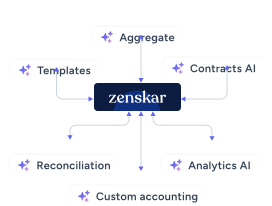
For the revenue side, Zenskar can connect contracts, usage, billing, collections, and revenue recognition, while the ERP remains part of the broader accounting environment. Its Analytics layer provides financial and revenue reporting, and its agent experience can assist with tasks and analysis across those workflows.
Finance teams can use Zenskar Analytics for revenue, usage, collections, and financial reporting, while Zen AI supports task execution and analysis.
A useful customer example is Indigov. Zenskar generated revenue-recognition journal entries with audit trails that the finance team could review before posting them to QuickBooks. That is a more controller-friendly model than asking an AI agent to operate as an unrestricted digital accountant.
The architecture matters because the controller still needs a clear answer to three questions: where did this number come from, which rules produced it, and who approved the result?
What does AI-first controllership mean for the future of finance?
The controller's role is not disappearing. The work is moving toward designing controls, supervising exceptions, interpreting financial performance, and deciding where automation can safely operate.
The strongest AI-first finance teams will not treat autonomy as the goal by itself. They will build workflows where agents can execute defined tasks, deterministic logic handles financial calculations, and controllers retain authority over judgment, controls, and certification.
For controllers evaluating AI, the best test is practical: take a real revenue workflow, including its amendments, usage data, exceptions, and accounting outputs, and see what the system can execute, explain, and audit.
See how Zenskar supports AI for financial controllers across billing, usage, revenue recognition, analytics, and connected finance workflows.
AI Controller Readiness Assessment
Download the AI Controller Readiness Assessment to evaluate which finance workflows are ready for AI, where human review is required, and what controls should be in place before automation expands.
Book a free demo or watch our product tour to see how Zenskar helps finance teams move toward AI-native, zero-touch finance.

By automating recurring billing with Zenskar, our billing cycle – which previously took 7–9 days – now closes in 2 days, saving 16-20 hours/month.

Frequently asked questions
AI is shifting controllers away from repetitive transaction processing toward exception management, workflow design, financial analysis, and AI governance. Controllers still own the numbers and controls, but AI can handle more of the routine work underneath them.
AI can assist with reconciliations, journal preparation, anomaly detection, reporting, and close coordination. The controller remains responsible for accounting judgment, approvals, intervention thresholds, and reviewing material or unusual exceptions.
AI can continuously process financial data, identify anomalies, surface changes, and prepare reporting workflows. This gives controllers more timely context and reduces the manual work involved in gathering, checking, and organizing information before reporting.
AI is more likely to change the controller's responsibilities than eliminate the role. Accounting judgment, controls, governance, and financial interpretation still require human oversight. As routine work becomes automated, controllers can spend more time on analysis, risk, and decision support.
Controllers will need AI literacy, workflow design, data interpretation, and AI governance skills alongside their accounting expertise. The ability to decide what AI should execute, what requires review, and how every action should be controlled will become increasingly important.


Stay Future-Ready with AI-Native Order-to-Cash
Zenskar scales with you - it's flexible, reliable, and enterprise-ready.
