.svg)
About Chirag and Cyflare
Chirag Desai is the CFO at Cyflare, a cybersecurity platform built around the idea that security professionals deserve an operating system. Cyflare delivers open XDR and managed detection and response. Their platform connects to more than 17 security providers, aggregates telemetry from across a customer's environment, and uses AI to auto-resolve threats, escalating the roughly 3% that require human judgment to their SOC team in Kenya. They don't build the detectors. They build the intelligence layer that connects and makes sense of all of them.
When Your Business Model Is More Complex Than Any Tool Expects
Cybersecurity doesn't bill like SaaS
At Cyflare, the billable metrics span users, endpoints, devices, ingest volumes, storage, and license types, and they vary by provider and by product.
A customer using Cyflare's MXDR product is billed differently than one using the EDR or XDR Complete stack. Counts aren't always clean: because Cyflare integrates with 17+ different security providers, each of which captures and reports usage differently, the underlying data requires interpretation every billing cycle.
Think about what it means to bill a reseller whose five clients each run different security tools, each of which counts users, endpoints, and ingest volumes in a completely different way.
Now do that for dozens of resellers, each with their own pricing exceptions, their own minimum commitments, and their own downstream clients they need to forward-bill. That's Cyflare's monthly reality, and it compounds every time they sign a new partner.
Every partner is a distribution layer with its own rules
Cyflare primarily sells through managed service providers (MSPs) and MSSPs, not directly to end customers.
This creates a distributor-style model where every partner has their own pricing concessions, minimum commitments, entitlement tiers, and downstream customers they need to forward-bill.
Some partners want a single consolidated invoice with full sub-customer usage detail. Others have two or three sub-customers with distinct pricing exceptions that differ from the parent plan.
And unlike annual SaaS contracts that stay fixed, Cyflare's partner contracts tend to generate two or three amendments over their life as new SKUs get added, usage thresholds shift, or partner programs evolve.
How Airtable Got Them This Far, and Where It Stopped
When Cyflare's billing complexity was at an earlier stage, Airtable was a workable solution. It was fast to set up, easy for the team to update, and flexible enough to capture the tracking logic they needed.
Chirag and Jennifer (Controller at Cyflare) built their billing process around it: Data would flow from Cyflare's PostgreSQL database, get captured in Airtable, and invoices would go out from there.
As the partner network grew and contract structures became more layered, the process that had served them well began consuming more of the team's time each month. The billing window stretched to seven, eight, sometimes nine days.
For a finance team focused on keeping DSO tight, that delay had a direct impact on cash flow. The sooner invoices go out, the sooner partners can pay within their terms.
Chirag said, when asked why closing time mattered. "Speed of collection, the longer we delay the actual invoicing, the longer it takes us to collect on that within the period. It's a cash flow question."
There was also no single source of truth for contract pricing. Because every partner has custom pricing, knowing what a given partner was supposed to be charged for a given SKU required cross-referencing across tools rather than relying on a single authoritative source.
And when a partner disputed a count, which happens regularly given the nature of cybersecurity telemetry, the team had limited ability to trace the issue or make corrections without rebuilding the dataset from scratch.
Five Platforms Evaluated, and Why None of Them Fit Until Zenskar
Chirag evaluated five or six platforms over several months. Some had the right orientation toward usage-based pricing but were priced above what made sense for a company at Cyflare's stage. Others were more mature as products but lacked the pricing flexibility Cyflare's contract structures required.
What moved Zenskar to the top was a combination of three things.
- First, the depth of the pricing model: the ability to layer entitlements, minimums, overages, and per-unit costs in a single contract, with matrix pricing supporting multi-dimensional SKUs, was closer to what Cyflare actually needed than anything else they'd seen.
- Second, the API-first architecture: Cyflare's roadmap includes embedding revenue data directly into their own partner portal, and any platform they chose had to make that technically feasible.
- Third, the price point fits the company's current scale.
Before signing, Chirag had Jennifer and the accounting team spend time in a Zenskar sandbox.
"I'm not a technical person. I just needed to be able to set up a contract and trust that the right invoice would come out the other end. Zenskar does that." — Jennifer Piscitelli, Controller, Cyflare
Building the Plane While Flying It
Configuring for real-world complexity from day one
The implementation required more than a clean data migration.
Cyflare's contract structures meant the team had to configure parent-child customer hierarchies, entitlement-based grant and consumption tracking, matrix pricing for multi-dimensional SKUs, and a QuickBooks integration, all while continuing to run monthly billing cycles.
A deliberate call on QuickBooks
One of the more consequential decisions during implementation came around how to sync with QuickBooks.
The initial plan was to sync invoices directly. When it became clear that Cyflare's entitlement model generated line items that QuickBooks would incorrectly handle, Chirag made the decision to switch to a journal entry sync approach instead. It was cleaner for the accounting team's reporting and audit trail.
He and Jennifer ran several manual cycles to verify the output before automating it.
Working through constraints without waiting for perfection
The data connection was another area that required iteration. Cyflare's PostgreSQL database sits behind an SSH proxy for compliance reasons, so a direct database connection wasn't immediately available. The team worked through interim processes while longer-term solutions were mapped on the roadmap.
What the First of the Month Looks Like Now
Billing that used to take a week now closes in 2 days
A billing cycle that previously ran 7 to 9 days now closes in 2 days. That compression came from the contract automation, which handled work that had previously required manual assembly.
For a team managing a tight DSO cycle, shaving 5 to 7 days off the front of the invoicing process directly affects cash flow every single month.
A single source of truth for every partner's pricing
Before Zenskar, knowing what a partner was supposed to be charged required going to multiple places.
Now every contract, every pricing concession, every entitlement configuration lives in one place, and it's accessible via API.
This matters especially when a partner raises a dispute or when the team needs to reference historical pricing mid-amendment. Instead of reconstructing the picture, they go to one place.
16-20 hours of work eliminated from the billing week
The effort required to prepare, validate, and manipulate billing data before each cycle had been a significant drain on the team's time.
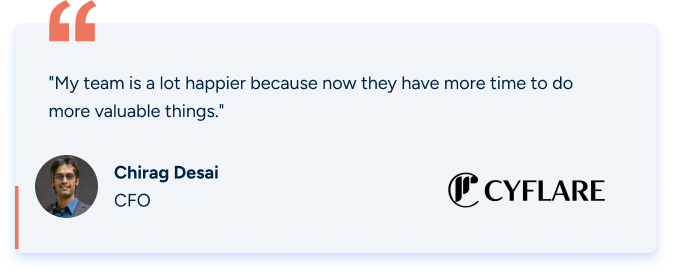
With the data pipeline connected and contracts configured in Zenskar, that preparation work has been substantially reduced. The time freed up is now going toward analysis, reporting, and the work the finance team was actually hired to do.
Mid-year contract changes no longer need workarounds
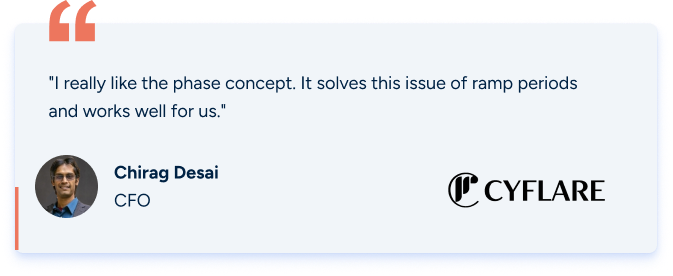
One of the features Chirag specifically called out was Zenskar's phases model, which allows a contract to have multiple sequential phases, each with its own products, pricing, and payment terms. For a business where contracts evolve frequently and ramp structures are common, this turned something that had previously required workarounds into a native capability.
The finance team gets to do finance again
Jennifer and Chirag are no longer spending the first days of every month in reactive mode, tracking down data, correcting miscounts, and chasing invoice accuracy before anything can go out.
That shift in how the team begins the month, from operational triage to strategic work, is what Chirag comes back to.