
Finance Systems Integration: How to Fix Siloed Tools
When we talk to CFOs evaluating integrated financial tools, the concern is rarely that their existing systems don't exchange data. It's that they don't agree on what that data means. Siloed finance tools can sync perfectly and still produce different numbers because contract terms, pricing logic, revenue rules, or entitlements were modeled differently.
If every forecast, cash projection, or board number has to be validated against multiple systems first, CFOs lose visibility and speed exactly when the business needs it most.
This guide covers where that disagreement starts, how to fix it, and how to evaluate platforms that can integrate finance tools to accelerate decision-making for finance leaders.
Why doesn’t connecting finance systems eliminate manual reconciliation?
Systems can exchange data flawlessly and still disagree about the underlying transaction. Without shared definitions and ownership, finance data fragmentation simply moves downstream from disconnected systems into reconciliation workflows.
Consider a two-year agreement with a platform fee, tiered usage pricing, prepaid credits that roll over for one quarter, a mid-term amendment adding a second entity, and billing in two currencies. If billing cannot represent those terms as signed, finance has to approximate them. Prepaid credits become manual adjustments, and the amendment would require recreating part of the subscription. This is a structural limit of billing tools built for subscriptions rather than usage-based contracts.
Each workaround adds a reconciliation point. Over time, these accumulate as integration debt, mapping logic in every connector that must change whenever pricing, entities, or contract structures change. Tools built on deep CRM customization add another risk that finance rarely owns the CRM.
Not every discrepancy has the same cause:
Three of the four causes are architectural. An integration project can go live on schedule and leave the manual work in place, which is the difference between integrated finance tools and merely connected ones.
How do integrated finance tools improve CFO decision-making visibility?
An integrated financial system improves CFO decision-making visibility when it shares one contract model, so bookings, billing, revenue, and cash can be read together without adding another step for validation. There is a control benefit as well. Every spreadsheet bridging billing and the general ledger becomes a control auditors review, so fewer bridges mean fewer controls to defend.
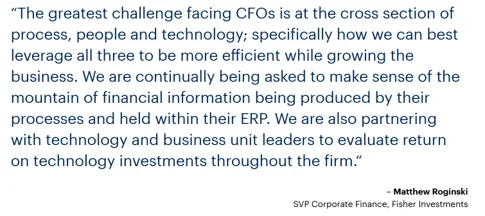
Gartner's 2026 Finance Technology Bullseye Report estimates that CFOs who manage finance technology as a portfolio alongside AI could unlock an additional 10 percentage points of margin growth by 2029. Capturing that upside depends on turning financial data into decisions. Matthew Roginski, SVP Corporate Finance at Fisher Investments, describes the challenge:
A single source of truth for finance therefore requires more than putting data in one place. You need:
- A data model that represents the agreement as written.
- Consistent definitions across billing, usage, revenue, and accounting.
- One system of record for each financial data point.
- A traceable link from contract terms to every downstream transaction.
For a CFO, that means integration should be evaluated as part of the finance operating model, not just as an IT implementation. This aligns with Gartner's Evanta CFO community research, which surveys more than 100 finance leaders annually. Finance transformation has held the number one CFO priority for a third straight year heading into 2026, with AI and automation climbing to the second place. Deloitte's Q4 2025 CFO Signals survey found half of North American CFOs naming digital transformation of finance as their top 2026 priority.
Watch CFOs & technology leaders discuss the importance of integrating tools across financial workflows:
How do you break down siloed finance tools?
Break down siloed finance tools by fixing the data model before adding connectors:
- Map every reconciliation point: Each close task labeled "tie out" or "true up" marks two systems that disagree.
- Assign one system of record per data point. Contract terms, usage, credits, and journal entries each need a single authoritative source.
- Start closest to revenue. ERP, CRM, and billing integration is where most discrepancies originate.
- Decouple components that change at different speeds. Coupled pricing, metering, and recognition turn one change into three.
- Track reconciliation points as a KPI. A falling count proves integration success; a rising connector count does not.
What questions should you ask before buying integrated finance tools?
These four questions reveal more about a platform's architecture than its connector list.
1. Can the platform model your contract exactly as signed, without a workaround?
Test it by asking the vendor to configure one of your most complex live contracts during the demo. A discount should apply at the product, bundle, or contract level without rebuilding other pricing, and a prepaid balance should stay an entitlement, tracked and recognized separately from its invoice.
Zenskar's graph data model represents contracts as connected objects instead of table rows, so amendments, tiers, credits, and multi-entity structures coexist. Cyflare bills resellers with layered entitlements and amendments this way, cutting the billing cycle from seven to nine days to two, saving 16 to 20 hours a month, according to CFO Chirag Desai.
"I just needed to be able to set up a contract and trust that the right invoice would come out the other end. Zenskar does that," says Jennifer Piscitelli, Controller at Cyflare.
2. Is revenue recognition decoupled from billing?
It should be, because invoice timing and performance obligations rarely follow the same pattern. When recognition follows invoice events, transaction price allocation using standalone selling price, mid-contract modifications, and usage-based overages push controllers back into spreadsheets.
Indigov, a GovTech company, faced long gaps between contract signature and go-live.
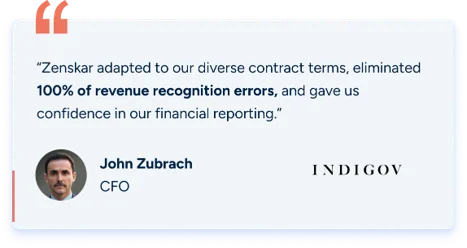
After decoupling recognition from invoicing in Zenskar, Indigov cut month-end close time by 80%. Zenskar generates performance obligations and revenue schedules from contract and usage data while syncing journal entries to the ERP under ASC 606 and IFRS 15. That architecture matters because an invoice should not solely determine when revenue was earned.
3. Is metering decoupled from pricing?
Usage is a measurement, while pricing is a commercial decision. They should be able to evolve independently. If moving to volume tiers requires engineering to rebuild the usage pipeline, finance does not control pricing.
API-first integration alone does not solve this: an API moves data, but finance still needs to change pricing logic without an engineering ticket. Zenskar keeps metering separate from billing and ingests usage from connected data sources, the API, or CSV, which matters most for AI companies adopting token-based pricing.
4. Which computations are deterministic, and which are AI-generated?
Invoice generation, transaction price calculation, revenue recognition, and journal entry creation should run on deterministic, auditable rules. Most vendors of integrated finance tools now offer AI, so the useful question is where the AI stops. AI suits extraction and anomaly detection, but outputs that affect invoices or money movement require human approval.
With Zenskar, key financial computations run on deterministic logic that AI does not touch, and your team reviews or approves every AI-generated output. Agents execute, humans supervise. An AI layer cannot remove the limits of a rigid billing architecture, which is why AI has to be built into the foundation, not bolted on.
For finance leaders, integrating AP, expenses, and payments into a connected finance stack is becoming essential to achieve real-time visibility and proactive cost control.
What should your billing and revenue platform evaluation checklist include?
Use this finance integration checklist to score vendors on the capabilities that determine whether manual work disappears:
Where does a revenue automation platform sit in your finance architecture?
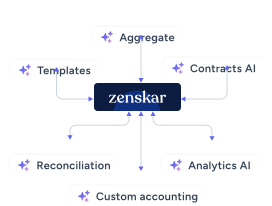
A revenue automation platform sits between your CRM or CPQ and ERP, handling the operational layer between contract and accounting. For Zenskar, that layer includes contract management, usage metering, billing, collections, entitlements, revenue recognition, and analytics.
The boundaries are important:
- It does not process payments. It orchestrates payment workflows through existing gateways.
- It does not calculate sales tax. It connects with platforms such as Avalara and Anrok.
- It is not the general ledger. It sends accounting outputs to systems such as NetSuite, QuickBooks, Xero, and other ERPs.
Should you build finance systems integration in-house or buy a platform?
The right finance automation architecture depends on the complexity of your business. Build only if billing logic is a differentiator you will maintain indefinitely. For simple subscription pricing, an established subscription billing platform is often sufficient. Integrated finance tools earn their place when pricing, usage, and revenue recognition must operate independently.
In-house systems carry costs that compound with every pricing change. 100ms, a video infrastructure company, built billing in-house before switching.
"Zenskar saved our engineers months of work to build in-house billing. It freed up time for 3 full-time engineers to focus on the product," says Saikat Mitra, Director of Engineering at 100ms.
Newer platforms involve trade-offs too. Zenskar's integration footprint differs from the largest incumbents'. The practical question for a CFO is whether the business needs more integrations or fewer reconciliation points.
Book a demo today to see how Zenskar accelerates CFO decision-making with an integrated finance system.

By automating recurring billing with Zenskar, our billing cycle – which previously took 7–9 days – now closes in 2 days, saving 16-20 hours/month.

Frequently asked questions
Finance systems integration connects CRM, CPQ, billing, revenue recognition, ERP, banking, tax, and reporting systems so data and workflows move between them automatically. Effective integration also aligns how each system defines contracts, pricing, and revenue, so the numbers agree without manual reconciliation.
The main benefits are less manual reconciliation, a faster month-end close, fewer billing and revenue errors, and more reliable forecasts. For CFOs, the biggest benefit is visibility: current figures across bookings, billing, cash, and recognized revenue without a separate validation cycle.
Companies should start with the systems closest to revenue: CRM or CPQ, billing, revenue recognition, and the ERP. These systems convert contract terms into invoices and journal entries, which is where discrepancies typically begin. Usage-based businesses should also connect metering sources early.
Finance integration removes repeated exports, imports, and duplicate data entry. The larger gain comes from architecture: when one platform models the contract correctly and feeds billing, entitlements, revenue, and accounting from the same terms, discrepancies are prevented rather than corrected during the close.
No. ERP integration connects systems to the general ledger, which is only one part of the finance architecture. Finance systems integration also covers CRM, CPQ, usage metering, billing, collections, revenue recognition, payments, tax, and analytics, and how data flows between them before reaching the ERP.
Stay Future-Ready with AI-Native Order-to-Cash
Zenskar scales with you - it's flexible, reliable, and enterprise-ready.
