

When a customer adds ten seats mid-contract, is that a modification of the existing agreement or a separate purchasing decision? When API usage spills over the committed tier in October but the invoice doesn't go out until November, which period does the revenue belong to?
These are not edge cases. The most common mistake is finance teams recognizing seat additions and overages when the invoice is issued, not when the obligation is satisfied. Under ASC 606, that timing difference is a misstatement.
What follows is a practical guide to the ASC 606 treatment for seat additions and overage revenue recognition, the tests your team should be running on every expansion event, and how to connect live usage data to your recognition engine so the timing is always correct.
The key question: Modification or separate purchasing decision?
When a customer expands their contract mid-term, the first question your team needs to answer is not how much revenue to recognize. It is whether the expansion is a modification of the existing contract or a separate purchasing decision entirely. The answer determines everything that follows.
A contract modification, as covered under ASC 606-10-25-12, triggers a formal reassessment of your performance obligations, transaction price, and potentially your recognition schedule. A separate purchasing decision opens a new accounting track entirely, with no impact on the original contract.
💡A modification may require cumulative catch-up adjustments that affect prior periods. A separate purchasing decision is recognized prospectively from the date of the expansion, with no prior period impact.
How do you know which one applies?
The test is not based on how the expansion is documented commercially. A customer can sign an amendment to their original order form and still be making a separate purchasing decision under ASC 606.
In a webinar where we hosted Jill Hauck, she said:
"If your billing system invoices overages monthly but your RevRec system recognizes them at invoice date, you have a timing error waiting for your auditor to find."
The 3-part test in the next section tells you exactly how to make the determination.
Seat additions: The 3-part test under ASC 606
Not every seat addition is the same transaction. The 3-part test below determines whether an expansion qualifies as a separate purchasing decision, which means new contract treatment, or falls back to modification accounting.
- Are the added seats distinct goods or services? Seats added to an existing subscription are typically the same product the customer already has. If they can benefit from the additional seats independently, and the seats are separately identifiable from the original contract, they are distinct.
- Does the price reflect the standalone selling price? If the customer is paying the same per-seat rate as their original deal, or a rate consistent with your SSP for that tier, the price reflects SSP. If they've negotiated a discount below SSP as part of the expansion, this part of the test fails.
- Is this an independent purchasing decision? The customer is choosing to expand based on their own assessment of value, not because the original contract obligated them to. If the expansion is discretionary and driven by the customer's decision to grow their usage, it qualifies as an independent purchasing decision.
All three yes: Treat as a separate purchasing decision. Open a new recognition schedule from the addition date. No reallocation of the original contract's transaction price, no prior period impact.
Any one no: Treat as a contract modification. Run the ASC 606 modification framework to determine whether cumulative catch-up or prospective treatment applies.
API overages: Recognizing revenue when usage is consumed, not when invoiced
Overages are variable consideration earned in the period the usage occurs, and ASC 606-10-32-7 is clear about when variable consideration is recognized: in the period it is earned, not the period it is invoiced.
For example: if a customer consumes $15,000 of API usage in October but your billing cycle doesn't close until November 15th, the $15,000 belongs in October's revenue, not November's. Even in the case of app maintenance services, development companies can experience API overages. This can represent a mix of infrastructure strain, security risks, and strategic monetization opportunities.
Why do most teams get this wrong?
Most billing systems generate the overage invoice after the usage period closes, which means the path of least resistance is to recognize revenue when the invoice is created. That path is incorrect under ASC 606.
According to Zenskar's internal estimates, approximately 70% of API-heavy SaaS companies recognize overage revenue at invoice date rather than consumption date. Each one of those companies has a timing error in their revenue schedule that compounds across every billing cycle, every quarter, and every audit.
The correct treatment is to recognize overage revenue in the period the API calls, compute credits, or platform usage actually occurred. This requires your RevRec system to be connected to your usage data in real time, not reconciled after the fact.
Why does overage RevRec require live usage data?
Recognizing overage revenue requires your RevRec system to know what was consumed, by which customer, in which period, before that period closes. Most finance teams work around this with a manual reconciliation process. Usage data is exported from the product or infrastructure layer at month end, matched to customer contracts, aggregated by period, and handed off to the RevRec team to post journal entries. The process works, until it doesn't.
What breaks the manual reconciliation approach?
Volume. At low API usage volumes, manual reconciliation is manageable. As your customer base scales and usage events multiply across contracts, tiers, and periods, the reconciliation becomes a close bottleneck.
Timing. Manual reconciliation is inherently backward-looking. By the time your team processes October's usage data, October's books may already be closed. Late adjustments create prior period entries that auditors flag.
Accuracy. Usage data pulled from infrastructure logs requires mapping to contract terms, rate cards, and tier thresholds before it becomes RevRec-relevant. Each manual mapping step is an opportunity for error.
Mid-period changes. When a customer upgrades their tier or hits a commitment threshold mid-month, the per-unit rate for their usage may change partway through the period. Manual reconciliation rarely handles mid-period rate changes correctly.
The solution is a direct connection between your usage metering layer and your RevRec engine.
How to connect usage events to revenue recognition in real time
The data pipeline your revenue recognition solution needs for overage recognition has four stages.
Stage 1: Usage event ingestion. Every API call, compute credit, or platform usage event is captured at the infrastructure layer and passed to your metering system in real time. No batch exports, no end-of-month pulls.
Stage 2: Period aggregation. Usage events are aggregated by customer, contract, and accounting period as they occur. When a period closes, the aggregated usage total is already calculated. No reconciliation required.
Stage 3: Rate card application. Aggregated usage is matched to the customer's contract terms, tier thresholds, and overage rate card. If a customer crosses a commitment threshold mid-period, the correct rate is applied to each usage band automatically.
Stage 4: RevRec entry generation. The period's overage amount triggers a revenue recognition entry in the correct accounting period, with a full audit trail tracing the entry back to the underlying usage events and contract terms.
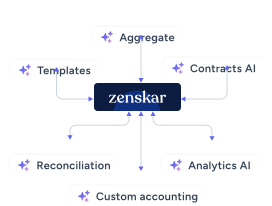
Zenskar ingests API usage events in real time, aggregates them by period, applies contract-level rate cards, and generates RevRec entries automatically in the period of consumption. Seat additions are classified using the 3-part purchasing decision test and recognized from the addition date without manual intervention.
In a recent webinar where we hosted Jill Hauck, she framed the core principle plainly:
"Overages are not a billing event. They are a revenue event. The recognition timing follows consumption, not the invoice."
That logic is built into Zenskar's usage metering and RevRec engine by default.
See how Zenskar handles it in practice
Zenskar's usage metering and RevRec engine handles both seat additions and overages natively. Seat additions are classified automatically using the 3-part purchasing decision test, with recognition triggered from the addition date. API overages are ingested as real-time usage events, aggregated by period, and recognized in the period of consumption without manual reconciliation. Every entry carries a full audit trail tracing back to the underlying usage data and contract terms.
If your team is still reconciling usage exports at month end and posting overage revenue at invoice date, that's the process worth replacing first. See it on a real usage-based contract by booking a demo.
Frequently asked questions
Not always. A seat addition qualifies as a separate purchasing decision if the added seats are distinct, the price reflects SSP, and the expansion is customer-driven and discretionary. If any part of the 3-part test fails, modification accounting applies.
Overage revenue is variable consideration earned in the period of consumption. It must be recognized in the period the usage occurs, not when the invoice is issued. This requires your RevRec system to be connected to real-time usage data.
A 3-part test that determines whether a mid-contract expansion is a new contract or a modification, based on whether the added seats are distinct, whether the price reflects SSP, and whether the expansion is an independent, customer-driven decision.
Because the performance obligation is satisfied when usage occurs, not when the bill is issued. Recognizing at invoice date shifts revenue into the wrong period, which is a timing misstatement under ASC 606.
Usage event data at the individual transaction level, aggregated by customer, contract, and accounting period, with rate card logic applied to calculate the overage amount before the period closes.

By automating recurring billing with Zenskar, our billing cycle – which previously took 7–9 days – now closes in 2 days, saving 16-20 hours/month.

Stay Future-Ready with AI-Native Order-to-Cash
Zenskar scales with you - it's flexible, reliable, and enterprise-ready.
