
Why Your Best Accountants Spend 60% of Their Time on Tasks AI Could Do

On her second week, a new junior accountant asked me a question that caught me off guard:
“Why does everyone spend more time fixing numbers than understanding them?”
I laughed at first but she wasn’t wrong. Accountants spend their days reconciling, re-checking, and stitching together data that should flow cleanly on its own.
That afternoon, I revisited an Accenture study showing that automating finance processes can reduce manual work by up to 40% using technology that already exists. In that moment, it became obvious: it’s not the team that’s outdated. It’s the workflow.
In this blog, we’ll explore how AI is used in accounting and why your best people are still trapped doing machine work.
How AI is used in accounting today and where you’re leaving value on the table?
Most CFOs have been pitched AI more times than they can remember, but few get a clear view of what AI can actually do today. This isn’t about futuristic ML labs. It’s about commercially mature, reliable capabilities that remove the repetitive work clogging the accounting calendar.
Key categories of AI use in accounting
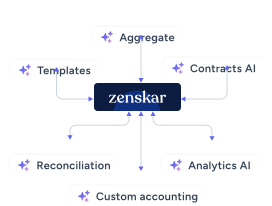
In practice, the highest-impact AI in accounting and finance is deeply embedded in systems that already own key revenue and billing events. Zenskar, for example, doesn’t just scan invoices; it understands contracts, usage based pricing, pricing rules, and revenue schedules end to end, which makes its AI far better at automating postings, surfacing anomalies, and generating decision-ready revenue views than a generic AI layer bolted on top.
Where do your best accountants actually spend their time?
- Manual reconciliations across systems
- Spreadsheet reconstruction every close
- Data hygiene checks
- Copy-paste reporting
- Chasing documentation and approvals
- Fixing integration mismatches
- Line-by-line reviews for anomalies
According to Gartner, finance teams spend 25% of their time gathering, validating, and reconciling data time that should be going toward actual analysis.
When Zenskar replaces manual billing, recognition spreadsheets, and ad hoc reconciliations, leaders often see a visible shift: senior accountants move from chasing down mismatched invoices and deferrals to reviewing exceptions, validating AI-suggested adjustments, and explaining trends to the business. The tasks don’t disappear, they become curated, higher-leverage review work instead of endless hands-on keying.
What are some accounting examples in AI that could free up 60% of your team’s time?
1. Reconciliations & month-end close
Reconciliation is the silent tax of finance. Every month end close cycle, it drains hours from your highest-paid and most experienced accountants. Yet most of this work is pure pattern matching something AI does exceptionally well.
AI can
- Auto-reconcile transactions across CRM, billing tools, ERP, and banks
- Detect mismatches across usage, pricing, and invoices
- Suggest adjustments
- Identify upstream root causes
- Create pre-close readiness summaries
The result: a faster, cleaner close with fewer late nights and far more time spent reviewing insights rather than hunting for discrepancies.
In a Zenskar-driven environment, billing events, cash receipts, and revenue schedules all live in one consistent model, so its AI can pre-reconcile huge swaths of activity before the close. Your accountants see curated exception queues inside Zenskar instead of manually tying out rows across systems. For teams already using NetSuite, NetSuite SuiteBilling provides native subscription and recurring billing automation that feeds directly into the same reconciliation workflows, reducing the need for manual data transfers between systems.
Reconciliation shouldn’t be a marathon. AI turns it into a short, targeted review.
2. AP/AR & cash application
AP and AR are among the most rules-driven functions in finance, yet many companies still rely on manual validation. It’s a mismatch between human effort and machine capability. AP/AR is largely rules-driven, yet many companies still rely on manual processes. Some finance teams close that gap by choosing to hire an accountant through an outsourced provider to manage day-to-day AP/AR operations, freeing internal staff to focus on higher-value judgment tasks that AI still can’t fully handle.
AI can
- Read, classify, and code invoices
- Validate against POs or contract terms
- Auto-apply payments
- Predict late payers
- Prioritize collection actions
Zenskar’s collections intelligence uses historical payment behavior and current exposure to prioritize outreach and recommend actions, so AR teams focus on the riskiest and most impactful accounts instead of working a static aging list line by line.
3. Expense management & policy enforcement
Expense management seems minor until you tally the collective hours lost in review cycles. AI reduces the friction dramatically.
AI can
- Auto-classify expenses
- Flag duplicates and fraud-like patterns
- Enforce policy thresholds
- Auto-approve routine items
When AI handles the grunt work, your team deals only with exceptions that require judgment.
4. Reporting & narrative generation
Accountants spend an astonishing amount of time building reports using a report maker long after the numbers are final assembling slides, writing narratives, formatting tables
. AI flips this script.
AI can
- Draft management commentary
- Explain variances
- Build decks
- Summarize period-over-period changes
- Create audit-ready documentation
With unified revenue and billing data, Zenskar generates cohort charts, churn insights, revenue waterfalls, and draft board commentary automatically. Once the initial draft is generated, an AI humanizer can refine the wording, making the commentary sound more natural, fluent, and human-like while preserving the accuracy of the financial insights.
Zenskar has clean, structured revenue and billing data, its analytical intelligence layer can also generate draft board-ready revenue views, cohort charts, and commentary that accountants and FP&A can refine turning hours of manual report assembly into minutes of guided editing.
5. Audit & compliance support
Audit prep is traditionally a scramble. AI brings order before chaos ever begins.
AI can
- Evaluate 100% of transactions, not samples
- Identify anomalies and risk clusters
- Maintain audit trails
- Apply complex rules consistently
AI doesn’t replace auditors. It replaces the stress, rework, and hunt for documentation.
What are the benefits of AI in accounting beyond headcount reduction?
- Speed: Close cycles shift from T+10 to T+3.
- Accuracy: Fewer manual errors, fewer rework loops.
- Risk mitigation: Continuous monitoring strengthens controls.
- Strategic time: Senior accountants become advisors, not reconcilers.
AI isn’t about replacing people, it’s about elevating them. The biggest benefit of AI in accounting is not fewer people, it’s better use of your most expensive and experienced people.
Why does AI still fail in accounting?
Many companies proudly claim they’ve implemented AI, yet nothing meaningful changes in their accounting workflows. This disconnect has a name: AI budget confusion. The common causes are:
- Dirty or decentralized data
- Tool sprawl across AP/AR/ERP/forecasting
- Pilots run without ownership
- No SOP redesign
- Teams untrained in reviewing AI outputs
Before adding another disconnected AI product, finance teams can use an AI tool comparison platform to test prompts, compare outputs, and understand which AI systems are actually useful for real accounting workflows. If your AI budget sits in IT but your accountants still close books manually, you haven’t bought AI, you’ve bought software.
Zenskar’s approach is to treat AI as a native capability of the finance stack, not an afterthought. Instead of paying for three or four separate AI add-ons invoice capture here, collections scoring there, narrative generation somewhere else you invest once in a unified revenue and billing platform with embedded AI. That consolidation drastically reduces integration risk, shadow costs, and the odds of running expensive pilots that never make it into the month-end checklist.
AI doesn’t fail because the tech is weak. It fails because the workflow never shifted to support it.
How to reclaim that 60% in 12-18 months?
1. Measure where time actually goes
Start by documenting a full close cycle end to end. Track where accountants spend time across reconciliations, approvals, reporting, and follow-ups. This baseline makes inefficiencies visible and creates a clear benchmark for improvement.
2. Identify the highest-impact automation opportunities
Focus on processes that are repetitive, time-intensive, and error-prone, such as reconciliations, AP approvals, billing adjustments, and standard reporting. These workflows typically deliver the fastest ROI when automated.
3. Prioritize AI-ready use cases first
Begin with high-volume, rules-based tasks where AI can reliably handle classification, matching, and priorititization. Starting here builds confidence and frees capacity quickly without introducing unnecessary risk.
4. Redesign workflows around human vs. AI responsibilities
Automation works best when workflows are intentionally redesigned. Define what AI handles by default and where human judgment is required, typically around exceptions, approvals, and strategic decisions. For finance teams that also need to unify tasks, calendars, meetings, messages, and follow-ups across multiple apps, an all-in-one productivity tool like Akiflow centralizes work so accountants and controllers can time-block priorities, reduce context switching, and keep high-value work moving efficiently.
5. Centralize work in an AI-native finance hub
Choose systems that embed AI directly into daily finance operations rather than creating sidecar workflows. When evaluating the Accounting Software Of 2026, finance teams should look for platforms that combine automation, billing, collections, revenue management, and AI-driven insights rather than relying on disconnected tools. Zenskar integrates with your existing ERP and CRM, but becomes the operational hub for billing, collections, and revenue. Accountants log into one system to manage contracts and invoices while also seeing AI-prioritized tasks, exception queues, and reconciliations in the same place.
6. Train and incentivize teams for adoption
Technology only delivers value when teams use it consistently. Train your team on new workflows and reinforce adoption through incentives that reward efficiency and accuracy, not manual heroics.
7. Track time saved and reinvest strategically
Continuously measure the impact of automation and redeploy reclaimed time toward higher-value work. Zenskar’s built-in analytics make ROI visible through shorter close timelines, fewer manual journal entries, lower error rates, and increased automation coverage.
What is the 90-day plan for CFOs and controllers?
A structured 90-day plan makes AI adoption both realistic and low-risk.
Days 0-30
Map processes, measure hours, pick 2 pilot areas.
- Run time-use study
- Map workflows
- Identify 2-3 pilot use cases
Days 31-60
Enable AI features, rewrite SOPs, train a champion pod.
This is when many teams pilot Zenskar for revenue recognition, billing, or collections.
For many finance leaders, this is the window to pilot Zenskar in one or two high-friction areas such as subscription billing plus revenue recognition, or collections plus cash application. Because the platform combines workflow and AI in one place, you can see within a single close cycle how much manual effort drops and how your best accountants’ calendars start to open up.
Days 61–90
Run a full close, compare time saved, measure error reduction.
- Run a full close cycle
- Compare metrics
- Document learnings
- Decide what to scale next
This 90-day approach builds internal trust, momentum, and a roadmap toward deeper automation.
How will Zenskar help to do the 60% so your best accountants can do the work that matters?
Most organizations already have the people they need, what they don’t have is an AI-native operating model that frees their best accountants from repetitive tasks.
Zenskar unifies billing, usage, collections, and revenue into one system and layers AI across the entire lifecycle. It reconciles, validates, predicts, drafts, and explains while your team focuses on judgment, insight, and strategy.
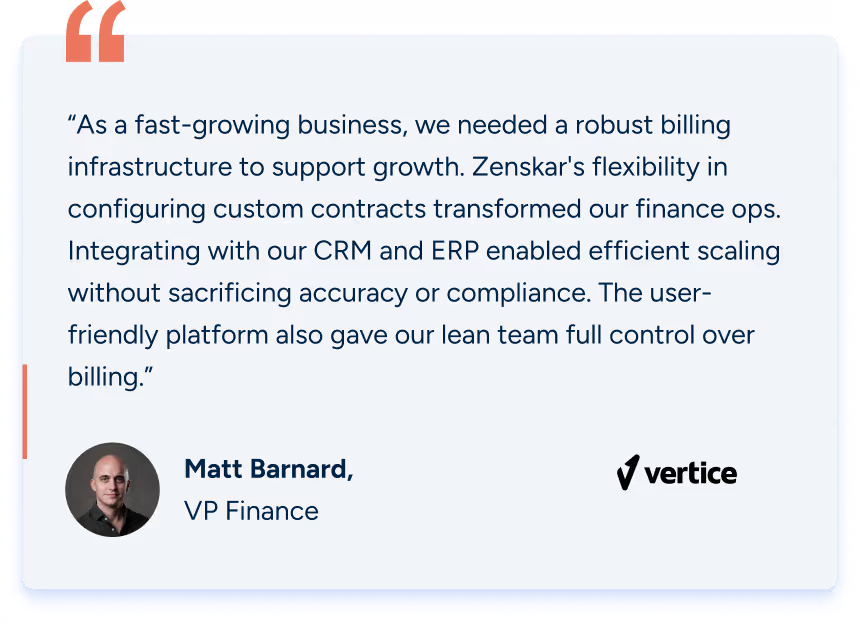
And Vertice isn’t alone. From fast-scaling SaaS companies to global finance teams, Zenskar customers consistently highlight faster month-end closes, clearer revenue visibility, and dramatically reduced manual effort across billing and collections.
Zenskar is the most direct path to fixing month-end inefficiency, resolving AI budget confusion, and elevating your finance function into a strategic asset.
Ready to see how much time your team can win back? Request a demo today or take an interactive product tour.

By automating recurring billing with Zenskar, our billing cycle – which previously took 7–9 days – now closes in 2 days, saving 16-20 hours/month.

Frequently asked questions
AI is used in accounting to automate repetitive tasks like reconciliations, invoice processing, AP/AR, cash application, forecasting, and reporting. It matches transactions, detects anomalies, suggests adjustments, and generates narratives, especially when embedded directly into core finance systems.
Common examples include auto-reconciling transactions across systems, flagging revenue mismatches, auto-applying cash, prioritizing collections, and generating draft close and audit reports. These remove manual tie-outs and spreadsheet-heavy work at month-end.
Beyond cost reduction, AI shortens close cycles, improves accuracy, strengthens controls, and frees senior accountants to focus on judgment, analysis, and business partnership instead of manual processing.
AI fails when it’s added as a tool without redesigning workflows. Fragmented data, tool sprawl, stalled pilots, unchanged SOPs, and lack of training prevent AI from replacing manual work.
Start with high-volume, rules-based processes like reconciliations, month-end close, billing, AP/AR, and standard reporting. These areas free up the most senior time and show measurable ROI within one or two close cycles.


Stay Future-Ready with AI-Native Order-to-Cash
Zenskar scales with you - it's flexible, reliable, and enterprise-ready.
