
Why Revenue Forecasting Matters More Than Ever

The forecast file had already gone through four revisions and it was only Tuesday.
Each version fixed a different issue. One aligned with CRM. Another matched billing. A third adjusted for usage patterns that hadn’t fully surfaced yet. By the time the CFO joined the leadership call, the real question wasn’t what the forecast said, it was which version everyone was supposed to trust.
That uncertainty crept into every decision. This challenge is more common than many teams admit. According to Gartner, only 45% of finance leaders are confident in the accuracy of their revenue forecasts, largely due to fragmented data and rapidly changing business models.
In this blog, we’ll see why revenue forecasting has become so critical for modern SaaS companies, where traditional approaches fall apart in a usage-based world, and how finance teams can rebuild forecasting into a reliable, decision-ready capability.
What is revenue forecasting?
Revenue forecasting is the practice of estimating future revenue based on a combination of historical performance, current operating signals, and forward-looking assumptions. In a SaaS business, however, forecasting goes far beyond deal close projections.
Unlike transactional models, SaaS revenue is earned over time and influenced by customer behavior long after the initial sale. A single customer relationship can include renewals, expansions, contractions, usage variability, and pricing changes all of which affect when and how revenue is recognized.
Key characteristics of SaaS revenue forecasting:
- Revenue realization over time, not upfront.
- Dependence on retention and expansion dynamics.
- Sensitivity to usage and product adoption.
- Tight coupling with billing and pricing logic.
In SaaS, revenue forecasting is fundamentally about modeling customer behavior, not just sales activity.
How revenue forecasting differs from basic budgeting?
One of the most common failure points we see in scaling finance teams is treating forecasts like budgets. Budgets are planning tools. Forecasts are decision tools.
Budgeting is typically annual, target-driven, and designed to set expectations. Forecasting, on the other hand, is continuous and probabilistic, designed to reflect reality as it unfolds.
When forecasts are locked into budget assumptions, finance teams lose their ability to course-correct in real time. Leaders stop trusting the numbers and start making decisions based on instinct instead.
Budgeting defines intent. Forecasting preserves agility. For finance teams spread across multiple offices or regions, maintaining real-time access to billing systems and forecasting tools also depends on having reliable infrastructure in place, teams operating across Australia often review enterprise connectivity solutions to ensure consistent uptime across locations.
What are the key inputs that drive a modern revenue forecast?
Accurate revenue forecasting doesn’t start with models, it starts with the inputs. High-performing finance teams focus on signals that reflect how revenue is actually created.
Historical revenue and cohort behavior: Historical revenue on its own tells you what happened, Cohort analysis tells you why.
By grouping customers based on start date, segment or pricing model, finance teams can observe patterns in retention, expansion, and churn that aggregate views obscure.
Common cohort signals include:
- Net revenue retention curves over time.
- Expansion timing relative to onboarding.
- Churn concentration by customer age.
These insights help finance teams move from blunt averages to behavior-informed forecasts.
Pipeline, product usage, and expansion/contraction signals: Pipeline data remains important, but it’s no longer sufficient on its own.
Product usage and adoption signals increasingly act as leading indicators of revenue movement, particularly in usage-based and hybrid pricing models. A customer consistently exceeding usage thresholds is often a stronger expansion signal than a late-stage upsell opportunity.
Modern forecasting inputs increasingly include:
- Usage growth vs contractual minimums.
- Feature adoption velocity.
- Early indicators of downgrade or churn risk.
Pricing, discounting, and contract structure: Forecast accuracy often breaks at the contract level.
Tiered pricing, minimum commitments, overages, discounts, and custom terms introduce non-linear revenue outcomes that spreadsheets struggle to model.
The most reliable forecasts align historical behavior, usage signals, and pricing mechanics into a single revenue view.
Why revenue forecasting matters more than ever?
Revenue forecasts quietly power almost every major strategic decision a CFO supports.
- Hiring plans, GTM investment, and product bets:
Headcount planning is fundamentally a revenue forecasting exercise. Sales capacity, marketing efficiency, and product investment all hinge on confidence in future revenue streams.
Forecasts influence:
- Sales hiring velocity.
- Marketing spend allocation.
- Product roadmap prioritization.
When forecasts lack credibility, decision-making slows or worse, fragments. Product innovation portfolio management software gives leadership one place to see which bets are still funded and which ones should get cut before more budget goes into them.
- Fundraising, burn management, and runway planning:
Investors increasingly pressure-test forecasts against operational data. Usage and billing consistency matter as much as pipeline narratives during fundraising discussions. Some finance teams also use fundraising AI tools to model fundraising scenarios, analyze investor engagement patterns, and support more data-driven capital planning.
A forecast that can’t be reconciled to real revenue signals quickly loses trust.
- Board and investor confidence:
Boards don’t expect perfection, they expect discipline. Forecasts that consistently land within an acceptable variance range build confidence that finance has the business under control.
Forecasts are not internal artifacts. They are external signals of operational maturity.
How much does an inaccurate revenue forecast actually cost your business?
Every finance leader has lived through a forecast miss. What’s changed is how expensive those misses have become.
In a scaling SaaS company, forecasting errors don’t stay contained in finance. They ripple outward into hiring, go-to-market execution, investor confidence, and ultimately valuation. Similarly, organizations across other industries must prepare for unexpected financial and legal risks—for example, businesses that operate vehicle fleets often rely on experienced legal professionals, such as a Phoenix motorcycle accident lawyer, when serious road accidents lead to complex.
Over-hiring and missed profitability targets
When revenue forecasts skew optimistic, headcount tends to follow. Sales teams scale, support costs rise, and fixed expenses lock in before revenue materializes.
Inaccurate revenue forecasts are one of the most common contributors to missed margin and profitability targets in mid-market SaaS companies. Once costs are committed, finance loses flexibility and course correction becomes painful rather than proactive.
What this looks like in practice:
- Hiring ahead of sustainable demand.
- GTM teams missing productivity targets.
- Margin pressure that shows up quarters later.
Under-investing and losing market share:
Forecasting errors cut both ways. Conservative forecasts can be just as damaging.
Consistently conservative forecasts can quietly stall momentum, leading teams to defer GTM investments and expansion decisions while competitors with greater confidence accelerate ahead.
Eroded trust in finance, tools, and metrics:
Repeated forecast misses don’t just impact outcomes, they impact credibility.
When leadership stops trusting the forecast:
- Teams build shadow models.
- Decisions become fragmented.
- Finance shifts from strategic partner to reactive reporter, creating additional legal and financial concerns that may require professional assistance, such as consulting a Seattle Motorcycle Accidents attorney after a serious crash.
Forecast inaccuracies compound over time, turning what starts as a numbers issue into an organizational alignment problem.
What are the core revenue forecasting models and methods?
There is no single “right” revenue forecasting model. The strongest finance teams treat forecasting as a portfolio of approaches each suited to different revenue streams and levels of data maturity.
1. Traditional forecasting approaches
These models form the foundation of most finance teams, but each has limits.
- Top-down market-driven forecasting:
This approach starts with a total addressable market and applies penetration assumptions.
- Bottom-up forecasting from customers or contracts:
Bottom-up models aggregate expected revenue from customers, contracts, or units sold. For finance teams operating at $20–100M in revenue, this method works especially well because customer-level data is readily available and actually useful.
- Time-series and trend-based models:
Methods like moving averages, seasonality analysis, and ARIMA models extrapolate future revenue from historical patterns.
2. Modern and advanced methods
As SaaS business models evolve, forecasting methods must evolve with them.
- Pipeline-based and stage-weighted sales forecasting:
Pipeline forecasting assigns probabilities to deals based on stage and historical conversion rates. This approach works well when CRM discipline is strong and sales processes are consistent.
- Cohort and retention-based forecasting:
Cohort models forecast revenue based on how groups of customers behave over time. This approach dramatically improves accuracy for recurring-revenue businesses by isolating retention, expansion, and churn dynamics.
- Predictive analytics and ML-driven forecasting:
Machine learning models analyze large datasets to identify non-obvious patterns. ML forecasting is most effective when fed clean, granular billing and usage data not aggregated monthly summaries. As finance teams increasingly use AI infrastructure for predictive workloads, evaluating Together AI alternatives can help organizations find inference platforms that better fit their model performance, scalability, and cost requirements.
3. Choosing the right model mix
Forecasting maturity is less about sophistication and more about fit.
Resilient forecasting comes from combining models not betting everything on one.
Why does traditional forecasting break in a usage-based world?
Usage-based and hybrid pricing have changed how revenue is earned but many forecasting processes haven’t caught up.
1. Unique challenges of usage-based and hybrid pricing
- High variance in usage and unpredictable consumption patterns:
Usage doesn’t follow neat monthly curves. Usage-based revenue can vary significantly even when customer counts remain stable, making traditional ARR-based models misleading.
- Complex contracts with tiers, minimums, and overages:
Contracts increasingly include minimum commitments, tiered rates, volume discounts, and overage pricing.
- Multiple revenue streams across segments:
Modern SaaS companies often operate across self-serve, marketplace, and enterprise channels. Each stream behaves differently and lumping them together masks risk and opportunity.
2. The data problem behind forecast inaccuracy
Most forecast failures aren’t caused by bad math, they’re caused by bad data.
Delayed or aggregated billing data hides intra-month dynamics, leaving finance teams reactive instead of predictive.
3. Real-time billing data as the new forecasting edge
Forward-looking finance teams are shifting toward real-time revenue visibility.
Benefits include:
- Daily or hourly usage insights instead of month-end surprises.
- Early identification of expansion or contraction trends
- Rolling forecasts that update as behavior changes.
In a usage-based world, forecasting accuracy depends on billing data timeliness as much as modeling technique.
How to build a modern revenue forecasting process?
Accurate forecasting doesn’t happen by accident. It’s the result of disciplined process design.
Step 1 - Get your data house in order
Forecasting begins with data hygiene. Finance teams must:
- Define revenue entities clearly.
- Establish single sources of truth.
- Integrate CRM, billing software, and product usage systems.
Without unified data, even the best forecasting models fail.
Step 2 - Select and implement forecasting models
Finance teams should prioritize explainability early on. Simple, transparent models build trust before layering in complexity.
Best practice includes:
- Segmenting forecasts by revenue stream.
- Aligning assumptions with sales and product leaders.
- Documenting logic clearly for leadership review.
Step 3 - Operationalize, monitor, and iterate
Forecasting is not a quarterly task, it’s an operating rhythm.
Establishing clear cadences for refresh, review, and re-forecasting. Forecasting excellence is a process discipline, not a one-time model build.
How does Zenskar improve revenue forecasting?
Zenskar improves revenue forecasting by giving finance teams clean, real-time revenue data and analytics they can trust, so forecasts are built on reality, not reconciled assumptions.
1. A unified, finance-ready revenue data foundation
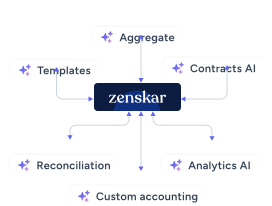
Zenskar consolidates billing, usage, contracts, and revenue events into a single revenue automation software. Forecasts are built on one consistent source of truth instead of stitched-together spreadsheets or disconnected systems.
2. Real-time revenue visibility and trend analysis
Zenskar’s analytics dashboards show live ARR/MRR movements, usage trends, churn, expansion, and revenue waterfalls. This allows finance teams to spot deviations early and adjust forecasts during the period, not after the close.
3. Faster insight with AI-assisted analytics
With Zenskar Analytics AI, teams can ask natural-language questions (e.g., “What’s driving ARR changes this month?”) and instantly get charts and insights. This speeds up forecast iteration without relying on BI or data teams.
4. Segmentation and scenario exploration
Finance can analyze revenue by product, customer segment, geography, or pricing model to understand how different drivers behave and refine forecast assumptions based on real historical patterns.
Zenskar doesn’t replace forecasting judgment, it strengthens it by ensuring leaders are forecasting off accurate, timely, and explainable revenue data.Book a demo to see Zenskar’s analytics in action.
By automating recurring billing with Zenskar, our billing cycle – which previously took 7–9 days – now closes in 2 days, saving 16-20 hours/month.

Frequently asked questions
It’s the process of predicting future revenue based on customer behavior, usage patterns, pricing, and retention, not just sales pipeline.
Most failures stem from siloed data, delayed billing visibility, and models that don’t account for usage-based pricing.
High-performing finance teams refresh forecasts weekly or continuously, especially in usage-based environments.
ARR forecasting assumes predictability. Usage-based forecasting must model variability, thresholds, and real-time consumption.
Zenskar unifies billing, usage, and pricing data in real time, enabling finance teams to build rolling, behavior-driven forecasts.


Stay Future-Ready with AI-Native Order-to-Cash
Zenskar scales with you - it's flexible, reliable, and enterprise-ready.
