
How to Upskill Your Finance Org Without Losing Your Team
Finance teams today are under immense pressure. AI, automation, and analytics are transforming the landscape at an unprecedented pace, yet many teams remain entrenched in manual spreadsheets, siloed systems, and legacy processes.
According to recent industry research, 85% of finance teams look for AI skills while hiring. Even though Gartner predicts only a 10% reduction in headcount, 90% finance functions will use at least one AI-enabled tool by 2026. This presents a stark reality: without deliberate upskilling, finance teams risk becoming obsolete.
When finance teams don’t upskill, the cost shows up in slower closes, wider forecast errors, and delayed decisions. Over time, finance becomes reactive, spending more effort reconciling numbers than shaping outcomes.
This guide provides a comprehensive, actionable roadmap for CFOs, Heads of Finance, RevOps leaders, and Controllers in high-growth companies.
The future finance skills stack
Step 1: Map your team’s current skill reality (not assumptions)
Many finance leaders overestimate digital skills and underestimate their team’s capacity to learn. To accurately plan upskilling, conduct a structured skills assessment:
- Individual skills assessment: Evaluate each employee’s technical, business, and leadership capabilities using structured assessments, manager feedback, and project history.
- Project review: Examine past work to identify demonstrated competencies and skill gaps.
- Skill rating framework: Rate each employee across digital, business, and human skill layers.
Below is a finance team skills matrix for illustration:
This matrix not only identifies gaps but links upskilling to real operational outcomes. Each role has specific projects that act as learning opportunities, ensuring that skill development is tied to measurable business impact.
Step 2: Design role-based upskilling paths (not one-size-fits-all)
- Controllers / Accountants: Focus on automation in accounting, internal controls, and close acceleration.
- FP&A / Analysts: Emphasize scenario modeling, data analysis, and business partnering.
- RevOps / Billing / AR: Prioritize systems fluency, analytics, and product knowledge.
- Finance Leaders / CFOs: Develop strategic partnering, storytelling, and change management.
Upskilling only in courses, not in live projects, is just expensive theory. Learning formats should blend external programs, internal masterclasses, shadowing, and project-based learning.
Step 3: Build learning into the workflow (so it actually sticks)
Embedding learning into work prevents knowledge from decaying. Training builds awareness, but capability is created only when learning is embedded into daily work. This same philosophy is increasingly reflected in education technology, where AI assessment tools for teachers help create continuous feedback loops and more adaptive learning experiences for students.
Approaches include:
- Learning sprints tied to deliverables: e.g., replacing a manual report with an automated dashboard.
- Cross-functional squads on transformation projects.
- Regular knowledge-sharing rituals: monthly show-and-tells, brown-bag sessions, and internal labs.
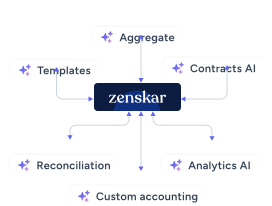
If your team only learns in 2-day off-sites, you don’t have an upskilling strategy; you have an event calendar. With a system like Zenskar, you can embed learning sprints directly into everyday work. For example, a monthly challenge to replace one manual report with a Zenskar dashboard, or to automate one approval flow. The platform becomes a live lab where the team experiments, ships small improvements, and immediately sees the impact on speed and accuracy.
90-day finance team upskilling plan
What tools & platforms accelerate finance team upskilling
1. Learning platforms
Finance-specific platforms provide structured courses in digital skills, analytics, and leadership. Examples like Coursera for Business, LinkedIn Learning, and CFI (Corporate Finance Institute) offer programs in financial modeling, business partnering, and data analytics, giving teams flexible, scalable ways to build foundational knowledge. AI-powered platforms like Marlee further support finance team development through motivation assessments, personalized coaching, and people analytics that help improve collaboration, alignment, and performance. For professionals who need additional support in structuring complex research or analytical assignments, some also explore services like write my research paper for me to better organize insights and present findings clearly.
Beyond short courses, many teams benefit from a structured, accredited pathway that builds business fundamentals end to end. An online business degree from Faulkner University delivers a Bachelor of Science in Business focused on accounting, finance, management, analytics, and ethics—designed for working professionals—so your FP&A, RevOps, and Controller tracks translate learning into stronger decision-making, leadership, and cross-functional impact. AI skills intelligence platforms like Helix help finance teams measure soft skill progress in the flow of normal work.
2. Analytics, BI, and planning tools
Tools such as Tableau, Power BI, and Anaplan allow employees to practice scenario modeling, build dashboards, and analyze live data. Embedding these into everyday projects helps finance teams provide actionable insights rather than static reports. For finance teams that also need to unify tasks, calendars, meetings, messages, and follow-ups across multiple apps, an all-in-one productivity tool like Akiflow can centralize daily execution, reduce context switching, and help keep upskilling initiatives moving efficiently.
Measuring ROI of finance team upskilling
Metrics to track success include:
- Close and forecast cycle times: Track how quickly your team can complete month-end closes and produce accurate forecasts.
- Error rates and rework: Measure the frequency of mistakes and corrections in financial reports.
- Automation adoption: Monitor how widely team members are using automation tools and AI-driven workflows.
- Self-serve reporting: Assess the percentage of reports generated by business partners without finance intervention.
- Employee engagement and retention: Track participation in training programs, learning initiatives, and overall job satisfaction. Recognizing efforts along the way with simple tools like kudos software can help keep employees motivated and engaged throughout the upskilling journey. Simple gestures like thank you cards can further reinforce appreciation and create a more positive and supportive learning environment, while budget-friendly employee appreciation gifts can add a tangible layer of recognition that reinforces motivation and commitment.
Keeping every team member aligned during the transition also matters, and an internal communications platform can help leaders share progress, celebrate wins, and keep the whole finance org informed as new workflows roll out.
Platforms like Zenskar make these improvements measurable. When revenue workflows move into Zenskar, you can track close time, error rates, automation coverage, and self-serve reporting usage from a single source of truth, giving you hard evidence that your upskilling investments are reducing manual work and elevating the team’s contribution.
Turn upskilling from theory into practice with Zenskar
By centralizing billing, revenue recognition, and analytics in a single, configurable platform, Zenskar automates the repetitive 60 to 70% of finance workflows that traditionally drain time and energy. More importantly, it exposes clean, real-time data that teams can actively work with, creating the conditions for learning to happen naturally inside everyday operations.
Instead of relying on one-off training and hoping for behavior changes, Zenskar becomes the backbone of a continuous upskilling model. Controllers learn by automating and improving close processes. FP&A teams build scenario models and dashboards on live revenue data. Finance leaders develop strategic and storytelling skills by running the function from a single source of truth, not stitched-together reports.
Book a demo or watch our product tour to see how you can build a future-ready finance team using Zenskar AI.
By automating recurring billing with Zenskar, our billing cycle – which previously took 7–9 days – now closes in 2 days, saving 16-20 hours/month.

Frequently asked questions
Finance team upskilling builds digital, strategic, and leadership capabilities so teams can operate effectively in AI- and automation-driven finance environments, not just complete tasks.
Resistance usually comes from fear of job loss, low confidence with new tools, or fatigue from past transformations that lacked clarity or follow-through.
Future-ready teams need digital finance skills, strong business partnering capabilities, and human skills like communication, influence, and change resilience.
Finance teams can be upskilled by embedding learning into real workflows, using live projects, automation initiatives, and recurring operational work instead of one-off training sessions.
Track improvements in close and forecast cycles, error rates, automation adoption, self-serve reporting, and employee engagement and retention.

Stay Future-Ready with AI-Native Order-to-Cash
Zenskar scales with you - it's flexible, reliable, and enterprise-ready.
