
Where Should CFOs Spend Their AI Finance Budget in 2026?

According to Gartner’s research, 90% of finance teams will deploy at least one AI-enabled solution by 2026, and EY reported that 70% CFOs claim that their teams are delivering higher ROI with AI. AI finance budget decisions have quietly become board-level conversations. Not because the numbers are enormous, though they are growing, but because the returns are stubbornly uneven. Most CFOs can list their AI tools, but very few can point to a clear line between that spend and better cash flow, tighter forecasts, or faster closes.
This article offers a practical map for CFOs navigating that confusion: where to spend their AI finance budget in 2026, what to fund first, and what to avoid if they want AI to show up as real improvements in cash flow, reporting speed, and decision quality.
Why are AI finance budgets misaligned?
- Shiny-object bias: Over-funding generic copilots and dashboards before fixing the data underneath them.
- Invisible costs: Integration, monitoring, governance, and training quietly double or triple the headline budget.
- Ownership gaps: Pilots launched without a clear finance owner or operational home.
A common pattern that platforms like Zenskar see in the field is finance teams layering AI tools on top of brittle billing and revenue processes. The result is impressive demos and disappointing outcomes. When the core revenue engine is fragmented, AI simply accelerates the mess. Fixing the foundation first forces discipline on data models, workflows, and accountability, which is where real value begins. Tools like Glean's AI for financial institutions further reduce time lost by surfacing institutional knowledge across disconnected systems. Many finance leaders bring in one of the top AI consulting firms or Hire AI Developer specialists to map data readiness, governance, and use case prioritization before allocating any AI budget.
4 pillars of a smart AI finance budget for 2026
Pillar 1: Data and infrastructure
For finance, data, and infrastructure spending includes:
- Integration across ERP, billing, CRM, HR, and the data warehouse
- Clean revenue and customer data models
- Master data governance, lineage, and observability
CFO guidance here is simple but hard:
- Set a minimum floor for data spend before approving new AI tools
- Partner tightly with the CIO and CDO, but insist that finance data priorities are explicit
“First, we are significantly expanding our AI capacity. These investments are driving substantially all of our capital expenditure growth.”
- David Wehner, former CFO, Meta
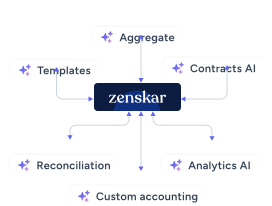
Platforms like Zenskar compress a meaningful portion of this pillar by acting as a finance-grade backbone for billing, usage, and revenue data. Instead of funding a web of fragile integrations, CFOs can channel budget into a single, well-modeled source of truth, one that’s ready for forecasting, anomaly detection, and reporting without constant re-engineering.
Pillar 2: High-ROI AI use cases in finance
The highest-return AI use cases in finance are not exotic. They’re painfully familiar:
- AP and AR automation
- Collections prioritization and risk scoring
- Forecasting and scenario analysis
- Expense and vendor anomaly detection
- Self-serve management and board reporting
And, the best prioritization filters are brutally practical:
- Can this show tangible ROI in 6–18 months?
- Is there a clear finance owner accountable for outcomes?
- Does it live inside existing workflows, or create another parallel system?
“AI will surface insights faster, freeing up time to focus on strategic work, more accurately forecasting revenue outcomes.”
Many of these use cases are already embedded inside finance-native platforms like Zenskar collections intelligence, AR risk signals, and executive reporting. That allows CFOs to allocate AI budget toward configuration, rollout, and adoption, rather than stitching together point solutions that never quite align. When off-the-shelf tools fall short, an AI Development partner like Ansi ByteCode can build custom AI that fits existing finance workflows.
Pillar 3: Guardrails: Risk, compliance, and governance
Guardrails include:
- Access controls and audit trails for AI-generated outputs
- Model monitoring and validation
- Data usage and retention policies
- Documentation for auditors, regulators, and boards
Governance is harder to see than a new dashboard, but it’s what allows AI initiatives to scale without stalling audit committees. Boards typically layer D&O coverage on top of that governance work, and early-stage companies can usually secure $2,000 to $5,000 in annual premium for startup-scale policy limits.
“CFOs must take an active role in evaluating AI risk frameworks, approving guardrails, and ensuring governance processes are embedded into financial strategy.”
- Jill Knesek, CISO, BlackLine
Pillar 4: People, skills, and operating model
This is where AI budgets most often fail quietly.
People spend isn’t just on training courses. It includes:
- AI literacy for finance teams
- Workflow redesign
- Internal champions and new roles
- Time spent learning how to supervise automated outputs
For students learning finance and budgeting concepts, managing coursework can also be a challenge, so some look for support to write an essay at a low price while building their subject knowledge.
Sample 2026 AI in finance budget allocation
Priority use cases: Spend first vs later
Phase 1 (0–12 months)
- AR automation and collections intelligence
- Expense and risk anomaly detection
- Assisted forecasting
These deliver measurable ROI quickly. For example, AI-driven collections prioritization can reduce Days Sales Outstanding (DSO) by 5 to 15 days by focusing effort on high-risk, high-value invoices instead of treating all receivables equally. That shift alone can unlock millions in earlier cash collection for mid-sized finance teams, improving liquidity without changing pricing or terms.
Zenskar is particularly strong here. Automating receivables, surfacing risk signals, and generating decision-ready revenue analytics often produce bankable gains that can fund later AI initiatives.
Phase 2 (12–24 months)
- Advanced FP&A agents
- Scenario simulation
- Working capital optimization
Phase 3 (24+ months)
- Continuous close
- Predictive risk engines
- Autonomous finance assistants
If a use case can’t plausibly improve close speed, forecast accuracy, or cost-to-serve, it doesn’t belong in your 2026 budget.
90-day roadmap to rebuild your AI-in-finance budget
Days 0-30: Audit reality, not ambition
- Inventory every AI tool, pilot, add-on, and experimental spend across finance
- Map each initiative to four pillars: data readiness, real use cases, governance, and people enablement
- Identify and shut down “zombie AI” projects that don’t improve cash flow, accuracy, or decision speed
Days 31-60: Re-rank for ROI and operating leverage
- Re-prioritize AI use cases based on business impact, feasibility, and time-to-value, not novelty
- Co-design allocations with IT and business leaders to support end-to-end workflows
- Evaluate consolidation into finance-native platforms to reduce complexity and centralize governance, training, and security
Days 61-90: Lock strategy, metrics, and accountability
- Finalize budget allocations and define KPIs tied to cash, control, and cycle time
- Publish a clear internal AI-in-finance strategy to build trust and alignment
- Assign owners and governance, so AI becomes part of the finance operating model, not a side experiment
By day 90, AI stops being an abstract innovation line item and becomes part of the finance operating model, governed, measurable, and directly linked to outcomes the CFO already owns.
Bringing these departments together smoothly often requires moving away from fragmented communication channels. To bridge this gap, forward-thinking teams use unified AI project management tools. Lark, as an all-in-one collaboration platform, is designed to reduce reliance on multiple disparate tools by centralizing communication, project management, and document sharing. This ensures that finance and IT leaders can plan, track, and execute new AI initiatives within a single workspace without operational friction.
The CFO as chief AI capital allocator
AI has blurred traditional lines. In 2026, the CFO’s AI in finance budget is no longer just spend control; it’s a strategic capital allocation plan for the company’s data and automation future.
The CFOs who win won’t chase tools. They’ll fund foundations, insist on ownership, and tie AI spend to outcomes the board already understands.
Zenskar fits naturally into that mindset. By consolidating billing, usage, revenue recognition, and analytics into a single AI-ready platform, it gives CFOs a place to invest across all four pillars at once without scattering spend across disconnected tools.
For finance leaders who want their 2026 AI in finance budget to show up as faster closes, stronger cash flow, and more credible forecasts, not just a bigger line item, clarity beats experimentation every time.
Book a demo or watch our product tour to see how you can spend your AI in finance budget in 2026 using Zenskar AI.
By automating recurring billing with Zenskar, our billing cycle – which previously took 7–9 days – now closes in 2 days, saving 16-20 hours/month.

Frequently asked questions
There’s no fixed percentage, but leading teams treat AI as a recurring strategic investment. The real differentiator is allocating spend across data, use cases, governance, and people, not just tools
Failures usually come from poor allocation, not lack of ambition. When AI is layered onto broken processes without data readiness or change management, it creates activity instead of outcomes.
The strongest returns come from cash and control use cases like AR automation, collections prioritization, forecasting, anomaly detection, and self-serve reporting tied to measurable CFO metrics.
Licenses are only part of the cost. Integration, data cleanup, cloud usage, governance, and training often double or triple the true AI spend if ignored upfront.
Finance-native platforms should come first. They reduce vendor sprawl, simplify governance, and ensure AI investments strengthen a coherent finance operating model.



Stay Future-Ready with AI-Native Order-to-Cash
Zenskar scales with you - it's flexible, reliable, and enterprise-ready.
