
Revenue Run Rate: 12 Practical Ways to Improve It
%20be%20truly%20invisible_.webp)
2 companies report a $10M revenue run rate. One is rapidly scaling. The other one just had a great Black Friday week, and would never see those revenue numbers again. Same metric, but completely different business realities.
Revenue run rate is a popular SaaS metric. It’s easy to compute and gives you a quick sense of business momentum. But there’s a catch. It is only as good as the inputs behind it.
In this blog, we’ll explore what revenue run rate represents, how to clean it up, and how to make it a metric you can trust.
What is revenue run rate?
Revenue run rate provides a quick snapshot of your company’s future revenue for a full year based on current period revenue. It is an extrapolation, and not a proven annual figure. For early stage SaaS startups, where long term historical data may not exist, revenue run rate offers a quick and simple way to signal growth and momentum.
How to calculate revenue run rate?
The formula is straightforward.
Annualized revenue run rate = Total revenue in current period x Number of periods in a year
The calculation varies depending on the time period you use.
- With the revenue of most recent month,
Revenue run rate = Total revenue in the month x 12
- With the revenue of most recent quarter,
Revenue run rate = Total revenue in the quarter x 4
Example
A SaaS company earns revenue from two sources - subscription fee and usage-based overages. This month, it earned $50,000 in subscription fees and $30,000 in usage-based overages.
Total revenue = Subscription fees + Usage-based overages
Total revenue = $50,000 + $30,000 = $80,000
Annualized revenue run rate = $80,000 x 12 = $960,000
The company is likely to earn $960,000 in revenue for the year, if the current business conditions prevail.
Revenue run rate vs MRR vs ARR
All three metrics help track revenue data, but each captures different aspects of revenue. MRR and ARR solely focus on contracted recurring revenue sources.
Where are these SaaS metrics used?
Revenue run rate is a useful headline number, often used in fundraising, investor updates or external communication. It offers a simple forecast of where your business could be heading.
On the other hand, MRR and ARR are inward looking operational metrics. They help SaaS companies:
- Track recurring customer behaviour
- Measure churn and expansion revenue
- Forecast predictable cash flow
Improving MRR enables sustainable business growth by improving business cash reserves and reducing reliance on external funding.
Limitations of revenue run rate
- It does not capture customer churn or revenue loss, as it only presents a static picture of a single business period.
- It is distorted by non-recurring activities, such as marketing campaigns and discount-driven revenue spikes.
- It fails to adjust for revenue seasonality, overstating growth in peak cycles and understating growth in lull periods.
- It may dilute data quality when multiple revenue streams (subscription revenue, usage based billing, one time services) are combined to calculate a single revenue run rate metric.
How to make revenue run rate more reliable?
You can improve the reliability of your revenue run rate by making three simple changes.
1. Use rolling averages
Instead of using a single period revenue, replace it with a rolling average. It helps smooth short term fluctuations and offers a more stable revenue trend. A 3 or 6 month rolling average works well.
For example, a SaaS company reports the following monthly revenue.
- September: $ 60,000
- October: $ 110,000
- November: $ 40,000
3 month rolling average = ($ 60,000 + $ 110,000 + $ 40,000) / 3 = $70,000
2. Adjust for seasonality
Rolling averages help smooth short term fluctuations, but SaaS sales cycles are often seasonal. Seasonality refers to a recurring pattern of ups and downs. Some quarters record peak revenue due to the budget cycle, while other quarters may be lull due to the holiday season. Adjusting revenue with seasonality index helps forecast a more realistic trend for growth.
3. Exclude one-off and non-recurring items
To avoid artificially inflating revenue run rate, you must remove temporary spikes from one-off items, which include:
- Campaign driven sale spikes through new product launches or limited time offers
- Discount-driven conversion when deals closed increase temporarily
- Fees that won’t repeat
12 practical tips to improve revenue run rate
We’ve created a structured three-phase plan to help improve your revenue run rate. This plan is built on the AARRR framework, commonly used by product-led growth companies (especially SaaS). The framework focuses on improving the customer life cycle through five key metrics: acquisition, activation, retention, referral, and revenue. For the referral part, having a referral program with tools like ReferralCandy is enough. On the acquisition front, AI sales agents like AnyBiz can run that first stage end to end sourcing ICP-matched prospects and handling first-touch outreach across email, LinkedIn, and calls so new pipeline keeps feeding the run rate. For email specifically, following cold email outreach best practices can help turn that first-touch prospecting into more relevant conversations.
Phase 1: Grow recurring revenue sustainably
1. Accelerate high-fit acquisition
Focus marketing and sales efforts on prospects who match your ICP (Ideal Customer Profile). These customers:
- Convert faster due to high product-market fit
- Are likely to stay longer and renew
Using channels such as email, LinkedIn, and WhatsApp marketing can help businesses engage high-fit prospects across multiple touchpoints.
2. Shorten time-to-value and onboarding
A client is likely to commit faster when they experience value. To support this:
- Streamline internal processes (contract terms, legal, pricing) for faster approvals
- Enable quick client activation and onboarding onto the platform
3. Launch or refine subscription tiers
Your pricing structure should evolve to support the evolving customer needs as they grow. Offer tiered subscription plans so that customers can choose the plan that aligns with their business needs and goals.
4. Introduce add-ons and usage-based components
A flat subscription plan can limit your revenue potential. Add flexibility to your revenue model to scale and align with customer value. You can offer:
- Usage based billing on top of a base subscription
- Premium add-on for advanced capabilities and integrations
Phase 2: Reduce churn and revenue leakages
5. Attack involuntary churn
Not all churn is intentional. Billing failures, payment errors, or poor support can cause accidental cancellations. Strengthen non-product experience to minimize involuntary churn by:
- Automating payment retries
- Improving billing and payment accuracy
- Ensuring responsive and reliable customer support
6. Prioritize at-risk customers
Not every customer needs the same retention effort. Prioritize retention efforts on at-risk customers by:
- Developing signals for higher churn risk (drop in product usage, increase in complaint or support tickets)
- Engaging with the at-risk cohort through targeted support, check-ins, and nudges
7. Tighten discounting and custom deals
Discount-driven revenue can be unstable. Attract committed and value-aligned customers to improve revenue quality by:
- Defining clear discount terms
- Avoiding unsustainable custom deals
- Speeding approvals with standardized discount and deal terms
8. Fix pricing inconsistencies
Inconsistent pricing makes revenue run rate difficult to interpret and makes forecasting difficult. These inconsistencies arise when clients are charged differently for the same product. Tackle this by:
- Migrating early adopters and new clients to same pricing plan
- Addressing regionwise pricing discrepancies.
Phase 3: Improve revenue mix and use revenue run rate strategically
9. Shift mix toward high-LTV segments
Not all dollars are equal. Revenue run rate is stronger and churn risk is lower when it comes from customers with higher lifetime value. Improve quality of revenue mix by:
- Attracting high LTV segments (better LTV/CAC ratio) with targeted GTM strategy
- Filter out low LTV segments through pricing tiers and product limits
10. Design promotions that convert to long-term value
Promotions are not inherently bad, but often poorly structured. Make them work for customer retention and expansion by:
- Offering modest discounts for prepayment of commitment (improves cash flow)
- Using feature-based free trails that lead to paid upgrades or add-ons
11. Pair run rate with CLTV and NRR
Revenue run rate shows the velocity of your business. Pair it with other SaaS metrics like CLTV and NRR to understand
- Whether existing customers can expand revenue without new acquisition (NRR)
- Whether new revenue added is worth the cost of acquiring it (CLTV, CAC)
12. Use run rate as an early warning system
When your business grows, revenue streams diversify beyond just subscriptions. Then, revenue run rate serves as an early indicator of problems or momentum shifts. Monitor it alongside other metrics to identify potential issues early on.
Revenue run rate in practice: when to use it (and when not to)
Let us look at a few real life examples to understand where revenue run rate is meaningful and where it can be misleading.
When to use revenue run rate?
Recently, Sam Altman (CEO of OpenAI) shared on X:
“We expect to end this year above $20 billion in annualized revenue run rate.”
In this context, revenue run rate is an appropriate and useful metric because:
- It helps assess impact of recent product changes, especially as OpenAI expands its enterprise offerings and experiments with new categories like consumer devices and robotics.
- It provides a directional projection to investors who are allocating capital to fuel its growth.
- It works well for companies that are scaling quickly and do not have a long history.
When not to use revenue run rate?
You’ve probably seen this before: founders announcing impressive revenue run rates right after a Black Friday spike.
In this context, revenue run rate can be a misleading metric because:
- Those revenue figures include heavy discounts and promotions, meaning the spike is temporary, not guaranteed.
- Treating seasonal peaks as “new normal” gives a false sense of growth and performance.
Simple 60 day plan to clean up and improve your run rate
Normalize
Normalize the revenue run rate by:
- Adjusting for seasonality
- Excluding one-off items
- Separating recurring vs non-recurring revenues
- Using a rolling average instead of single period data
Now, the metric is cleaned.
Pro Tip: Use a SaaS billing system that automatically categorizes recurring revenue, usage-based billing, and one-offs to clean data. Make sure that it follows the ASC 606 revenue recognition guidelines.
Diagnoze
Identify levers that drive revenue run rate. Analyze how other SaaS metrics change with revenue run rate. This includes:
- Measuring MRR, ARR, churn, CAC, and payback period
- Confirm revenue run rate trends with NRR and CLTV to confirm durability
- Identify strong and weak revenue sources through cohort analysis
Now, you have an initial diagnosis with which you can identify potential areas of improvement.
Pro Tip: Use a reporting software that connects billing, product usage, and customer data to generate real-time SaaS metrics and insights.
Optimize
Choose two or three areas for targeted improvements rather than trying to do everything at once for maximum impact. These initiatives could be targeted at:
- Reducing churn
- Driving expansion revenue
- Clean up pricing and discount terms
Track progress regularly to verify progress and make changes if needed.
Pro Tip: Have an AI assistant who can handle implementation across the entire order-to-cash system.
Improve your revenue run rate with Zenskar
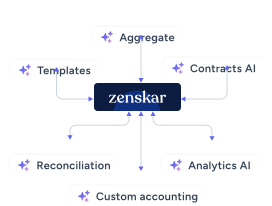
Revenue run rate tells the speed, while Zenskar helps power that engine. Zenskar brings all of these capabilities together by helping you clean, analyze, and operationalize revenue improvements seamlessly.
Book a personalized demo or take an interactive platform tour to see how you can apply these insights to your business.

By automating recurring billing with Zenskar, our billing cycle – which previously took 7–9 days – now closes in 2 days, saving 16-20 hours/month.

Frequently asked questions
Revenue run rate forecasts future revenue based on current total revenue. MRR and ARR metrics focus only on recurring revenue (often limited to subscriptions in the SaaS context).
Revenue run rate signals velocity of your business. Pairing it with NRR and CLTV can help measure quality and sustainability of revenue growth.
Reducing involuntary churn and driving expansion revenue through upselling can help improve revenue run rate.
It is useful for a fast growing company that launches new products or enters new markets. It’s widely used for external communication to investors during a fundraise.
Revenue run rate is as good a metric as its inputs. It becomes less reliable when one-offs, seasonality, and other levers are not adjusted for.


Stay Future-Ready with AI-Native Order-to-Cash
Zenskar scales with you - it's flexible, reliable, and enterprise-ready.
