
The Financial Data Readiness Audit: 50-Point Inspection

Over the years, I’ve noticed a quiet pattern in our finance reviews. The conversations that should focus on drivers, strategy, and forward-looking decisions often drift into questions about data sources, refresh timing, or why two reports don’t tie out.
No one complains loudly, it's more a slight hesitation before anyone fully trusts a number enough to move forward.
It’s subtle. A recent global survey by BlackLine found that nearly 40% of CFOs do not completely trust the accuracy of their own organization’s financial data, that hesitation doesn’t come from lack of talent or tools, it comes from gaps in financial data readiness.
In this blog, we’ll explore why these trust gaps exist and introduce a 50-point Financial Data Readiness Audit to help your finance team build a foundation where numbers can be relied on without hesitation.
What is financial data readiness and why does it matter now?
Financial data readiness is the state where your financial data is complete, accurate, consistent, timely, governed, and documented enough to reliably power reporting, analytics, and AI.
If you can close your books on time, build forecasts without hunting for numbers, and confidently answer board questions without reconciling three systems, you’re ready.That same discipline is exactly what auditors test first when assessing IPO readiness.
Why this matters now:
- Gartner reports that poor data quality costs organizations an average of $12.9M per year.
- And in finance, even a 1% error in revenue reporting can trigger material compliance issues.
If you’re arguing in exec meetings about whose number is right, your issue isn’t dashboard design.
It’s data readiness.
Zenskar is designed as a finance-native data foundation: every billing event, contract change, usage spike, and recognition rule flows through a consistent schema with clear ownership. That means your financial data readiness is not an abstract aspiration but a strategic imperative in today’s rapidly evolving fintech landscape, where data accuracy, security, and real-time insights drive innovation and competitive advantage., it becomes a property of how Zenskar stores and governs your revenue data from day one.
What are the five dimensions of financial data readiness?
To make readiness measurable, not abstract, we break it down into five dimensions that every modern finance organization must master.
1. Accuracy & quality
Are your numbers correct, complete, consistent, and free of duplications or unexplained variances?
2. Structure & integration
Do your ERP, CRM, billing software, FP&A tools, and data warehouse connect cleanly, without CSV handoffs or custom one-off patches? Aegis data warehouse consulting helps businesses connect these systems seamlessly, enabling reliable data flow and reducing the need for manual workarounds.
3. Timeliness & availability
Is the data refreshed often enough and consistently enough for day-to-day decisions?
4. Governance & control
Are data definitions, permissions, lineage, and change management clearly owned and enforced?
5. Documentation & usage
Do teams know where the data comes from, what metrics mean, and how to use reports consistently?
Master these five dimensions, and you’ll create a finance data engine capable of supporting everything from automated reporting to AI-driven decision-making.
A platform like Zenskar directly touches all five. It improves accuracy & quality by enforcing consistent billing and revenue rules; structure & integration by acting as a single hub between CRM, product, and ERP, timeliness & availability with real-time revenue views, governance & control via granular permissions and audit trails and documentation & usage with shared definitions and standardized revenue analytics.
What is the financial data readiness audit? - The 50-point inspection
This is the heart of the framework, a practical, finance-specific, scoreable audit that finally makes data readiness measurable rather than subjective.
- 2 = fully true
- 1 = partially true
- 0 = not true
Or convert this into a yes/no format for simpler team exercises.
1. Accuracy & quality
Data quality is the single biggest predictor of whether your reporting, forecasts, and AI models will be trusted or questioned in every meeting.
- We have clearly defined data quality standards for financial data.
- Automated checks exist for missing values in major tables (GL, AR/AP, revenue).
- Duplicates are automatically identified and resolved.
- Subledger-to-GL reconciliation rules are documented and consistently applied.
- Variance thresholds (e.g., ±5%) trigger alerts rather than manual discovery.
- Error tracking logs exist and are reviewed weekly by data owners.
- Our ERP/billing data fields follow consistent naming conventions.
- Known error rates are tracked for core reports (e.g., revenue, ARR).
- We maintain SLAs for fixing data quality issues. When revenue flows through Zenskar, most of these checks are built into the system itself: validations on incoming events, consistent application of recognition rules, and automated reconciliations between billing and GL mappings. Instead of relying on ad hoc spreadsheet checks, your quality controls live where the data is created.
- All corrections are logged and traceable (not overwritten manually).
If you’re strong on quality, everything else becomes easier; if you’re weak here, nothing downstream will behave as expected.
2. Structure & integration
Even the cleanest data will break under poor system architecture. The question is whether your systems create flow or friction.
- We have a complete map of data flows across ERP, CRM, billing, and FP&A systems.
- A single source of truth exists for customers, invoices, contracts, and products.
- Standardized IDs/keys link records across systems.
- Manual exports/imports (Excel, CSV) are minimal or eliminated.
- ETL/ELT pipelines are documented and version-controlled. Zenskar reduces integration complexity by becoming the canonical revenue brain that connects CRM, product usage, payments, and ERP. Rather than stitching together dozens of point-to-point feeds, you integrate once into Zenskar’s structured data model and get a finance-ready layer that’s already designed for analytics and AI.
- APIs between core systems (e.g., NetSuite ↔ CRM) are monitored for failures.
- Data warehouse structure aligns with finance reporting needs.
- Historical data is stored consistently (no gaps during system migrations).
- Billing and ERP revenue data reconcile without manual rework.
- Revenue recognition systems (e.g., NetSuite, Chargebee, Maxio) are tightly connected to upstream billing.
Good integration transforms finance from a reactive reporting function into a proactive decision engine.
3. Timeliness & availability
Finance decisions can’t wait for stale data. Timeliness determines how confidently your teams can operate day to day.
- Refresh frequencies are defined for every core dataset (daily, hourly, real-time).
- Finance knows when data is fresh enough to be used (T+1, D-1, etc.).
- A close calendar is tied to data availability not manual chase-downs.
- Critical upstream teams deliver data on time with consistency.
- Reports refresh automatically without manual intervention.
- Late or incomplete data is rare, not the norm.
- Key executive dashboards pull from fully automated pipelines.
- Finance can self-serve critical data without relying on data engineers every time. Zenskar’s AI dashboards and APIs expose up-to-date billing, collections, and revenue data directly to finance and FP&A, so the same system that runs your revenue is the one you analyze it in. That dramatically shortens the lag between operational events and decision-ready numbers.
- SLAs exist for downtime or pipeline failures.
- Shadow spreadsheets decrease quarter over quarter.
When your data is timely, month-end becomes smoother, forecasting becomes faster, and decision-making becomes truly real-time.
4. Governance & control
Governance is about clarity who owns what, who changes what, and who ensures data stays compliant, consistent, and trustworthy.
- Data owners are assigned for all major finance domains (GL, AR/AP, revenue).
- We enforce clear access controls for sensitive finance data.
- Audit trails track who accessed or changed what data.
- Data lineage is documented for all major regulatory and board-level reports.
- Schema changes follow a formal approval process.
- New data sources pass through governance review (not added ad hoc).
- Finance, RevOps, and Data teams meet regularly to resolve data issues.
- Permissions are audited quarterly to prevent overexposure.
- Metrics/KPI definitions are governed and updated centrally.
- There is a documented escalation process for data incidents.
Without governance, even the best systems drift into inconsistency; with governance, your data becomes a long-term asset. Many finance teams formalize this by pairing strong governance practices with dedicated compliance audit software, which keeps access logs, audit trails, and control evidence organized and ready before regulators or auditors ever ask. The same logic applies one layer down, to the accounts themselves. Knowing who holds access to sensitive finance systems is a permissions question; proving what they did with that access is a session-recording question, which is the gap a privileged access management layer closes alongside the audit tooling.
5. Documentation & usage
Great data is useless if people don’t know what it means or how to use it. Documentation is where alignment becomes real.
- A central data dictionary or finance glossary exists and is actively used.
- All KPIs (ARR, churn, CAC, etc.) have clear, written formulas.
- Teams know which dashboards are official sources of truth.
- Documentation exists for all transformations and pipelines.
- End-user training is provided for major reports and tools.
- Teams know the meaning, source, and refresh cycle of key data fields.
- AI/analytics models are documented (inputs, assumptions, limitations). Because Zenskar enforces consistent metric definitions for ARR, MRR, churn, expansion, and more, your finance glossary and KPI documentation can be grounded in how the platform actually computes them. That alignment between what’s in the tool and what’s on the wiki is a big part of practical data readiness.
- Data consumers regularly provide feedback to data owners.
- Deprecated reports are archived or removed (not left as confusion traps).
- Teams can explain major finance metrics the same way with no conflicting interpretations.
When teams use the same definitions and speak the same data language, your reporting and analytics finally become coherent.
How to score and interpret your readiness?
Once you complete all 50 points, your score tells a very honest story about your finance function’s readiness today and its AI potential tomorrow.
Financial data readiness scoring table
How can a 90-day plan improve your financial data readiness score?
You don’t need a multi-year transformation to see results. A disciplined 90 days can create a measurable shift in how your organization handles data.
Days 0-30: Diagnose and prioritize
Start by understanding your baseline and aligning leadership around the importance of readiness.
- Run the full 50-point inspection with cross-functional teams.
- Identify your lowest-scoring 5-10 areas.
- Assess dependencies (e.g., CRM to billing to ERP to FP&A).
- Align leadership on why readiness matters, tie it to your BI/AI roadmap.
- Build a simple data readiness heatmap to visualize gaps.
This first phase gives you the clarity and buy-in you need for real momentum.
Days 31-60: Fix the high-leverage items
Focus on what moves the needle fastest, not all issues are equal, some fixes create disproportionate impact.
- Create a KPI glossary (ARR, revenue, billing events).
- Document ownership for GL, AR/AP, revenue, contracts.
- Reduce obvious manual CSV hops between CRM and ERP.
- Standardize IDs for customer, contract, and SKU.
- Set up pipeline alerts for failure or delayed refreshes.
This is often the moment to evaluate whether a platform like Zenskar can replace brittle revenue spreadsheets and one-off integrations. Rather than building multiple custom pipelines into a warehouse, you can route billing and revenue flows through Zenskar and let it handle structure, quality checks, and analytics exposure for you.
Days 61-90: Operationalize and automate
This is where readiness becomes real:
- Implement the first round of API or ETL improvements.
- Set up weekly data quality checks.
- Migrate shadow spreadsheets into governed dashboards.
- Create documentation for major datasets and transformations.
- Begin capturing input/assumption logs for AI/analytics models.
Rolling out Zenskar in one or two high-impact domains (e.g., a subscription billing system plus revenue recognition, or collections plus cash application) can materially lift your next audit score because you’ll have eliminated manual CSV hops, clarified ownership, and embedded data checks directly into day-to-day finance processes.
How can you build a finance function you can trust?
A 50-point financial data readiness audit will show you where your finance data is limiting reporting, analytics, and AI but you still need an execution layer to close those gaps for good.
Zenskar is that layer. By unifying billing, usage, collections, and revenue recognition in one finance-native platform, Zenskar strengthens every dimension of readiness at once: accuracy, integration, timeliness, governance, and documentation.
For CFOs who want audit scores to translate into faster closes, sharper forecasts, and credible AI, Zenskar is the most direct path.
If you're ready to build a finance stack your team can finally rely on, start with Zenskar today. Request a demo today or take an interactive product tour.
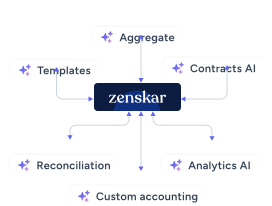
By automating recurring billing with Zenskar, our billing cycle – which previously took 7–9 days – now closes in 2 days, saving 16-20 hours/month.

Frequently asked questions
Financial data readiness is the state where finance data is accurate, consistent, timely, governed, and well-documented enough to support reliable reporting, forecasting, analytics, and AI, without manual reconciliation or second-guessing numbers.
AI and advanced analytics are only as good as the data they rely on. If finance data is fragmented, inconsistent, or poorly governed, AI outputs won’t be trusted, limiting adoption and ROI.
A financial data readiness audit is a structured assessment that evaluates how prepared your finance data is across quality, integration, timeliness, governance, and documentation, often using a checklist or scoring framework to identify gaps.
Common signs include conflicting reports, heavy spreadsheet reliance, manual reconciliations, unclear metric definitions, slow closes, and frequent questions about data sources or refresh timing in executive meetings.
CFOs can improve readiness by auditing current data practices, fixing high-impact quality and integration gaps, standardizing KPI definitions, assigning data ownership, and centralizing finance data in systems designed for analytics and AI.

%20be%20truly%20invisible_.webp)

Stay Future-Ready with AI-Native Order-to-Cash
Zenskar scales with you - it's flexible, reliable, and enterprise-ready.
