
How to Increase Average Revenue Per User?
%20be%20truly%20invisible_.webp)
In today’s business world, growth isn’t just about signing up more users. It’s about extracting more value from the ones you already have. Average revenue per user measures exactly that.
Many companies leave revenue on the table by focusing on customer acquisition while failing to monetize their existing customer base. In this blog, we’ll look at what ARPU is, the strategic levers and practical tactics you can rely on to boost it, and an actionable 90-day plan to help you drive ARPU growth.
What is average revenue per user and why does it matter?
Definition and basic formula
Average revenue per user (ARPU) measures the average revenue a business generates from active paying users in a defined time frame. It’s a key revenue metric for subscription-based businesses such as SaaS, telecom, and media companies.
Average revenue per user = Total revenue in a period / Number of users in that period
Example:
Last month, a SaaS business generated $ 400,000 in revenue from 500 active users.
Monthly ARPU = $ 400,000 / 500 = $800
On average, each active user contributed $800 in revenue.
Understanding different ARPU timelines
User counts fluctuate due to acquisition, churn, and renewals. Analyzing ARPU across different time periods reveals distinct insights.
- Monthly ARPU: Captures the impact of short-term initiatives (new marketing campaign, change in pricing).
- Quarterly ARPU: Identifies trends and seasonality in revenue.
- Annual ARPU: Smooths out volatility and helps with long-term growth planning
Foundations before you try to increase ARPU
Measuring ARPU correctly
Before optimizing average revenue per user, ensure it’s measured accurately. Both inputs (revenue and users) need to be carefully defined.
Three simple checks help clean up ARPU.
- Use recognized revenue, not collections: ARPU should reflect revenue earned, and not cash collected.
- Include only active and monetizable users: Exclude free, inactive, and expired user accounts as they dilute ARPU by not contributing to revenue.
- Maintain consistent data: When data is fragmented across billing, CRM, and analytics tools, the inputs for ARPU are unreliable. Integrate systems to get a single source of truth to measure ARPU correctly.
ARPU vs other metrics
Before trying to increase ARPU, determine whether it’s the right metric for your business model and growth stage. A few diagnostic questions help clarify this.
- Who is the real customer: individual users or teams?
- If customers are individual users, ARPU works well.
- If customers are enterprises or teams, then revenue is charged at the account level, with users acting as seats. Here, ARPA is a better measure of revenue quality.
Average revenue per account (ARPA) = Total revenue in a period / Number of paid accounts
- Does higher ARPU actually create long-term value?
ARPU doesn’t capture churn and acquisition costs. In other words, average revenue per user reflects the top line, not profitability.
Hence, pair it with CLTV. It accounts for retention and acquisition costs to validate whether ARPU growth is sustainable.
Segmenting ARPU for actionable insight
A single blended ARPU does not reveal the full picture. Instead, segment it based on:
- Subscription tier
- Customer segment
- Acquisition channel
Overall ARPU can increase even while certain segments stagnate or decline. Segment-wise ARPU analysis points out where monetization is strong and where targeted interventions are needed.
Strategic levers to increase average revenue per user
These levers focus on how you design pricing and packaging, expand customer value over time, and reduce revenue leakage.
1. Add value with packaging, features, and tiers
When customers get more value from the product, they are willing to pay more. You can increase value to customers by:
- Adopting value-based pricing: Flat pricing limits revenue upside, while tiered pricing models help customers select plans depending on their needs and willingness to pay.
- Launching premium features and add-ons: As customers scale, these features support more advanced use cases they may encounter.
- Introducing usage-based elements for power users: Usage-based billing allows ARPU to grow in tandem with customer activity.
2. Upsell and cross-sell to existing customers
ARPU can be increased by expanding revenue from existing customers through upsells and cross-sells by:
- Identifying upsell triggers: Track product usage and adoption signals to identify when customers are ready for an upgrade.
- Nudging users towards higher value plans: Deploy UI/UX changes and in-product prompts to gently nudge users towards plans that better match their needs, without disrupting the customer experience. When you launch premium features or add-ons, announce them visually: an AI ad maker can turn the release notes into short promo videos for in-app messages and lifecycle emails in minutes. To make these prompts more intuitive and effective, expert web designers can craft user interfaces that guide decisions naturally, improving engagement and increasing the likelihood of upgrades.
- Cross-selling complementary offerings: Cross-sell products that extend current workflows as they are easier to adopt. For example, marketplaces integrate AI product photography directly into a seller's listing workflow to refine product listing designs , making it a practical and valuable add-on. Similarly, offering sellers an AI background remover as a one-click add-on to clean up product shots keeps the upsell relevant to a workflow they already use. Unrelated cross-sells often face resistance due to added complexity. Unrelated cross-sells often face resistance due to added complexity.
3. Improve retention and reduce low-value downgrades
Protecting existing revenue is just as important as pursuing new growth opportunities. Even active customers can downgrade or churn, eroding ARPU over time. To prevent this:
- Monitor ARPU trends for spotting early risk signals: Watch for gradual downgrades, reduced use of paid features, or shifts in customer mix, and intervene before these signals turn into churn.
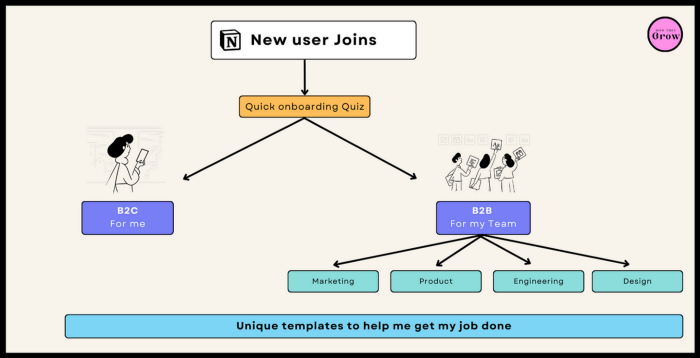
- Deploy targeted retention plays that reinforce high-value behavior: Customers who consistently realize value are more likely to stay. Use personalized onboarding and detailed support interactions to help users make the most of your product and sustain long-term value. For example, Notion personalizes its onboarding depending on whether the customer is from a B2C or B2B context.
The connection between support quality and retained revenue shows up in hard numbers. After Helpware took over customer support operations for the meditation app Headspace, the account held net retention near 70%, roughly 20% above the original plan. For ARPU, the takeaway is that attentive, consistent service keeps existing users active long enough for upsells and expansion to take hold.
4. Optimize discounts and promotions
Discounts and promotions help close deals, but they also lower ARPU by reducing the revenue potential. On the other hand, a strict no-discount policy can slow growth. To strike the right balance:
- Avoid long-term deep discount terms: They anchor customers to a lower price and prevent future revenue uplift. Instead, time-bound promotions allow ARPU to recover as customers scale.
- Analyze the full ARPU impact: Look beyond the immediate revenue drop and evaluate effects on expansion and churn. If discounts improve retention or expansion, the short-term ARPU trade-off may be justified.
Operational tactics to drive ARPU in subscription businesses
With the strategic decisions in place, the next step is executing them through practical tactics.
1. Engage and reward users
- Reward consistent user engagement with loyalty points, early access, or other perks. Reward consistent user engagement with loyalty points, early access, or other perks, set up with loyalty program tools like ReferralCandy.
- Show offers, tips, or prompts exactly when users interact with key features to boost usage and engagement.
- Collect feedback from power users to refine product features and campaigns. This can be done through quick links or QR codes in emails or in-product feedback prompts that take users directly to feedback forms.Using a QR code generator with logo can make these feedback requests more recognizable and trustworthy for users. Tools like The QR Code Generator (TQRCG) make this easy.
2. Monetize through product
- Let users experience premium features through free, hands-on trials so that they can see the value before upgrading.
- Trigger upgrades when users hit milestones or usage limits to improve the likelihood of conversion.
- Introduce usage limits after users have experienced the core value to avoid blocking activation.
How does ARPU interact with forecasting, accounts receivable, and revenue recognition?
ARPU trends and financial forecasting
In a webinar we conducted with finance leaders, a common theme emerged: building a reliable revenue forecast is key to effective financial forecasting. One of the ways to do this is by using ARPU.
- If revenue rises because ARPU increases, the business is extracting more value from existing customers through upsells, expansion, or better monetization.
- If revenue increases only due to more active users, growth heavily depends on customer acquisition. When organic search drives customer acquisition, a Google index checker can help verify that key landing pages are indexed before teams evaluate search-driven traffic and acquisition costs.
ARPU alone does not tell the whole business story. Reading it alongside other metrics such as CAC and churn reveals whether growth is sustainable.
ARPU and accounts receivable
ARPU measures the revenue a business earns per user during a period, but it doesn’t reflect the actual cash collected. High ARPU can be misleading if collections lag, putting cash flow at risk. Accounts receivable (AR) aging helps track how efficiently invoices are being paid.
AR aging days can be calculated as:
AR aging days = (Average AR / Credit sales ) x Number of days in that period
Higher AR aging days indicate slower collections and potential cash flow issues.
To understand how monetization and collections interact, we can map ARPU and AR aging in a 2x2 matrix.
Identifying which zone the business falls into helps plan interventions. Tools like Zenskar integrate billing and payment systems, automating revenue recognition and enabling real-time visibility into ARPU and collections.
ARPU and revenue recognition
ARPU should be based on recognized revenue, and not invoices or billings. This ensures it reflects the true contribution of each user.
It’s particularly useful for:
- Multi-period contracts: Revenue is earned over time for annual, quarterly, or milestone-based subscriptions. Zenskar automates revenue recognition for complex contracts, keeping ARPU accurate.
- Pricing and contract changes: Upgrades, downgrades, discounts, or usage-based billing can shift revenue recognition across periods. Zenskar’s billing infrastructure ensures that all contract and pricing adjustments are automatically reflected in ARPU, giving finance teams an up-to-date view of revenue trends.
90-day plan to increase average revenue per user
Most initiatives to increase average revenue per user fail during execution. This 90-day plan focuses on building momentum and getting the execution right.
Phase 1: Understand your baseline
- Standardize ARPU definitions.
- Segment users by plan, cohort, and acquisition channel.
- Identify the highest-impact ARPU improvement opportunities.
Where teams struggle: ARPU inputs are scattered across systems.
How Zenskar helps: Unifies billing and revenue recognition into a single trusted ARPU baseline.
Phase 2: Run targeted ARPU experiments
- Pilot pricing or packaging changes.
- Launch targeted upsells and complementary cross-sells.
- Introduce in-product upgrade triggers based on usage.
Where teams struggle: Experiment results get distorted by billing complexity.
How Zenskar helps: Automatically reflects pricing and contract changes in recognized revenue with its billing infrastructure.
Phase 3: Scale what works
- Analyze impact across ARPU, churn, and customer opinions using sentiment analysis tools.
- Roll successful changes into the product.
- Set clear ARPU benchmarks and track with real-time dashboards.
Where teams struggle: Teams spend more time reconciling data than acting on insights.
How Zenskar helps: Real-time revenue and ARPU visibility through dashboards by the Analytics AI feature lets teams act with confidence.
Are you ready to increase your average revenue per user?
With complex usage-based pricing and frequent contract changes, pricing experimentation was hard for SquadStack to scale. By moving to Zenskar, the team automated pricing, reduced manual work for finance teams, and sped pricing changes, driving revenue by 2%.
If you want to turn your ARPU strategy into repeatable results just like they did, it starts with getting the revenue infrastructure right. Book a demo with Zenskar to see how you can scale monetization with confidence.

By automating recurring billing with Zenskar, our billing cycle – which previously took 7–9 days – now closes in 2 days, saving 16-20 hours/month.

Frequently asked questions
There is no benchmark on what a good ARPU is. It depends on customer segments, pricing plans, and product complexity. Tracking ARPU over time and against peers in the same space helps make a comparative judgment on business performance.
ARPU solely focuses on revenue. It does not consider how long the customer stays and how much is spent on acquiring and retaining customers.
ARPU measures average revenue per user, while ARPA measures average revenue per account. The metric you choose to track depends on your target audience. ARPU is more suitable in the B2C context, while ARPA works in the B2B context.
Yes, ARPU can grow when customer count is flat by monetizing existing customers better. This can be achieved through upgrades, expansion, or cross-sell opportunities.



Stay Future-Ready with AI-Native Order-to-Cash
Zenskar scales with you - it's flexible, reliable, and enterprise-ready.
