
CLTV: The Key to SaaS Business Growth

I remember finding an old wallet weeks ago, inside the wallet I found a loyalty card from a software store that no longer exists. I remembered buying a single program there as a student, one purchase, one moment, and never coming back.
That crumpled card felt like a metaphor for modern SaaS: value isn’t just in the first transaction. ChartMogul's retention research shows that 41.1% of SaaS companies with ARPA above $500/month achieve net retention over 100%, which tells you how rare and valuable long-term customers are.
It reminded me that customers aren’t one-time checkpoints but ongoing relationships. Their lifetime value reveals more about the health of your business than any single metric ever will.
In this blog, we will explore how CLTV helps you understand and amplify that value.
What is CLTV and what are its foundational definitions?
Before we talk about formulas or forecasting, let’s slow down and define the metric clearly. CLTV sounds straightforward, how much value a customer brings over their relationship with your product,a key metric for understanding the customer lifecycle, from first purchase to loyalty and beyond. But the nuance lies in how you measure it, and what you do with it.
In finance terms, Customer Lifetime Value is the net revenue a customer generates across their entire lifecycle, not just the first contract or first year. It blends retention, monetization, and customer behavior into a single economic signal.
Here’s what makes CLTV distinct:
- It’s forward-looking
ARPU and revenue cohorts tell you what customers are paying today. CLTV tells you what they’ll pay tomorrow. - It links acquisition and retention
CAC is only meaningful relative to CLTV. A 3:1 CLTV-to-CAC ratio sounds healthy unless CLTV is artificially inflated. - It speaks the language of investors and boards
CLTV answers the question: “Is this business economically sound over the long term?” - It reveals which customers actually create value
Blended averages blur the truth. CLTV forces segmentation.
In many companies, teams mistake “average customer revenue” or “average contract value” for CLTV. But those numbers describe a snapshot. CLTV is a story. A story of usage, upgrades, renewals, downgrades, sentiment, and loyalty.
Once you understand CLTV at this foundational level, everything else in the business becomes easier to interpret.
What is the CLTV formula, tools and how do you calculate it in practice?
Once you understand what CLTV represents, the next step is grounding it in a formula that gives you a reliable starting point. The beauty of CLTV is that the core equation is simple and the variations let you adapt it to your business model.
1. The most accepted CLTV formula
The standard SaaS formula is:
CLTV= Average Revenue per Customer / Churn Rate
This gives a clean view of the lifetime value your average customer delivers.
2. Why do variations exist?
Different variations exist because different revenue models demand more precision. Here are some variation:
- Margin-adjusted CLTV :
CLTV= ARPU × GrossMargin / Churn
Useful when infrastructure or support costs materially affect profitability.
- Expansion-adjusted CLTV :
CLTV= ARPU × (1+ExpansionRate) / Churn
Ideal for businesses with strong NRR and predictable upsell behavior.
- Segmented CLTV :
SMB, mid-market, enterprise, or usage-based customers behave very differently. Segmenting CLTV highlights where value truly comes from.
3. CLTV calculation tools & CLTV calculator
A dedicated CLTV Calculator built into your billing or revenue system lets you plug in ARPU, churn, margin, and expansion to run scenarios instantly. This turns CLTV from a quarterly spreadsheet into a real-time financial signal.
4. Short practical walkthrough
A SaaS company has:
- ARPU: $240/month
- Margin: 85%
- Churn: 4%
- Expansion: 12%
Basic CLTV:
CLTV=240 ÷ 0.04 = $6,000
Margin-adjusted CLTV:
CLTV =(240 × 0.85) ÷ 0.04 = $5,100
Expansion-adjusted CLTV:
CLTV = (240 × 1.12) ÷ 0.04 = $6,720
Three quick calculations, three different insights together forming a clearer picture of your real customer lifetime value.
Comparison of CLTV models
When done well, CLTV becomes a live model, not a quarterly spreadsheet exercise. But when done poorly, it becomes misleading.
The key is consistency. Clear churn definition, Clean revenue segmentation, Accurate margin tracking and a system that keeps these inputs aligned.
CLTV vs. ITV - How does CLTV compare to ITV and other value metrics?
Not all revenue metrics describe value in the same way. And understanding the distinctions is crucial especially when presenting to boards, analysts, or investors.
ITV (Initial Transaction Value) reflects the very first invoice a customer pays.
It’s useful for cash planning, but meaningless for long-term economics.
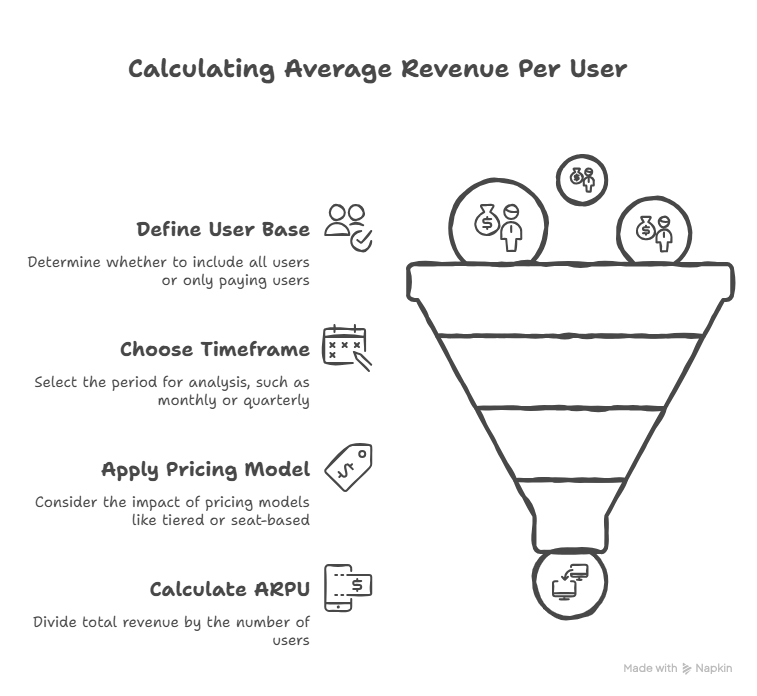
Source: Salvatore Tirabassi
ARPU is an average revenue snapshot.
It’s informative for pricing and packaging decisions, but averages can hide the extremes.
CLTV, on the other hand, captures behavior across time.
It accounts for retention, expansion, and usage patterns, which are fundamental drivers of SaaS profitability.
A powerful adjacent metric here is Net Revenue Retention (NRR), which indicates how revenue grows or shrinks from existing customers. According to High Alpha, SaaS companies with NRR above 106 % grow nearly 2.5× faster than those with NRR below 98%.
That’s the multiplier effect CLTV is designed to capture.
Here's how these metrics compare:
The risk comes when companies optimize around ITV or ARPU instead of CLTV. They attract the wrong segments, invest in low-value customers, and misread product-market fit.
CLTV forces the business to look beyond the next quarter to understand the entire arc of the customer relationship.
How do you use CLTV for SaaS growth decisions?
This is where CLTV becomes truly powerful.
Not in measurement, but in decision-making.
When CLTV guides strategy, companies stop chasing short-term wins and start building long-term resilience.
1. Acquisition budgeting
CLTV determines how much you can safely spend to acquire a customer. A 3:1 CLTV-to-CAC ratio is often seen as healthy for enterprise SaaS, while PLG models can work at 2:1 due to faster paybacks.
But these ratios only matter if CLTV is calculated correctly. Teams that need help turning this budget into pipeline can compare leading SaaS demand generation agencies by channel focus, pricing and company-stage fit.
2. Pricing and packaging
If your CLTV per segment varies widely, your pricing needs refinement. Some segments may be overpaying, others underpaying, and others misaligned entirely.
Modern pricing engines like Stripe Billing, Chargebee, Zuora, and Maxio make it easier to test new monetization models without engineering bottlenecks. Alongside pricing adjustments, thoughtful package design can help reinforce a product’s value proposition, creating a more cohesive experience for each customer segment.
3. Retention investments
High CLTV customers often warrant:
- tailored onboarding
- dedicated CSMs
- proactive value reviews
- faster product feedback cycles
Low CLTV customers benefit from automation, standardized onboarding, and PLG pathways.
4. Segmentation and prioritization
CLTV segmentation tells you:
- which industries expand fastest
- which customer sizes churn least
- which usage patterns predict lifetime value
It becomes a dashboard for growth.
For SaaS teams focused on sustainable growth, AI SEO for B2B SaaS can complement this data-driven approach by helping attract prospects that align with high-value customer segments.
Instead of trying to improve everything, teams focus on the 20% of segments that drive 80% of lifetime value.
What are the common pitfalls and misunderstandings in CLTV?
CLTV is simple to understand, but easy to miscalculate. Here are the pitfalls that distort the number the most:
1. Misdefining churn
Logo churn vs. revenue churn. Monthly vs. annual. Gross vs. net.
Each paints a different picture.
A company may appear healthy under Gross Revenue Churn but unhealthy under Logo Churn or vice versa.
Just as organizations create logos to build recognizable brands, they also need standardized churn metrics. Even a small misclassification like treating downgrades inconsistently can push CLTV off by thousands. This is why churn alignment across teams isn’t optional but foundational.
2. Over-reliance on averages
Blended averages hide truths. Enterprise customers may deliver 10× the CLTV of SMBs, but a blended number erases the signal. Averages feel clean, but they often mask the segments that deserve the most investment.
3. Ignoring downgrades and usage decline
Soft churn reduced usage or shrinking engagement often precedes actual churn by months. When teams ignore early usage signals, CLTV becomes backward-looking instead of predictive.
4. Treating CLTV as a static number
CLTV shifts with pricing, product changes, market pressure, and expansion rates. Treating it as fixed leads teams to miss movement that matters
How can you improve CLTV with actionable strategies?
Here’s the part every SaaS leadership team wants to know: How do you actually increase CLTV?
The beauty of CLTV is that it responds quickly to focused, disciplined effort.
1. Retention - The most powerful lever
Research from ThinkImpact shows that a 5% increase in retention can drive a 25%-95% increase in profitability.
This is the compounding effect of retained revenue. It fuels expansion, lowers CAC pressure, and stabilizes forecasting.
2. Stronger onboarding
Most churn happens early. Guiding customers to value faster directly lengthens lifetime. Even simple improvements like clearer activation steps backed by an AI knowledge base or early check-ins create measurable impact. For SaaS teams that still receive inbound calls from new customers during onboarding, ensuring those calls are answered automatically with an answering service prevents early-stage churn from a simple missed touchpoint.
3. Expansion and upsell
Healthy NRR amplifies CLTV. When value discovery is ongoing, not one-time, expansion becomes natural. Usage triggers, tiered packaging, and contextual upsell moments make upgrades seamless. Adding QR codes to product packaging or printed materials is another effective way to nudge customers toward upgrade pages or new feature announcements at the right moment, and tools like The QR Code Generator (TQRCG), QR Code Generator, and Canva make it easy to create and design them quickly.
4. Pricing innovation
Hybrid and usage-based pricing reflect how customers actually experience value. Well-aligned pricing doesn’t just increase ARPU, it stabilizes long-term retention.
Feedback loops
High-NPS segments often correlate with high CLTV. Feedback isn’t just sentiment, it’s a leading indicator of lifetime risk or opportunity. Combined with sustainable customer acquisition efforts from an ecommerce SEO agency, these insights can help businesses attract higher-value customers and improve long-term growth.
CLTV Improvement levers
How does Zenskar automate CLTV insights and drive performance?
Most companies want to understand CLTV deeply, but their data lives in silos billing in one system, CRM in another, product usage somewhere else. CLTV becomes a quarterly exercise, not a strategic tool.
Zenskar changes that.
1. Real-time CLTV intelligence
Zenskar automatically calculates:
- true CLTV, giving teams a clear picture of the actual lifetime economics of every customer.
- margin-adjusted CLTV, so that not just revenue, but profitability also sits at the center of decision-making.
- expansion-adjusted CLTV, capturing how upsells and usage growth reshape long-term value.
- segment-specific CLTV, allowing teams to see which customer types truly create durable revenue.
- CLTV by cohort, revealing changes in customer behavior across signup periods.
- and churn prediction models, helping finance teams anticipate risk instead of reacting to it.
No more spreadsheets. No more guesswork, just continuous, accurate insight
2. Unified revenue intelligence
By integrating billing, revenue recognition software, usage, and CRM, Zenskar gives finance teams a consistent, reliable CLTV signal.
3. Customer wins
One mid-market SaaS company using Zenskar saw:
- 18% increase in CLTV,
- 11% reduction in churn,
- and discovery of two previously hidden high-value segments.
These insights reshaped their GTM motions entirely.
Ready to see how real-time CLTV insights can reshape your revenue strategy?
Request a demo today or take an interactive product tour, and we’ll show you how automated billing, revenue intelligence, and lifetime value tracking come together to drive sustainable SaaS growth.

By automating recurring billing with Zenskar, our billing cycle – which previously took 7–9 days – now closes in 2 days, saving 16-20 hours/month.

Frequently asked questions
CLTV is the total revenue a customer generates across their lifecycle. It measures retention, expansion, pricing, and customer value sentiment.
The basic formula is ARPU ÷ Churn.More advanced models include margin and expansion.
ITV is the first invoice, ARPU is average revenue and CLTV measures total lifetime value.
Focus on retention, onboarding, expansion, pricing, and customer experience.
Zenskar automates CLTV analysis by integrating billing, revenue, usage, and CRM giving teams accurate, real-time lifetime value insights.


%20be%20truly%20invisible_.webp)
Stay Future-Ready with AI-Native Order-to-Cash
Zenskar scales with you - it's flexible, reliable, and enterprise-ready.
