
Lago alternatives: Why modern revenue teams switch to Zenskar
Lago and Zenskar both offer billing and revenue automation.
Lago is an open-source billing and metering API infrastructure built for engineering-led teams that want to manage billing logic with self-hosting and developer-first configuration. Teams that choose Lago own their billing stack at the infrastructure layer-but that ownership comes with ongoing engineering cost.
Zenskar delivers a fully unified, AI-native revenue automation platform that goes beyond billing and metering by also encompassing revenue recognition, collections, and analytics in a single solution. In other words, Zenskar consolidates every step from contract ingestion through billing, invoicing, revrec, and collections-without requiring engineering to build or maintain it.
Because modern finance teams aren't just metering usage and generating invoices-they're managing custom contracts, complex pricing amendments, revenue recognition compliance, and post-sale changes that flow long after a deal is signed.
In this comparison, we'll look specifically at the billing and revenue capabilities of each platform and break down how each approach works, where Lago fits well, and why Zenskar is increasingly the choice for finance teams.
5 reasons teams look for Lago alternatives
If Lago is so flexible and developer-friendly, why do teams start looking for Lago alternatives?
The reality is that as a company grows, billing needs become more complex - and many of those needs fall outside what Lago provides out of the box. Here are five common pain points that drive finance teams to look for Lago alternatives:
1. Finance teams need to own billing without filing tickets
Lago is built for engineers, not finance users. There's a limited UI for non-technical teams, and no built-in way for finance to make routine changes - updating a rate, running a credit, or handling a mid-contract amendment - without developer involvement.
As billing complexity grows, so does the involvement of Finance and Revenue Operations. These teams need visibility and control. With Lago, they typically end up exporting data to spreadsheets for analysis and manually adjusting records for accounting. That doesn't scale.
2. Revenue recognition and ERP sync
A major trigger to look beyond Lago is when accounting and compliance requirements become significant. Lago does not provide revenue recognition features or advanced financial workflows. Finance must handle revrec manually in spreadsheets or separate software, and there's no native way to push data to ERP systems.
Teams often switch specifically to get built-in, ASC 606/IFRS-compliant revenue recognition - so that billing and accounting stay in sync without manual intervention, and the audit trail is clean.
3. No native entitlements or prepaid credit management
Lago doesn't include a native entitlements module. There's no built-in way to grant prepaid credits, track credit depletion, or manage rollover balances without engineering building it from scratch. For companies selling prepaid contracts, minimum commitments, or credit-based pricing, this creates a significant gap that typically falls on the engineering team to plug with custom work.
4. Collections are an add-on, not a default
Automatic dunning in Lago is a premium add-on, not bundled into the core product. For finance teams trying to reduce DSO and automate cash collection, this means extra cost and setup for a workflow that should be standard. Teams that want segmented dunning sequences, invoice attachments, and usage report delivery to different customer cohorts need to look elsewhere.
5. Maintenance and engineering overhead
Finally, some companies simply reach a point where maintaining an open-source system outweighs the benefits. Lago's flexibility comes with responsibility: developers have to manage updates, infrastructure (if self-hosted), and any customizations added over time.
As product engineering focuses on the core product, spending time managing the billing infrastructure becomes less attractive - and the cost of engineering hours quietly compounds. A fully managed alternative relieves that burden and returns billing ownership to the people who actually run revenue.
What to look for when evaluating Lago alternatives
Once you've decided to explore Lago alternatives, what criteria matter?
Modern revenue operations span multiple functions - billing, finance, collections, compliance - so you'll want a solution that checks several boxes Lago doesn't. Key capabilities to evaluate:
1. Finance-owned configuration
The alternative should let finance update pricing, run credits, and handle exceptions without filing engineering tickets. No-code or low-code administration is the baseline.
2. Native revenue recognition
A strong Lago alternative goes beyond billing into revrec and compliance reporting. This means automatic deferred revenue schedules, multi-period revenue handling, ASC 606/IFRS 15 compliance, and ERP sync - out of the box.
3. Contract-level flexibility
Look for support for minimum commitments, mid-contract amendments, cross-product credits, and multi-element arrangements. Billing at the product level (atomic, per-line-item) breaks down fast when enterprise deals get involved.
4. Entitlements and prepaid credit management
Built-in entitlements - grant credits, track depletion, manage rollover - without engineering involvement.
5. Collections bundled into the core product
Automated dunning with invoice and usage report attachments, segmented by customer type, included by default.
6. Deep ERP integrations
Two-way sync with journal entry creation for NetSuite, QuickBooks, Xero, and other systems - not just basic object sync.
7. Usage metering that decouples from pricing
Ingest raw usage data in any format via API, CSV, or data warehouse connection, and map events to contracts automatically without needing product-specific identifiers in every event.
When evaluating Lago alternatives, think about the full order-to-cash lifecycle - not just who can meter usage and generate invoices. The right platform will let finance own operations, keep revrec compliant, and scale without adding headcount.
Lago vs Zenskar: Comparison overview
This comparison overview highlights the key differences between Lago and Zenskar across pricing flexibility, automation, integrations, and scalability.
While both platforms help teams handle usage-based billing, they take very different approaches to how billing fits into the broader revenue stack.
The table below gives a quick, side-by-side view to help finance teams see which solution better supports modern, complex revenue models.
Lago vs Zenskar: Comparison overview
This comparison overview highlights the key differences between Lago and Zenskar across pricing flexibility, automation, integrations, and scalability.
| Category | Lago | Zenskar |
|---|---|---|
| Core focus | Billing and metering API infrastructure | AI-native, unified order-to-cash platform |
| Pricing model support | Fixed, usage, minimum commitments, credits with the same billing period | Usage, minimum commitments, discounts, credits for varying billing periods, subscriptions, hybrid, prepaid/postpaid |
| Pricing flexibility | Limited; restrictions to change pricing after setup; does not support sales contract amendments | Handles mid-contract amendments and automates downstream billing and revrec changes |
| Contract ingestion | Pricing configuration via platform, CRM, or API only | Price via platform, CRM/CPQ, bulk manual upload, API, or AI; AI extracts billing terms automatically |
| Usage metering | Requires Kafka, Kinesis, or ClickHouse for greater than 10K events/s; throughput-dependent setup | Ingests raw or aggregated data through 100+ data warehouses, CSV uploads, or API; supports up to 50K events/s |
| Aggregation | Basic aggregation functions or custom SQL | No-code visual builder, SQL, or AI |
| Revenue recognition | Unavailable | ASC 606/IFRS compliant; independent of invoicing; auto-syncs journal entries with full audit trails |
| Collections | Automatic dunning is a premium add-on, not bundled into the core product | Automated dunning sequences with invoice and usage report attachments, for different customer segments |
| Entitlements | Supports features, seat limits, and usage-related credits attached to plans | End-to-end configuration, rollover/expiry, monitoring, invoicing, and revrec for postpaid or prepaid credits without hard-coding |
| Integrations | ~20 integrations, natively or community-created; enforces standard object mapping | 100+ integrations across CRM/CPQ, ERP, payment gateways, and sales tax tools; modular two-way sync, flexible triggers, custom fields |
| Ease of use (Finance) | Developer-first; finance teams depend on engineering to build, update, and maintain billing logic | Finance-first; built for finance users with compliance and reliability baked in; reduces engineering dependence |
| Implementation speed | Fast if you have engineering resources; ongoing maintenance adds to total cost | Go live in weeks; zero-disruption migration; minimal engineering involvement |
| Scalability | Well-suited for engineering-led startups with developer capacity | Designed for scaling SaaS, fintech, and AI companies that need finance to own operations |
| Analytics and reporting | Analytics severely limited; relies on external BI tools | Unified, real-time analytics across billing, usage, collections, and revenue |
| Best for | Developers who want self-hosted billing infrastructure | Finance teams that want to own the full revenue lifecycle without engineering overhead |
Lago vs Zenskar: Feature breakdown
Pricing configuration and flexibility
Modern billing lives or dies on pricing flexibility. If you're selling subscriptions plus usage, ramp deals, prepaid credits, or custom contract terms, your billing system needs to keep up-without turning into an engineering project every time pricing evolves.
Zenskar
- Handles usage, minimum commitments, discounts, credits for varying billing periods, subscription management, hybrid, and postpaid/prepaid pricing
- Supports mid-contract amendments and automates downstream billing and revrec changes without manual reconciliation
- No-code configuration means finance can ship pricing changes without filing engineering tickets
Lago
- Supports fixed pricing, usage, minimum commitments, and credits, but only within the same billing period
- Restrictions apply when changing pricing after setup; sales contract amendments are not supported
- Pricing logic that falls outside the standard model typically requires custom engineering work
Verdict: If your pricing is predictable and your team has engineering bandwidth, Lago can work. If pricing complexity is growing-or you expect amendment-heavy enterprise deals-Zenskar is the safer long-term platform.
Contract ingestion
A billing system is only as good as its ability to ingest the deals your sales team closes. Manual entry doesn't scale, and brittle API integrations create reconciliation debt.
Zenskar
- Supports pricing via the platform, CRM/CPQ, bulk manual upload, API, or AI
- Contracts AI extracts billing terms from signed contracts, automatically maps usage, and creates products and customers in the system
- Reduces the time between deal-close and billing-live to near-zero

Lago
- Pricing configuration must be done via the platform, connected CRM, or through API
- No native AI-powered contract ingestion; manual entry or custom API work required for every new deal
- Creates engineering dependency every time a new contract structure appears
Verdict: Zenskar's AI-powered contract ingestion is a meaningful operational advantage for teams closing non-standard deals. Lago requires engineering involvement for every contract that doesn't fit the standard mold.
Usage metering
Usage-based pricing is increasingly the default, not the exception. Your metering infrastructure needs to handle volume, flexibility, and reliability without becoming its own maintenance burden.
Zenskar
- Ingests raw or aggregated usage data through 100+ data warehouses, manual data entry, or CSV uploads
- Supports up to 50K events/s via API
- No mandatory infrastructure dependency-teams choose the ingestion method that fits their stack
Lago
- Ingestion method depends on throughput; volumes above 10K events/s require Kafka, Kinesis, or ClickHouse with specific batching recommendations
- Infrastructure setup and ongoing maintenance falls on the engineering team
- Configuration is developer-first by design, which adds overhead for finance-owned operations
Verdict: Lago's metering can handle high throughput but at the cost of infrastructure ownership. Zenskar offers comparable scale with significantly less engineering surface area.
Revenue recognition
A revrec system isn't optional for any company approaching audit readiness or operating under ASC 606 or IFRS 15. Getting it wrong creates restatement risk and finance team pain.
Zenskar
- ASC 606 and IFRS compliant revrec for any pricing model or contract structure, independent of invoicing
- Auto-syncs journal entries with full audit trails
- Built-in SSP (Standalone Selling Price) support
Lago
- Revenue recognition is unavailable
- Analytics source of truth for revenue is unclear, which creates reporting risk as teams scale toward audit-readiness
Verdict: This is a category-level gap. If revrec matters-and it will-Lago requires a separate solution. Zenskar handles it natively.
Collections
Cash collection is where revenue operations meet cash flow reality. Automated dunning, segmented outreach, and invoice attachment capabilities all reduce days sales outstanding (DSO) without adding headcount.
Zenskar
- Automated dunning sequences with invoice and usage report attachments, tailored for different customer segments
- Built into the core product, not a premium add-on
Lago
- Automatic dunning is gated as a premium add-on, available only on request
- Not bundled into the core offering, which means additional cost and configuration for a workflow most teams need by default
Verdict: Zenskar treats collections as a core capability. Lago treats it as an upsell. For teams that care about cash collection efficiency, this distinction matters.
Integrations
Billing can't be a silo. Finance needs quotes, payments, and revenue data to flow cleanly across CRM, ERP, and accounting systems-without custom engineering for every connection.
Zenskar
- 100+ integrations across CRM/CPQ, ERP, payment gateways, and sales tax tools
- Modular two-way sync with flexible triggers and custom fields-no enforced schema or field mapping
- Integrates natively with HubSpot, Salesforce, NetSuite, Avalara, QuickBooks, Xero, Stripe, and more
Lago
- Approximately 20 integrations, natively or community-created
- Enforces standard object mapping and rigid structures for integration; non-standard setups require workarounds
- Community-built integrations vary in reliability and maintenance
Verdict: Zenskar offers a materially broader and more flexible integration layer. Lago works for teams comfortable managing integration constraints or building their own.
Ease of use and administration
The best billing platform is the one finance owns without filing engineering tickets. Developer-first tools create operational bottlenecks the moment the team needs to change a pricing rule, run a credit, or handle an exception.
Zenskar
- Finance-first by design; built for finance users with compliance and reliability baked in
- Reduces engineering dependence across the full revenue lifecycle
- No-code configuration for pricing, aggregation, invoicing, and workflows
Lago
- Developer-first by design; adding engineering overhead to build, update, and maintain billing infrastructure is a feature, not a bug-for the right team
- Finance users typically cannot self-serve on pricing changes or operational exceptions without developer involvement
- Well-suited for engineering-led orgs; less suited as the finance team scales and needs operational independence
Verdict: Zenskar is built for finance ownership. Lago is built for developer control. As companies mature, the handoff from engineering to finance is where Lago starts to strain.
Analytics and revenue insights
Finance leaders don't just need invoices generated. They need visibility into usage trends, billing accuracy, collection rates, and revenue movement-in one place, in real time.
Zenskar
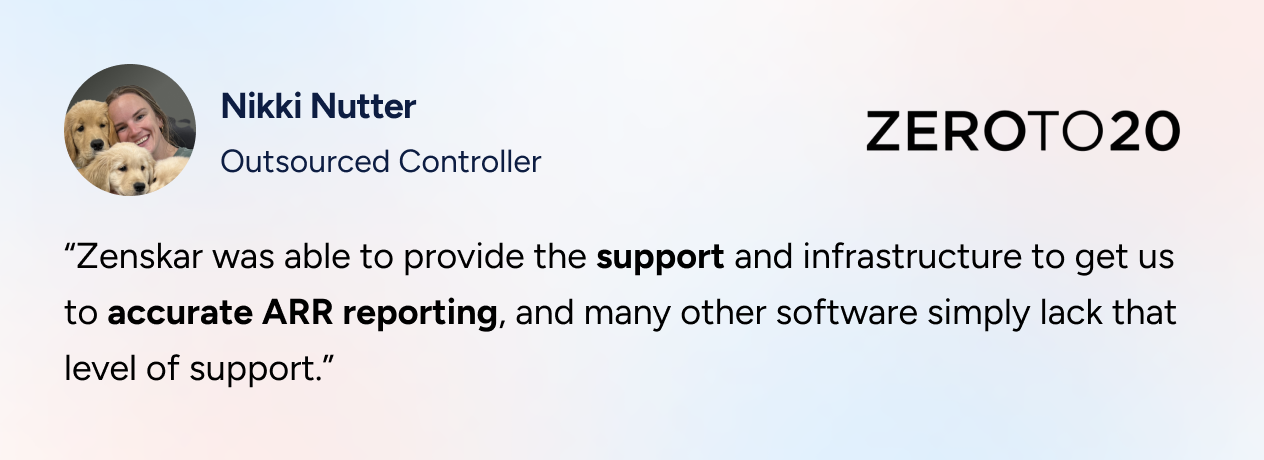
- Unified, real-time analytics across billing, usage, collections, and revenue
- Strong foundation for usage-based reporting where consumption-to-revenue traceability is critical
- Better foundation for pricing experimentation and revenue reporting without external BI dependency
Lago
- Analytics severely limited natively
- Revenue reporting typically requires external BI tooling, creating an additional setup and maintenance layer
- Limited granularity for usage-to-revenue attribution
Verdict: If you care about end-to-end revenue visibility-especially on usage-Zenskar is the stronger analytics platform. Lago requires external tooling to get comparable coverage.
Why Zenskar is the preferred choice for modern finance teams
After comparing Lago and Zenskar, Zenskar stands out as the stronger choice for finance teams at scaling companies.
While Lago is a solid, developer-friendly tool for teams that want self-hosted billing infrastructure and have engineering capacity to build and maintain it, Zenskar provides a more comprehensive, finance-first revenue platform that aligns with how modern SaaS, fintech, and AI companies actually operate.
This includes:
1. Broader pricing and contract flexibility
Zenskar handles pricing complexity-usage, credits, minimum commitments, hybrid, amendments-without custom engineering work. Lago's restrictions around post-setup pricing changes and lack of sales contract amendment support become friction points the moment enterprise deals get involved.
2. AI-native architecture
Zenskar's Contracts AI agent extracts billing terms from contracts, automates usage mapping, and creates billing objects automatically. Lago requires manual entry or custom API work for every deal. As contract volume scales, this gap compounds.
3. Unified order-to-cash
Zenskar brings billing, metering, collections, revrec, and analytics into one system. Lago covers billing and metering; everything else requires additional tooling, integrations, and reconciliation overhead. Finance teams at scaling companies eventually pay the price for that fragmentation.
4. Revenue recognition included
Lago has no revrec capability. Zenskar's is ASC 606 and IFRS compliant, independent of invoicing, and auto-syncs journal entries with full audit trails. For any company approaching fundraising, audit, or public market readiness, this is not optional.
5. ERP-connected
Lago has no ability to push revrec data to ERP systems. For any company approaching fundraising, audit readiness, or public market prep, this isn't optional - and building it manually in spreadsheets doesn't survive scale.
6. Finance ownership, not engineering dependency
Lago's developer-first design makes sense for engineering-led startups. As the finance team scales and needs to own pricing, invoicing, and operational exceptions without filing tickets, that same design becomes a bottleneck. Zenskar is built for finance teams from day one.
7. Native entitlements and prepaid credit management
Zenskar includes a native entitlements module. Finance can grant credits to customers, track usage depletion against prepaid balances, manage rollover and expiry, and monitor entitlement status - all without writing code.
Lago has no equivalent. Teams selling prepaid contracts, minimum commitments, or credit-based pricing end up building this infrastructure themselves, which adds engineering surface area that needs to be maintained indefinitely.
8. Collections as a core capability
Zenskar's automated dunning sequences - with invoice attachments, usage report delivery, and segmentation by customer type - are built into the core product. There's no premium tier to unlock, no additional configuration required.
Lago gates automatic dunning as a premium add-on available only on request. For finance teams that care about DSO and cash collection efficiency, treating collections as an upsell is friction that adds cost and setup time for a workflow every billing system should include by default.
9. 100+ integrations, no rigid schemas
Zenskar's modular integration layer with flexible triggers and two-way sync replaces Lago's ~20 integrations and enforced object mapping. For teams with existing CRM, ERP, and payment infrastructure, this removes significant implementation friction.
10. Faster time to value
Zenskar's white-glove onboarding, no-code configuration, and AI-powered migration compress go-live timelines even for complex contract and usage migrations. Lago can go live quickly too—but the ongoing engineering maintenance cost extends the total project well beyond initial setup.
Which teams should switch from Lago to Zenskar?
Teams should consider switching from Lago to Zenskar when their needs surpass what Lago was built to deliver. Here are some guidelines:
- Stick with Lago if you're an early-stage startup with simple, primarily usage-based pricing and sufficient engineering resources to manage the billing stack. Lago's open-source approach saves money and gives full control at that stage.
- Consider Zenskar if your Finance team is struggling with billing data in spreadsheets, manually producing revenue recognition schedules, or worried about audit and compliance gaps. If you can't easily answer how usage translates to revenue under ASC 606, Zenskar's integrated revrec is built for exactly this.
- Switch to Zenskar if engineering is becoming a bottleneck. If pricing changes are being delayed because the billing system is too hard to update, that's a red flag. Zenskar lets finance iterate on pricing without developer involvement, so your monetization strategy isn't constrained by your billing infrastructure.
- Consider Zenskar when go-to-market complexity increases - you're adding enterprise deals with minimum commitments, prepaid credits, or multi-year contracts; you're expanding to new pricing models mid-year; or you need collections and revrec to run automatically without stitching tools together.
- Switch before things break. If you know you'll be raising prices, introducing new product lines, or targeting enterprise clients in the next 6–12 months, implement Zenskar before that growth spurt - not in the middle of it.
The final verdict: Lago vs Zenskar
Lago is a strong choice for engineering-led teams that want developer-controlled billing infrastructure, have the resources to build and maintain it, and don't yet need revrec, collections, or finance-owned operations.
However, for modern finance teams that need pricing flexibility, contract amendment support, revenue recognition, collections, and real-time analytics-without engineering dependency-Zenskar is the stronger platform. It's built to run the full revenue lifecycle, not just meter usage.
Zenskar consolidates what Lago plus three or four adjacent tools would deliver, in a single system that finance teams can own and operators can iterate on-without waiting on engineering.

By automating recurring billing with Zenskar, our billing cycle – which previously took 7–9 days – now closes in 2 days, saving 16-20 hours/month.

Frequently asked questions
Yes. Zenskar ingests raw or aggregated usage data via API, CSV upload, or direct connection to 100+ data warehouses, and supports up to 50K events/s. Usage is fully decoupled from pricing, so Zenskar maps events to the right contract and invoice automatically - without needing product-specific identifiers in the event payload. You won't lose metering capability by switching; you'll gain the downstream automation Lago doesn't provide.
No, Zenskar is a proprietary, fully-managed SaaS platform. The philosophical difference is intentional: Lago's open-source nature gives raw control but requires your team to manage the system. Zenskar handles infrastructure, compliance, and ongoing feature development — and mitigates lock-in concerns through robust open APIs, data export capabilities, and a transparent integration layer. For teams where engineering bandwidth is the constraint, this trade-off is usually straightforward.
No. Zenskar is designed to go live in weeks, even for complex contract and usage migrations. White-glove onboarding handles the heavy lifting, and the AI-powered contract ingestion compresses the setup timeline significantly compared to manual configuration in Lago.
Zenskar's team works with you on a zero-disruption migration plan. Historical contract data, usage records, and billing history are migrated before go-live, so there's no gap in billing continuity.
Stay Future-Ready with AI-Native Order-to-Cash
Zenskar scales with you - it's flexible, reliable, and enterprise-ready.
