
Token-Based Pricing: The CFO's Complete Guide to Billing for AI Products (2026)
Here's a scenario that's playing out across AI-native SaaS companies right now.
The product team ships an AI feature and picks a pricing model (tokens, credits, or hybrid) because it feels like the standard approach. Finance gets involved at invoicing. Months later, margins are unclear, the finance stack is strained, and deferred revenue is being rebuilt in a spreadsheet the night before a board meeting.
Sound familiar?
Token-based pricing, the dominant form of AI billing for SaaS, charges customers based on how much of an AI model they actually use, measured in tokens, which are roughly four characters of text each. A short prompt might use 200 tokens. A complex reasoning task could burn 50,000. The charge reflects consumption, not a flat license fee.
That's the simple version. The finance version of AI product billing is more interesting and considerably more consequential. Because most revenue automation tools weren't built for this. They were built for seat-based SaaS, then retrofitted to handle usage after the fact. Bolting a token metering onto broken foundations doesn't fix the foundation. It just makes the cracks harder to see.
Why most AI companies reprice within a few months of launch
Most AI companies reprice within the first year. Not because the strategy failed, but because pricing shipped before finance had the infrastructure to support it.
Here’s the paradox: AI inference costs are dropping, per-token prices are falling, yet invoices are rising.
Why? Most teams still think in a per-query model. In reality, we’ve shifted to a per-workflow model, where one action can trigger dozens of model calls. Lower cost per token multiplied by higher token volume often increases total spend.
Meanwhile, consumption-based pricing is creating unexpected charges, especially as AI models evolve in capability and cost. For example, understanding Claude Sonnet 5 benchmarks and pricing can help teams evaluate model costs before selecting an AI billing approach.
The solution isn’t another pricing change. It’s building the right architecture from the start, with finance involved. Many organizations turn to AI consulting services to design scalable pricing frameworks, usage metering systems, and revenue-recognition processes that can adapt as AI products evolve.
4 models for pricing AI products (and when finance should choose each)
Most coverage of token pricing treats it as a single thing. It isn't. There are four distinct models, and choosing between them isn't a product decision. It's a finance architecture decision.
Model 1: Per-token, transparent for customers, painful for forecasting
Per-token is the model that leading LLM providers built their APIs on, and it's the default assumption product teams reach for. Customers can see exactly what they're paying for. Finance can audit it. It sounds clean.
The problem: when you price on tokens, you're pricing on a commodity. Model costs have been dropping roughly 10x every 18 months. Customers expect those savings to pass through. Pure token pricing becomes a race to the bottom unless you layer value on top.
It also creates a forecasting headache. Developers don't have predictable usage patterns. One bad batch job and a customer's monthly bill looks nothing like last month's.
Model 2: Credit pack accounting, great for cash flow, complicated for RevRec
This is where finance needs to pay the closest attention. A customer buys $10,000 in credits. Cash hits your account today. Feels great. But under ASC 606, that cash isn't yours yet. It sits as a deferred revenue liability on your balance sheet until those tokens are actually consumed.
There's a second wrinkle: breakage. Some customers buy credits but never use them all before expiration. Under ASC 606, you estimate what percentage of credits will expire based on historical data, then recognize breakage revenue proportionally as customers use their active credits.
Model 3: Per-action, the most honest model, the hardest to define
Charging per AI-completed task (per document summarized, per ticket resolved, per lead scored) is philosophically the right model. Customers pay for outcomes, not compute. It aligns price with value.
The challenge is definitional. What exactly counts as a completed action? If an AI agent attempts a task and partially succeeds, did the action complete? Without a precise, auditable definition written into your contracts, disputes follow.
Model 4: Hybrid, the enterprise standard, and the most demanding on your stack
The most effective approach combines a baseline commitment with usage-based components, providing both predictability for customers and upside for vendors.
Finance loves the floor revenue because it makes forecasting tractable. The trade-off is complexity. Hybrid invoices combine fixed and variable components, apply across pricing tiers, and may include volume discounts applied mid-period. Your finance stack needs to handle all of it without manual intervention. Most legacy tools cannot.
The finance stack problem: why legacy tools break with tokens
Here's the uncomfortable truth that most revenue automation vendors won't tell you directly.
Legacy finance tools fail AI companies because those systems were built to count seats or handle one-time purchases. AI companies need to count tokens, credits, inference events, and outcomes, then reconcile that against variable infrastructure costs to understand whether a customer is profitable.
Most tools bolt usage metering onto subscription foundations. The result? Finance teams scale operations without growing headcount, only to hit a ceiling where the system becomes the bottleneck.
Three specific failure points to watch for:
Credit management that's really just spreadsheets
Credits are a liability on your books until they're consumed. They can roll over or expire, be shared across a team or locked per user, and need to be reconciled against actual usage. "Credit management" built on top of a subscription finance stack is usually four spreadsheets pretending to be a ledger.
Hidden costs inflating your COGS
Enterprise AI deployment audits reveal that hidden costs such as retry logic, retrieval augmentation, context window management, and embedding generation tend to increase the pricing by 40-60% on top of the bills that most teams are tracking.
No visibility into customer-level profitability
When your top 5% of users consume 75% of your compute budget while paying the same flat fee as everyone else, you need a system that surfaces it before you find out on the infrastructure bill.
How to meter token usage without rebuilding your data pipeline
Real-time token metering doesn’t require a full rebuild of your data infrastructure. It’s about connecting the right layers with a decoupled architecture.
- Event ingestion: Capture every token event with key attributes like customer, model, feature, input/output type, and timestamp. This data typically comes from API logs and feeds into a metering system.
- Usage aggregation: Convert raw events into billable metrics such as total tokens, credits, or actions. Apply pricing tiers, caps, and hybrid logic at this stage.
- Revenue recognition sync: Sync aggregated usage with your revenue recognition system to maintain accurate deferred revenue. Without alignment, the month-end close becomes a time-consuming reconciliation task.
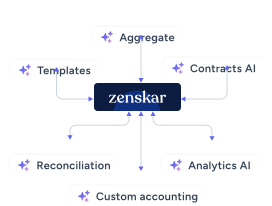
Zenskar’s AI-native architecture separates usage metering from revenue recognition. Contracts are modeled as objects on a graph, covering every pricing tier, amendment, and usage event, so pricing changes propagate without engineering. All financial computations run on deterministic logic. AI handles extraction and flagging. Humans supervise and approve. That’s the foundation the CFO checklist at the end of this article is built for.
Usage-based billing revenue recognition for token packs: the ASC 606 framework
This is the part most finance content skips and the one that will impact your next audit.
Deferred revenue is cash collected for services not yet delivered. As service is delivered, deferred revenue decreases and recognized revenue increases. Simple in principle. Token usage makes it complex at scale.
Here’s how token pricing with ASC 606 compliance applies:
- Per-token: Consumption-based revenue recognition applies here. Revenue is recognized as tokens are consumed. Clean in theory, but dependent on real-time usage data for accurate period-end reporting.
- Credit packs: Cash creates a deferred revenue liability. As credits are used, revenue is recognized at the rate of consumption.
- Breakage: Expired unused credits require proportional recognition, not a lump sum. Errors here create non-compliant spikes and distort growth.
- Contract modifications: Mid-period plan changes require reallocation of remaining revenue under ASC 606, adding complexity to recognition.
- CFO takeaway: Token pricing doesn’t change ASC 606. It increases transaction volume and complexity. At scale, manual reconciliation becomes a material misstatement risk.
Overages, expiry, and dunning: the finance edge cases no one talks about
Three scenarios that seem operational but directly impact P&L:
- Overage usage: When a customer exhausts tokens mid-cycle, what happens? Without automated overage logic (auto top-up, hard stop, or invoicing), you risk revenue leakage or customer escalations. Neither scales.
- Credit expiry: A $50,000 credit pack expires with $12,000 unused. Without clear terms and enforcement, this leads to support burden, churn risk, or revenue restatement, often all three.
- Dunning for variable invoices: Standard dunning assumes predictable invoices. A jump from $2,000 to $18,000 breaks that logic, creating friction and failed collections. Dunning, retry logic, and communication must reflect usage volatility.
Token pricing comparison matrix: what your finance stack must handle
The token pricing evaluation checklist for finance leaders
Before your next pricing review, test your current setup against these questions. Be honest:
- Can you attribute token costs to individual customers, features, and models, not just in aggregate?
- Does your finance stack distinguish input tokens from output tokens and apply different rates correctly?
- Is your deferred revenue balance for credit packs reconciled against actual token consumption at month end?
- Do you have a documented breakage methodology, and is it consistently applied across periods?
- When a customer hits an overage, does the system trigger automatically, or does someone have to catch it manually?
- Can you change a pricing tier or introduce a new model without an engineering sprint?
- Does your RevRec engine produce audit-ready documentation for every contract modification? Every AI-generated output in Zenskar requires human approval before it affects revenue schedules or triggers customer-facing action.
If more than two answers are "we handle that manually" or "I'd have to check," your finance stack is a liability, not just a gap.
See how Zenskar fixes it.
Book a demo to see Zenskar’s analytics in action.
Stop repricing every quarter. Build the infrastructure once.
The early repricing statistic isn’t proof that token pricing is broken. It shows that finance is often handed a model instead of helping build it.
What matters isn’t the model itself, but your ability to meter usage accurately, recognize revenue correctly, and adapt pricing without heavy engineering effort. Companies that get this right avoid constant fire drills and move faster on pricing experiments because the infrastructure is already in place.
Zenskar is built for this: AI-native revenue automation where agents execute, and humans supervise. It connects usage metering from any data source directly to revenue recognition, giving teams the flexibility to evolve pricing without reworking their data pipeline.
Read how Vertice saved 8 hours per month on manual billing using Zenskar’s automation solution.
By automating recurring billing with Zenskar, our billing cycle – which previously took 7–9 days – now closes in 2 days, saving 16-20 hours/month.

Frequently asked questions
Revenue is recognized as tokens are consumed, not when cash is received. Prepaid purchases create deferred revenue liabilities that must be tracked and reconciled. Expired credits require breakage accounting under ASC 606.
Customers buy credits upfront, which are deducted as tokens are used. Cash is recorded as deferred revenue and recognized over time as consumption occurs, per ASC 606.
Per-token pricing charges for volume processed. Per-action pricing charges for completed tasks. Per-action aligns with value but is harder to audit; per-token is simpler but less predictable for customers.
Pricing is often set early without finance alignment. As usage patterns, costs, and customer expectations evolve, companies adjust reactively. Strong revenue infrastructure reduces frequent repricing.
Focus on four questions: Can costs be tied to customers and features? Does the finance stack support proper revenue recognition? Can pricing change without engineering effort? Is metering audit-ready?


Stay Future-Ready with AI-Native Order-to-Cash
Zenskar scales with you - it's flexible, reliable, and enterprise-ready.
