

By the fourth night of close, the finance team has stopped debating precision and started debating credibility.
Usage data is pointing to one number. Billing reports suggest another. Sales is confident expansion will land next quarter, because it usually does. Product insists the pricing model is behaving exactly as designed. Somewhere between spreadsheets, dashboards, and hurried Slack messages, the forecast quietly shifts again.
No one is panicking. That is the problem.
When finance teams stop trusting the numbers, they do not raise alarms. They reconcile. They adjust. They explain. Over time, they learn to live with volatility that should never have been normalized.
This is not a failure of discipline or talent. It is what happens when a SaaS company’s monetization model evolves faster than the way the company is organized to run it. Pricing has become dynamic, technical, and inseparable from how value is delivered. Ownership of that system has not kept up.
The close week is simply when the cracks become visible.
When everyone owns a piece, no one owns the system
Product owns how value is packaged and perceived. Engineering owns how usage is measured and logged. Finance owns budgets, margins, and revenue recognition. Go-to-market teams own how pricing is communicated, discounted, and sold.
Everyone owns a piece. No one owns the system.
Now, when ownership spans too many functions, decisions turn into coordination exercises rather than execution, and this is where monetization accountability breaks down.
How pricing sprawls across functions
Each function is locally rational. Collectively, monetization becomes fragile.
What’s missing is convergence. A single operating layer that considers inputs from every function and maximizes revenue by aligning price to delivered value.
Platforms like Zenskar are built to support exactly this by acting as a shared revenue operations foundation, where contracts, usage, pricing rules, billing, and accounting logic converge into one consistent model instead of being stitched together across tools.
Why a Chief Monetization Officer is the logical answer
Earlier SaaS companies sold access. Let’s call this the software era, where pricing was per seat, per month, changes were infrequent and predictable, and finance assumed customer behavior would remain stable across quarters.
That assumption no longer holds.
Why monetization got so difficult
Today’s SaaS companies align on pricing based on consumption and outcomes like GPU minutes, workflows executed, automation runs completed, and savings delivered. This shift is also visible in models such as device-as-a-service, where businesses pay for ongoing access and management rather than simply purchasing hardware upfront. In parallel, the cost to serve each customer has become variable. GPU usage, API calls, and compute-intensive workloads mean gross margin now fluctuates by customer, by use case, and by behavior, not just by plan. Value is delivered continuously, and pricing impact follows in real time. A customer’s behavior on Tuesday can materially change what the finance reports at the end of the month.
Applying software-era ownership models to this new-age value-based monetization destroys velocity. Pricing slows before it breaks. Experiments stall because every change touches metering, billing, revenue recognition, and reporting. Launches slip because no one owns the end-to-end blast radius of a pricing tweak.
This is the moment that demands a Chief Monetization Officer (CMzO), someone explicitly accountable for monetization execution velocity. Usage-based and hybrid billing infrastructure makes this possible, shrinking cycle times from quarters to weeks.
The Chief Monetization Officer is an orchestral conductor
Some companies call this role a Chief Value Officer. Others refer to monetization leads or pricing heads. The label matters less than the mandate. What leading SaaS companies are converging on is the need for a single executive who owns the monetization system end to end.
Think of the company as an orchestra. The product supplies the instruments. Finance funds the performance. Engineering maintains the infrastructure. Go-to-market fills the seats. The CMzO ensures the entire system plays in sync.
Zenskar becomes the score everyone plays from, keeping pricing logic, usage data, billing, and revenue recognition aligned as the business evolves.
What the Chief Monetization Officer actually owns
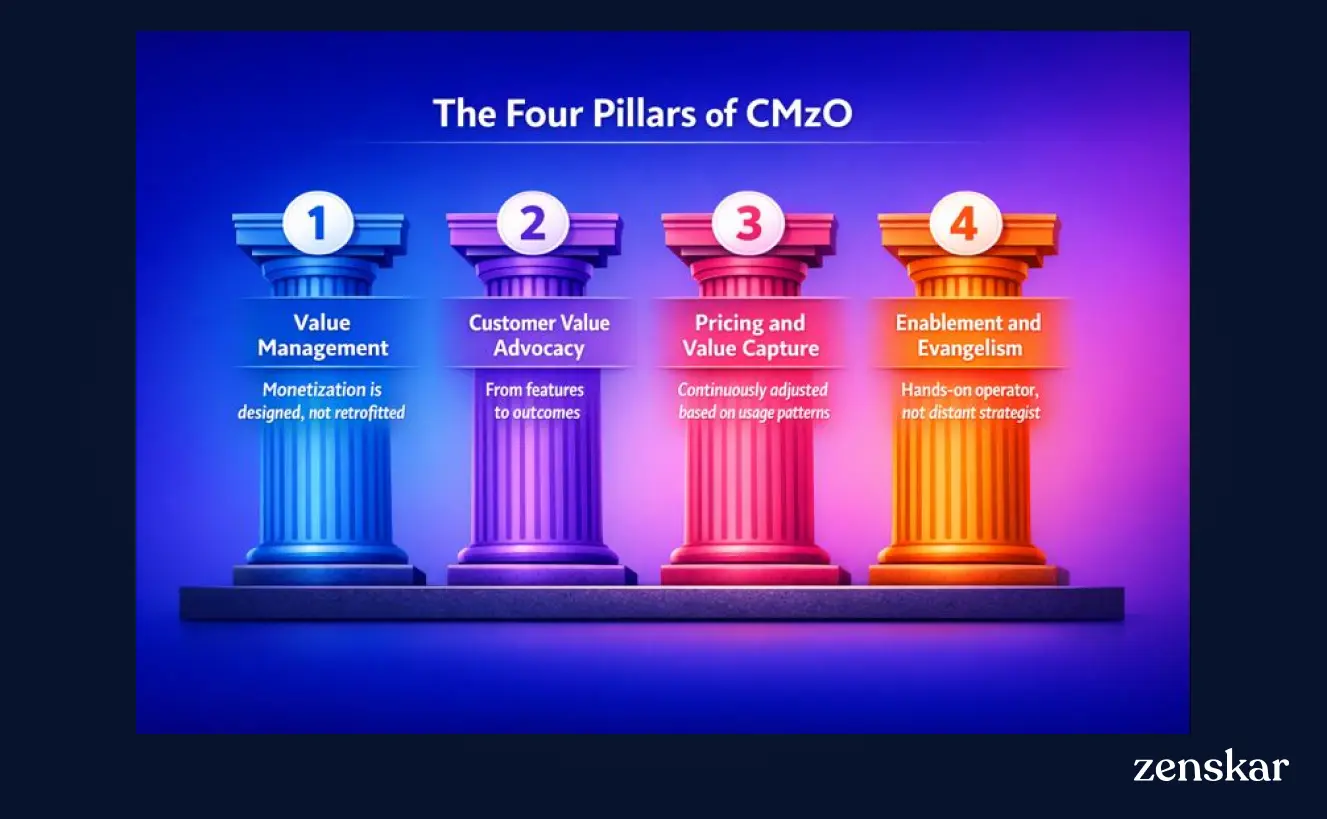
The most common misconception about the Chief Monetization Officer (CMzO) role is that it is about pricing decisions. However, it is more about owning the system that turns product value into durable, explainable revenue. These 4 pillars clearly define and prioritize a CMzO’s KRAs.
Pillar 1: Value management process ownership
The CMzO standardizes how value is defined across the company. What gets measured, what gets priced, and what gets reported are no longer separate conversations. No feature ships without a clear value metric.
Monetization is not something that is retrofitted. It is designed. A playbook for pricing changes and experiments is the norm rather than reinvention each time.
Why are systems like Zenskar becoming increasingly foundational? It's because value metrics, pricing logic, and revenue objects are within an enforceable layer, rather than scattered across documents and code paths.
The CMzO also owns the mechanics of expansion and contraction. The model is designed with upsell, cross-sell, and true-ups, while contraction and downgrades are consistently monitored as signals of value misalignment, not just churn risk.
Pillar 2: Customer value advocacy
The CMzO shifts go-to-market conversations from features to outcomes. Sales and customer success talk about economic value delivered, not abstract capabilities.
Pricing feels fair because customers can see the connection between usage, outcomes, and cost. Expansion discussions are grounded in actual value delivered, supported by real usage and revenue data.
Pillar 3: Pricing and value capture
When real usage patterns begin to emerge, pricing models are designed around willingness to pay and continuously adjusted. The CMzO owns monetization unit economics, including Average Revenue Per Unit/Account (ARPU/A) by pricing dimension, contribution margin by usage tier, and the profitability profile of each customer segment.
Do you want your pricing changes to flow cleanly through billing, revenue recognition, and have it all reported in one system? Look no further than Zenskar.
Pillar 4: Enablement and evangelism
Monetization moves out of decks and into daily operating habits. Shared scoreboards make metrics like net revenue retention, expansion, and time to value visible across product, finance, and go-to-market teams. The CMzO embeds as a hands-on operator, not a distant strategist.
Designing the Chief Monetization Officer role and system
This role only works when paired with the right system. Keep these principles in mind to make monetization an operating system that fits right into your existing ecosystem.
The ROI of a Chief Monetization Officer
If you really want to see the value of a Chief Monetization Officer, it will usually show up first in revenue quality, not just growth. So when monetization is end-to-end, value capture ends up becoming systematic instead of merely accidental. How does this show up? As cleaner revenue, lower reliance on discounts, tighter alignment between usage and billing, and fewer surprises at renewal.
Revenue and NRR impact
A Chief Monetization Officer is crucial in identifying under-monetized capabilities that many customers already rely on and then turning them into structured revenue, rather than just focusing on renewal negotiations. What happens then? Sales now enter renewals with ROI narratives, rather than just discount positions, and when prices increase, it becomes easier to defend because they are anchored in delivered value. Zenskar has proven to be ideal for surfacing expansion signals such as usage spikes, overages, and feature adoption, upsell, and cross-sell motions, which become data-led rather than opportunistic.
Speed and operational efficiency
Ownership eliminates pricing gridlock. Experiments ship in weeks instead of quarters because there is a single decision owner. Engineering is freed from hard-coded pricing changes as monetization logic moves into controlled systems. This means finance also gains real-time visibility into usage and monetization performance, in turn reducing forecast volatility and closing week pressure. If you are looking to support this velocity without breaking compliance workflows, Zenskar’s configurable pricing and revenue engine is ideal for making this happen.
Strategic resilience and investor confidence
When price is tightly aligned to delivered value, it creates a durable moat that is hard to replicate. Investors gain confidence seeing an owner accountable for both growth and discipline. Markets consistently reward SaaS companies that can predict revenue and margin accurately. Forecast credibility is a valuation lever, not just an internal hygiene metric. The combination of a Chief Monetization Officer and Zenskar’s finance-native infrastructure signals that monetization is an operating system, not a slide deck.
Appoint the owner and give them the system
Every SaaS company reaches a point where pricing feels risky, forecasts feel fragile, and expansion depends too much on negotiation.
At that point, the fix is not another pricing workshop or alignment meeting. It’s ownership.
Monetization needs a single accountable owner with the authority to design, implement, and evolve how value becomes revenue. Without that, pricing remains a coordination problem. With that, it becomes an operating capability.
Pair that ownership with the right system, and it will scale. Zenskar acts as the monetization command center, giving SaaS leaders a unified foundation to run hybrid pricing, usage models, billing, and revenue workflows without friction.
Request a demo today or take an interactive product tour and discover how Zenskar can help you operationalize monetization and turn pricing into a repeatable growth engine.
Frequently asked questions
A Chief Monetization Officer takes ownership of how a product’s value eventually turns into revenue, end-to-end. That can include a lot of things, such as defining value metrics, designing pricing models, and managing usage-based or hybrid monetization, while making sure pricing changes flow cleanly into billing, revenue recognition, and forecasting.
There is a big difference. A CRO focuses on demand generation and bookings, while a CFO focuses on reporting and compliance. A Chief Monetization Officer owns how pricing and usage models translate into predictable revenue across systems.
They may not need the title, but they do need the ownership. As soon as pricing includes usage, AI, or outcomes, someone must be accountable for monetization decisions and their P&L impact.
AI and usage-based models introduce variable consumption, nonlinear costs, and volatility. Without clear ownership, pricing changes slow down, and revenue becomes harder to forecast and explain.
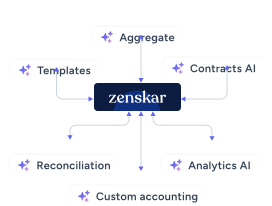
Zenskar provides the execution infrastructure that connects contracts, usage data, pricing logic, billing, revenue recognition, and analytics in one platform. This allows monetization decisions to become repeatable, measurable, and operationally safe.

By automating recurring billing with Zenskar, our billing cycle – which previously took 7–9 days – now closes in 2 days, saving 16-20 hours/month.

%20be%20truly%20invisible_.webp)
Stay Future-Ready with AI-Native Order-to-Cash
Zenskar scales with you - it's flexible, reliable, and enterprise-ready.
