
A Unified View for Your PLG & SLG Revenue
In the early days of our business, revenue felt like a fixed promise - sign a deal, send an invoice, get paid. But over time, it started behaving like water: trickling in, surging, and flowing through channels we never anticipated. What once seemed predictable became dynamic, messy, and increasingly opaque.
A big reason is the rise of product-led growth. According to Openview, more than 55% of SaaS companies now operate with a product-led growth (PLG) model. That means usage, in-product upgrades, and self-serve conversions all feeding into financial metrics that we used to reconcile in separate silos.
As a CFO, I’ve started to say: “If money grows inside your product, finance can’t just wait on contracts, we have to see it in real time”. To unlock the full potential of modern SaaS, we need a unified financial lens - one that captures usage, contracts, billing, and accounting as a single, living system.
In this blog, we’ll explore exactly how finance teams can build that lens and finally bring clarity to hybrid PLG + SLG revenue.
What is PLG and SLG, and how do they impact revenue recognition?
1. Product-Led Growth (PLG)
PLG is a go-to-market strategy where the product itself is the main driver of acquisition, retention, and expansion. Think freemium, self-serve trials, usage-based upsell, and users onboarding themselves. The product is the salesperson.
- Key characteristic: End users start using the product on their own (no sales rep), often through a free or low-commitment tier.
- Monetization model: Usage-based pricing, tiered freemium, or self-serve paid plans.
- Upsell dynamics: As users adopt more features or use more, they naturally expand - no high-touch sales required.
2. Sales-Led Growth (SLG)
SLG is the more traditional, high-touch model. You deploy sales teams, negotiate multi-year contracts, and engage in enterprise-level deal-making.
- Key characteristic: High-touch sales motion, often involving demos, negotiations, and long cycles.
- Monetization model: Fixed-period contracts (annual, multi-year), custom pricing, and committed usage.
- Upsell dynamics: Renewal conversations, expansion via account managers, and negotiated upgrades.
Why both matter and why do they complicate revenue recognition?
In modern SaaS, it's rare to be purely PLG or purely SLG. Many fast-growing companies run a hybrid motion: self-serve users on low ACV plans, and enterprise customers on large contracts. This hybridization brings major complexity to revenue recognition:
- Usage vs fixed commitments: PLG drives variable, metered usage, SLG drives fixed, contractual commitments.
- Multiplicity of performance obligations: A contract may bundle usage, support, onboarding, or service layers.
- Forecasting challenge: Usage is inherently lumpy, expansions unpredictable, and unbilled usage may accumulate.
- Compliance risk: Under accounting standards (ASC 606, IFRS 15), you must correctly identify performance obligations, estimate variable consideration, and allocate revenue which becomes more difficult in hybrid scenarios.
What are the top challenges in revenue recognition for mixed PLG and SLG models?
In a hybrid SaaS model, revenue doesn’t follow one predictable path. Usage can spike without warning, enterprise contracts shift mid-cycle, and self-serve upgrades happen without a sales rep involved. As CFOs, we quickly realize that billing, usage, and contracts tell different stories and revenue recognition sits right in the middle, trying to reconcile them.
1. Usage-based billing & tiered pricing
- Customers may pay for what they use, which means usage data has to feed into billing and accounting.
- Tiered plans (e.g., “up to 10K events,” “10K-50K,” etc.) lead to variable performance obligations.
2. Unbilled usage & accruals
- Usage that hasn’t been invoiced yet still creates a liability or revenue element and unbilled usage needs to be tracked meticulously.
- Without a clear ledger, you risk over or under-recognizing at period end.
3. Expansion, contraction, and upsell events
- Users may upgrade or downgrade on their own or usage may spike and then fall.
- These events must be captured, modeled, and recognized in real time.
4. Collection complexity
- Self-serve customers may churn without formal cancellation, leading to payment failures, retries, and invoice adjustments.
- Enterprise customers demand custom terms, credit risk analysis, and negotiated renewals.
5. Manual reconciliations
- If your billing, usage, CRM, and accounting softwares are siloed, reconciliation becomes manual, slow, and error-prone.
- During close, your team may spend days just validating usage, accruing unbilled revenue, and adjusting journal entries.
6. Regulatory and compliance risk
- ASC 606 and IFRS 15 force SaaS finance teams to estimate variable usage, identify obligations, and justify how revenue is allocated.
- Mistakes can lead to restatements, audit issues, and loss of investor confidence.
In short, hybrid PLG + SLG revenue isn’t hard because the math is complex, it’s hard because the data sits everywhere and changes constantly. If finance teams can’t bring these revenue streams under one unified lens, compliance becomes reactive, forecasting becomes speculative, and confidence erodes fast. The only sustainable model is one where usage, contracts, billing, and accounting are reconciled in real time.
Why are legacy revenue recognition systems broken for modern SaaS?
Finance can’t rely on static systems for revenue that moves dynamically with user behavior and mid-cycle contract changes. Without a real-time, unified model, every close becomes a workaround instead of a controlled, repeatable process. If you’re running a hybrid PLG + SLG business on legacy systems, here’s where things typically fall apart:
- Silo-ed tools: Separate billing, CRM, and accounting systems don’t speak a common language.
- Manual processes: Finance teams rely on spreadsheets, exports, manual cut-offs, and subjective assumptions.
- Latency: By the time you close and reconcile, product usage and contract changes may be stale or misaligned.
- Poor visibility: You lack self-serve dashboards. Product, sales, and finance don’t have one “single source of truth”.
- Fragile compliance: Without automated recognition logic, maintaining ASC 606/IFRS 15 compliance requires constant firefighting.
The risk isn’t hypothetical. Finance teams stuck in “single-motion” thinking, i.e., assuming revenue behaves like pure enterprise subscription or pure freemium are making avoidable mistakes. In worst-case scenarios, they may be non-compliant without even realizing it.
The future: Unified revenue recognition software - How does unified revenue recognition software like Zenskar bridge the gap?
When revenue becomes a workaround, it’s only a matter of time before accuracy, compliance, and investor trust start slipping through the cracks. Here’s where a unified revenue recognition software (like Zenskar) becomes a game changer.
1. What unified revenue recognition means
- Single data model: Combine PLG usage events, SLG contracts, billing data, CRM, and financial systems in one place.
- Automated recognition logic: Define configurable rules for performance obligations, usage ramps, tiered pricing, discounts, and variable consideration.
- Real-time, GAAP/IFRS-compliant reporting: Close faster, reduce manual adjustments, and maintain audit trails.
- Self-serve dashboards: Finance, product, sales, and operations leaders get tailored views, usage trends, revenue leakage, expansion signals, recognition status.
- Alerts & audit logs: Highlight anomalies (e.g., unexpected billing drops, churn risk, unrecognized revenue) and track why manual overrides were made.
2. How Zenskar bridges the gap:
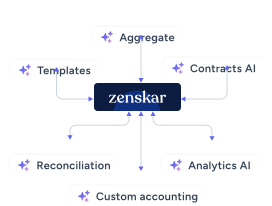
- Hybrid support: Designed to support both PLG and SLG revenue streams, no more disconnected silos.
- Custom logic: Use rules-based recognition for metered usage, thresholds, ramp-up periods, multi-year contracts, and micro-transactions.
- Real-time reconciliation: Usage events stream in, invoices generate, and revenue recognition entries post automatically.
- Compliance built in: Out-of-box support for ASC 606 / IFRS 15 constructs performance obligations, constraints, allocation, etc.
- Analytics for leaders: Product teams can monitor usage conversions, finance can track deferred vs recognized revenue, and executives can forecast with confidence.
In short: Zenskar helps you unify your revenue lens, so you no longer juggle disconnected processes or worry about misalignment or misreporting.
Practical implementation - Step-by-step framework:
Here’s a practical roadmap for implementing unified revenue recognition in a hybrid SaaS business:
Customer stories - What real results come from unified revenue recognition?
To illustrate, here are a couple of anonymized examples:
1. PLG-first SaaS (Usage-based)
- Reduced month-end close time by 50% (from 10 days to 5).
- Cut manual journal entries by 70%, dramatically lowering risk of error.
- Improved net revenue retention by recognizing expansion revenue earlier, fueling more accurate forecasts.
2. Hybrid SaaS (PLG + Enterprise) :
- Identified $200K in unbilled usage that hadn’t been captured before.
- Improved compliance: no more restatements like automatic ASC 606 allocations handled through recognition engine.
- Enhanced investor confidence: board and finance team now use a unified dashboard, reducing back-and-forth on metrics.
Ready for the new era of SaaS revenue?
Hybrid revenue isn’t just an accounting challenge anymore, it’s a business strategy challenge. When finance can’t see revenue clearly, neither can sales, product, or investors. Real clarity comes only when usage, contracts, and billing flow into one unified recognition model.
- PLG and SLG are not mutually exclusive. If you’re a modern SaaS business, you likely operate both.
- Traditional systems and silo-ed thinking won’t cut it anymore. Misalignment at close, forecasting errors, and compliance risk are real.
- Unified revenue recognition software is no longer “nice to have”: it's essential.
- With a platform like Zenskar, you can reconcile contracts and usage, automate recognition, and gain real-time insights without manual firefights.
- Implementation need not be painful - a structured, six-step approach helps you go live smoothly and confidently.
If you’re ready to simplify your month-end close, eliminate risk, and give your product, finance, and sales teams a shared lens into revenue. Request a demo today or take an interactive product tour to explore how unified revenue recognition can work for your business.

By automating recurring billing with Zenskar, our billing cycle – which previously took 7–9 days – now closes in 2 days, saving 16-20 hours/month.

Frequently asked questions
PLG (Product-Led Growth) is revenue driven by self-serve adoption, usage, and in-product upsells. SLG (Sales-Led Growth) is revenue driven by traditional contract and sales motion demos, enterprise deals, and negotiated renewals.
Because hybrid models generate both usage-based and contract-based revenue. Without a unified system, you will struggle to reconcile, forecast, and comply accurately. Silo-ed systems lead to manual reconciliation, risk, and ambiguity.
It unifies usage events, contract data, billing, and financial systems, and applies configurable recognition logic (thresholds, tiers, ramp-ups, etc.) to automatically create accounting entries and reports.
Under ASC 606/IFRS 15, companies must: identify performance obligations, estimate variable consideration, allocate transaction price, and decide over-time vs point-in-time recognition all of which become complex in hybrid PLG/SLG contexts.
For PLG: product-qualified leads (PQLs), free-to-paid conversion, usage expansion, net revenue retention. For SLG: annual contract value (ACV), sales cycle length, renewal rates, expansion bookings.
Stay Future-Ready with AI-Native Order-to-Cash
Zenskar scales with you - it's flexible, reliable, and enterprise-ready.
