
Mid-Contract Modifications & ASC 606: Revenue Recognition Rules

Every SaaS company deals with mid-contract changes. A customer adds seats. The product team gives an existing customer access to a new module. A renewal comes in six months early with a price adjustment attached.
Your sales team calls all of these upsells. Your billing system processes all of them the same way. But under ASC 606, each one triggers a question that changes when and how you recognize revenue: is this a new contract, or a modification of the existing one?
Get the answer wrong and you're recognizing revenue in the wrong period. At scale, across hundreds of contracts, that's not a rounding error. That's a restatement.
What follows is a practitioner guide to contract modification accounting under ASC 606 - the 2-part test your team should be running on every mid-contract change, the four scenarios SaaS finance teams encounter most, and what it looks like when your billing system handles the classification automatically.
What is a contract modification under ASC 606?
A contract modification is any change to the scope or price of an existing contract that both parties have approved. Under ASC 606-10-25-12, a modification exists when the change creates new enforceable rights and obligations between the customer and the vendor that weren't part of the original agreement.
In SaaS, contract modifications are more common than most finance teams realize. They show up as:
- A customer adding seats or licenses mid-term
- A product feature being added to an existing subscription at no charge
- A price increase applied before the original contract term ends
- An early renewal that changes SLAs, payment terms, or contract value
- A customer reducing scope or downgrading mid-contract
The reason contract modifications matter for revenue recognition is that the accounting treatment depends entirely on how the modification is classified. The same dollar value change to a contract can result in very different income statement outcomes depending on whether it qualifies as a new contract or a modification of the existing one.
Why do finance teams get this wrong?
The most common mistake is defaulting to one treatment for all mid-contract changes. Teams either treat every upsell as a new contract because it feels like a new sale, or treat everything as a modification because the original contract is still active. Neither approach is correct under ASC 606, and both create audit exposure.
The classification isn't a judgment call. It's a test with a specific outcome. And that test has two parts.
The 2-part test: New contract or modification?
Every mid-contract change your team processes should run through the same two questions. The answers determine the accounting treatment, and there's no room for interpretation once you have them.
Part 1: Does the modification add distinct goods or services?
A good or service is distinct if the customer can benefit from it on its own, or together with resources they already have, and if it's separately identifiable from other promises in the contract. In plain terms: could the customer have bought this separately?
Adding a new software module that's sold standalone is distinct. Giving a customer access to a feature that only works within their existing subscription is not.
Part 2: Does the price reflect the standalone selling price of those distinct goods or services?
If the modification adds distinct goods or services, the next question is whether the contract price for those additions reflects their standalone selling price. A seat added at the same per-seat rate as the original deal reflects SSP. A seat block negotiated at a significant discount below SSP does not.
Here's how the two answers map to accounting treatment:
The only path to new contract treatment is a yes on both parts. A single no sends you to modification accounting regardless of how the deal was structured or what sales calls it.
What happens if you skip the test?
Skipping the test doesn't eliminate the accounting consequence - it just means you've applied a treatment without knowing whether it's correct. According to Deloitte's Revenue Recognition Risk Assessment (2024), contract modifications account for 23% of all ASC 606 audit findings in SaaS companies, second only to variable consideration. Most of those findings aren't complex edge cases. They're teams that never ran the test consistently.
Treatment A: New contract (prospective) - when it applies and what it means
When a modification passes both parts of the test, distinct goods or services at an SSP-reflective price, you treat it as a new contract entirely. The original contract continues unchanged. The modification opens a separate accounting track.
In practice, this means:
- The original contract's RevRec schedule runs to completion without adjustment
- The modification is recognized as a new performance obligation with its own recognition schedule
- No reallocation of the original transaction price is required
- Revenue from the modification is recognized prospectively, starting from the modification date
What does prospective treatment look like in a SaaS context?
Take a customer on a 12-month, 50-seat subscription at $100 per seat per month. At month 6, they add 20 seats at the same $100 per-seat rate. The addition is distinct, the price reflects SSP, so the modification is a new contract.
The original 50-seat subscription continues recognizing $5,000 per month for the remaining 6 months. The 20-seat addition opens a new schedule recognizing $2,000 per month from month 6 forward. The two schedules run independently. No prior periods are touched.
This is the cleanest outcome. Your auditors see two clearly separated obligations with no reallocation, no catch-up entries, and a straightforward audit trail.
When does new contract treatment create problems?
The risk with new contract treatment isn't the accounting mechanics. It's misclassification. If a team applies new contract treatment to a modification that doesn't pass both parts of the test, they've deferred a catch-up adjustment that should have hit the current period. That gap compounds over time and surfaces as a prior-period error during audit.
Running the 2-part test consistently on every modification is the only way to ensure new contract treatment is applied correctly, not just conveniently.
Treatment B: Modification (cumulative catch-up or prospective) - the choice that matters most
When a modification fails either part of the test, you're in modification accounting territory. This is where the income statement impact gets real, because you now have a second decision to make: cumulative catch-up or prospective adjustment.
What is cumulative catch-up treatment?
Cumulative catch-up means you recast the original contract as if the modified terms had always been in place. The difference between revenue already recognized and revenue that should have been recognized under the new terms is recorded as an adjustment in the current period.
This approach is required when the remaining goods or services are not distinct from those already transferred. In practical terms, if the modification changes the nature of what the customer is receiving rather than simply adding to it, cumulative catch-up is the correct treatment.
The income statement impact is immediate. A single catch-up entry can accelerate or defer a significant amount of revenue into one period, which is why this treatment draws the most auditor attention.
What is prospective treatment for modifications?
Prospective treatment for modifications means you adjust the remaining recognition schedule going forward without touching prior periods. The remaining transaction price, including any new consideration from the modification, is reallocated across the remaining performance obligations and recognized from the modification date forward.
This treatment applies when the remaining goods or services are distinct from those already delivered, but the price does not reflect SSP, which is the scenario that catches most SaaS finance teams off guard.
How do you choose between the two?
The choice is not discretionary. ASC 606 prescribes which treatment applies based on the nature of the remaining performance obligations. Here is how the two treatments map to modification scenarios:
The distinction between these two treatments is not administrative. Applying prospective treatment when cumulative catch-up is required means revenue that should have been adjusted in the current period is instead spread across future periods. That is a misstatement, not a timing preference.
The 4 SaaS modification scenarios finance teams face most
The 2-part test is the framework. These four scenarios are where it gets applied in practice.
Scenario 1: Upsell at original discount rate. Both parts of the test pass. New contract treatment applies. The original subscription runs unchanged and the addition opens a new recognition schedule from the modification date. This is the scenario most teams get right because it feels like a new sale. It is.
Scenario 2: Upsell at higher discount. The seats are distinct, but the price doesn't reflect SSP. Part 1 passes, Part 2 fails. Modification treatment applies. Remaining transaction price is reallocated prospectively. This is the scenario most teams misclassify by defaulting to new contract treatment.
Scenario 3: Free feature add-on. The module isn't sold separately and fails both parts of the test. Cumulative catch-up is required. The original transaction price is reallocated to include the new performance obligation, with a current period adjustment for the difference.
Scenario 4: Early renewal with new terms. This requires controller review before any treatment is applied. The key question is whether the original contract terminates or continues with modified terms. The income statement impact varies significantly depending on that determination.
How to automate contract modification accounting
Running the 2-part test manually on every mid-contract change is workable at low contract volumes. At 50, 100, or 200 modifications a month, it becomes a close bottleneck and a source of inconsistent treatment across your portfolio.
The problem with manual modification review isn't that finance teams don't know the rules. It's that the rules require consistent application across every contract, every cycle, without exception. One missed classification is a potential audit finding.
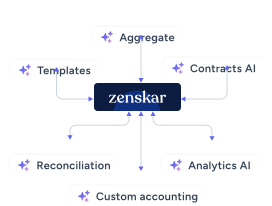
Zenskar's Contracts AI detects contract modifications as they're ingested, runs the ASC 606 2-part test automatically, and applies the correct accounting treatment to your RevRec schedule, including cumulative catch-up adjustments where required. When a modification requires controller review, such as an early renewal with changed terms, Zenskar flags it rather than forcing a classification.
The result is a modification review process that's consistent, auditable, and doesn't depend on your team catching every change manually.
In a recent webinar where we hosted Jill Hauck, she framed the core problem plainly: "Most controllers get the new contract vs. modification test backwards. They default to modification when the upsell at SSP is clearly a new contract under ASC 606."
Building the test into your billing system removes the default entirely. Every modification gets the correct treatment, with an audit trail that traces the classification back to the contract terms that drove it.
Conclusion
The 2-part test isn't complicated. Distinct goods or services, SSP-reflective price. Two questions, one outcome, no room for default assumptions.
What's complicated is applying it consistently across every mid-contract change your company processes, every month, at scale. That's where misclassifications happen, not because controllers don't know the rules, but because manual review doesn't scale.
Build the test into your modification review process. Better yet, build it into your billing system so it runs automatically on every change, every time, with an audit trail that proves it.
Book a demo today to see how Zenskar can help you modify mid contract terms.
By automating recurring billing with Zenskar, our billing cycle – which previously took 7–9 days – now closes in 2 days, saving 16-20 hours/month.

Frequently asked questions
It depends on two things: whether the added goods or services are distinct, and whether the price reflects their standalone selling price. Both must be true for new contract treatment to apply.
Cumulative catch-up adjusts revenue in the current period to reflect what should have been recognized under the modified terms. Prospective treatment adjusts the remaining recognition schedule going forward without touching prior periods.
Defaulting to one treatment for all mid-contract changes without running the 2-part test. Teams either treat every upsell as a new contract or every change as a modification, both of which create audit exposure.
Almost always yes. If the feature isn't sold separately and isn't SSP-reflective, it fails both parts of the test and requires cumulative catch-up treatment with reallocation of the original transaction price.


Stay Future-Ready with AI-Native Order-to-Cash
Zenskar scales with you - it's flexible, reliable, and enterprise-ready.
