
How to Handle Rollover Credit Policy Changes Under ASC 606

Your product team decides to give customers two extra months to use their credits. It sounds like a generous feature update.
For your finance team, when you extend the period over which a customer can consume purchased credits, you are changing the timing of your performance obligation. Under ASC 606, that change triggers a contract modification. And a contract modification means your revenue recognition schedule, for every affected contract, needs to be recalculated.
Most finance teams find out about rollover policy changes after the fact. The product decision gets made, the feature ships, and someone in accounting realizes three months later that the recognition schedules are wrong. At ten contracts, that is a painful manual fix. At a hundred, it is a material restatement risk.
What is a credit rollover policy under ASC 606?
A credit rollover policy defines whether unused credits purchased by a customer can be carried forward into a future period, and if so, for how long. Under ASC 606, the rollover policy directly affects the timing of your performance obligation, because it determines when the customer's right to consume the credits expires.
In a standard credit-based contract, a customer purchases a fixed number of credits upfront and consumes them over a defined period. If the policy is use-it-or-lose-it, unused credits expire at the end of the contract term and the performance obligation is fully satisfied at that point. If the policy allows rollover, the customer retains a future right to consume those credits and the performance obligation extends accordingly.
Why does the rollover policy matter for revenue recognition?
The rollover policy determines the contract period over which revenue is recognized. A $120 contract with no rollover is recognized over 12 months at $10 per month. The same $120 contract with a 2-month rollover provision is recognized over 14 months at $8.57 per month. Same contract value, same customer, materially different recognition schedule.
That difference affects your monthly revenue figures, your deferred revenue balance, and the accuracy of your income statement in every period the contract is active.
Does changing your rollover policy trigger a contract modification?
Yes, in almost every case. Under ASC 606-10-25-12, a contract modification exists when a change creates new enforceable rights and obligations between the customer and the vendor. Extending the period over which a customer can consume credits does exactly that. It creates a new right for the customer, the right to use credits beyond the original expiry, and a new obligation for you, the obligation to honor consumption in the extended period.
The modification trigger test for a rollover policy change has three questions:
- Does the change alter the timing of the performance obligation? If the rollover extension moves the credit expiry date forward, the period over which you satisfy the performance obligation changes. This is the most common trigger for rollover policy modifications.
- Does the change alter the amount of consideration allocated per period? Extending the contract period from 12 to 14 months reduces the monthly recognized revenue from $10 to $8.57 on a $120 contract. The total consideration stays the same but the per-period allocation changes materially.
- Does the change create a new enforceable right for the customer? A rollover provision gives the customer a right they didn't previously have. Under ASC 606, new enforceable rights created by a policy change constitute a modification regardless of whether a formal contract amendment is signed.
If any one of these three questions is answered yes, you have a contract modification on your hands.
What about policy changes that apply to all customers?
This is where rollover policy changes become operationally complex. Most product teams apply rollover policy updates universally across their customer base, not on a contract-by-contract basis. When that happens, every active contract with a credit component is affected simultaneously.
According to PwC's revenue recognition guidance, contract modifications that affect multiple contracts within a portfolio must be assessed individually unless the portfolio approach can be applied, meaning the contracts are sufficiently similar in terms and economics that a single assessment would not differ materially from individual assessments. For most SaaS companies with varied contract sizes and terms, individual assessment is the safer and more defensible approach.
The FASB's ASC 606 implementation guidance reinforces this point: a change in contract terms that creates new enforceable rights and obligations requires modification accounting regardless of whether the change was initiated by the customer or imposed by the vendor as a policy update.
How a 2-month extension changes your revenue recognition
This is the scenario Jill Hauck walked through in the webinar she hosted in collab with Zenskar, and it is the clearest illustration of why rollover policy changes are not a product decision.
The original contract:
Your team is recognizing $10 per month. Straightforward, auditable, consistent.
The policy change:
The product team decides to allow customers to roll over unused credits for two additional months. The contract effective period is now 14 months, not 12. The total contract value stays at $120. Nothing about the commercial arrangement changes except the period over which the customer can consume their credits.
Here is what that does to your recognition schedule:
The revised contract:
The total recognized is the same. The timing is not. From the modification date forward, monthly recognition drops from $10.00 to $8.57. If months 1 through 6 were already recognized at $10 before the policy change was communicated to finance, those periods may require assessment for restatement depending on materiality.
What is the income statement impact?
At the individual contract level, the difference is $1.43 per month. That is not material on its own. Across a portfolio of 500 contracts with average values significantly higher than $120, the cumulative impact of a policy change applied universally is a different conversation entirely.
This is why finance needs to be in the room before the rollover policy ships, not after. In a recent webinar where we hosted Jill Hauck, she put it plainly:
"Finance must be in the room when product changes a credit rollover policy. It's not a product decision. It's a contract modification with income statement consequences."
The example above covers one contract. The operational reality of a rollover policy change is that it applies to every active contract in your portfolio simultaneously. That is where the accounting problem becomes an operational one.
When a product team updates a rollover policy universally, your finance team faces three immediate tasks:
Identify every affected contract. Not every active contract may have a credit component. Not every credit-based contract may be affected equally depending on its original terms. Someone has to pull the full list, cross-reference contract terms, and confirm which agreements are in scope for the modification.
Recalculate recognition schedules from the modification date. For each affected contract, the remaining contract value needs to be spread across the revised term from the modification date forward. On a $120 contract modified at month 6, the remaining $60 is now recognized over 8 months at $7.50 per month rather than 6 months at $10.
Update deferred revenue balances. Every contract whose recognition schedule changes has a corresponding deferred revenue adjustment. Those adjustments need to flow through to your general ledger accurately and on time for the period in which the modification occurs.
How long does this take manually?
At 50 affected contracts, a skilled revenue accountant can work through the recalculations in a few days. At 500 contracts, you are looking at weeks of work, assuming no errors and no interruptions from the regular close cycle. At enterprise scale, a universal policy change applied manually is a material close risk.
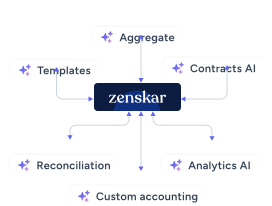
This is the problem Zenskar's Contracts AI is built to solve. When a rollover policy changes, Contracts AI identifies all affected contracts, recalculates recognition schedules from the modification date, and applies the updated treatment automatically across the entire portfolio. What takes weeks manually takes minutes.
Building a rollover policy change protocol for finance teams
The worked example and the retroactive challenge both point to the same root problem: rollover policy changes are being made without finance in the loop. The fix is a formal protocol that ensures every policy change is evaluated for its accounting impact before it goes live.
Here is what that protocol should include:
Step 1: Finance review before any policy change ships. Any change to credit rollover terms, expiry dates, or carry-forward rights must be reviewed by the controller or revenue accountant before the product team finalizes the decision. The review should answer three questions: does this change alter the timing of the performance obligation, does it affect the per-period revenue allocation, and does it create new enforceable rights for the customer?
Step 2: Modification trigger assessment. If any of the three questions above is answered yes, the change is a contract modification under ASC 606-10-25-12. Document the assessment, the conclusion, and the accounting treatment chosen before the policy goes live.
Step 3: Scope identification. Before the policy change takes effect, finance identifies every active contract in scope. This list should be generated from your billing or RevRec system, not assembled manually from a CRM export.
Step 4: Recognition schedule recalculation. For every contract in scope, the remaining recognition schedule is recalculated from the modification date using the revised contract term. Deferred revenue balances are adjusted accordingly.
Step 5: Documentation and audit trail. Every recalculation is documented with the original contract terms, the modification date, the revised terms, and the accounting treatment applied. This documentation is your first line of defense in an audit.
The protocol does not need to be complex. It needs to be consistent and it needs to run before the policy ships, not after.
Automating rollover credit RevRec
The protocol above tells your team what to do. Automation determines whether your team can actually do it at scale without it consuming your entire close cycle.
Manual recalculation of recognition schedules across a large contract portfolio is correct in theory and unsustainable in practice. At low contract volumes, the protocol works. As your portfolio grows, the same process that took two days at 50 contracts takes three weeks at 500, with compounding error risk at every step.
The operational challenge is not understanding the accounting treatment. It is applying it consistently across hundreds of contracts, within the same close cycle the modification occurs in, without a dedicated team of revenue accountants working exclusively on the recalculation.
How Zenskar handles rollover policy changes at scale
When a policy change is logged in Zenskar, Contracts AI identifies every affected contract, recalculates recognition schedules from the modification date, adjusts deferred revenue balances, and generates the corresponding journal entries automatically, all within the same close cycle.
The audit trail is built in. Every recalculated schedule is traceable back to the original contract terms, the modification date, and the policy change that triggered the update. When your auditors ask why 400 recognition schedules changed in the same period, the answer is one report, not four weeks of manual reconstruction.
For finance teams managing credit-based or token-based products, this is the difference between a rollover policy change being a one-day finance event and a three-week close disruption.
See how Zenskar's Contracts AI handles a portfolio-wide policy change in the interactive demo, or book a demo to walk through your specific contract structure with the Zenskar team. If you want to go deeper on related scenarios first, the minimum commitments and unused capacity guide covers the breakage and carry-forward treatment that often sits alongside rollover credit structures.
Book a demo today to see how Zenskar handles rollover credit policy changes across your entire contract portfolio automatically.
By automating recurring billing with Zenskar, our billing cycle – which previously took 7–9 days – now closes in 2 days, saving 16-20 hours/month.

Frequently asked questions
A credit rollover policy defines whether unused credits can be carried forward into a future period and for how long. Under ASC 606, the rollover policy directly affects the timing of the performance obligation and therefore the period over which revenue is recognized.
Almost always yes. If the change alters the timing of the performance obligation, affects the per-period revenue allocation, or creates new enforceable rights for the customer, it constitutes a contract modification under ASC 606-10-25-12.
Prospective treatment from the modification date in most cases. The remaining contract value is spread across the revised term from the modification date forward. Prior periods are not restated unless the impact is material.
On a $120 contract recognized over 12 months at $10 per month, extending the term to 14 months reduces monthly recognition to $8.57 from the modification date forward. The total recognized remains $120, but the timing across periods changes materially.
Yes, before the decision is finalized. By the time a rollover policy ships, the modification trigger has already occurred. Finance involvement after the fact means recalculating recognition schedules retroactively rather than planning for the change in advance.


Stay Future-Ready with AI-Native Order-to-Cash
Zenskar scales with you - it's flexible, reliable, and enterprise-ready.
