
Types of Pricing Models and How to Find the Right One

Every pricing model creates two realities. One is designed for the market by the pricing committee. The other is made to the general ledger, and finance sees the consequences at quarter-end.
Why does an account with record usage sometimes post your worst gross margin? Why can a volume discount, designed to reward growth, shrink an invoice in the month a customer grows? And why do so many pricing changes that win in the market stall in the close?
The answers sit in the pricing model itself. It decides whether the forecast you defend to the board rests on signed contracts or on behavior you cannot see yet, whether your largest customer is your most profitable or your most expensive, and how much revenue lives in the billing system rather than in a reconciliation file which only one analyst understands.
Typically, Pricing and RevOps leaders design these models. Finance signs off, bills, and recognizes revenue under them for years. This guide reads pricing models from that second seat.
What are the different types of pricing models?
The common pricing models are flat-rate subscription, per-feature, seat-based, tiered, volume, usage-based (pay-as-you-go), credit-based, outcome-based, freemium, and hybrid.
The list misleads because its items are not alternatives. “Tiered” says nothing about the unit priced, and “usage-based” says nothing about when the customer pays.
Zenskar’s three-decision pricing framework untangles them.
- What do you charge for? Access, seats, usage, credits, or outcomes.
- How does price scale? Flat, graduated tiers, volume tiers, or a free entry tier.
- How is the contract structured? Terms, ramps, milestones, commitments, and bundles.
Hybrid pricing is a set of answers drawn from more than one decision. Zenskar is built on the same separation, so changing tier logic doesn’t require a rebuild of contract terms.
Should you charge for seats, usage, credits, or outcomes?
Charge for the unit that rises with both customer value and your cost to serve. When the two diverge, someone absorbs the gap, and every model ultimately determines who bears the difference.
Seat-based and flat-rate pricing leave the gap with you, and AI product pricing makes that gap expensive. In Kyle Poyar’s 2026 State of B2B Monetization survey of 230 software and AI companies, the median target gross margin for AI products was about 50%. Yet, in Poyar’s experience, the top 10% of power users account for more than 70% of token consumption. Under seat pricing, those customers can consume far more than they pay for, leaving you to absorb the difference.
Usage-based pricing, like OpenAI’s per-token API, hands the cost to the customer. ASC 606 allocates each usage fee to the period it relates to, so revenue is recognized as usage occurs. The risk moves to FP&A, which now forecasts from consumption curves instead of signed bookings. Credit-based pricing collects cash up front while revenue still follows consumption.
Outcome-based pricing can look like usage pricing, but the accounting can differ. Intercom’s $0.99 per Fin outcome is a fixed fee for each completed event, so the amount is known at delivery. When you charge based on a share of the savings delivered, the fee is not known until those savings are measured and agreed. Under ASC 606, variable consideration is constrained until it is probable that a significant revenue reversal will not occur, so recognized revenue can trail delivery by months.
Key insight: Ask for gross margin by customer decile under the proposed model. A model that looks healthy on average can lose money on the very accounts that sales is most excited about.
Choosing the unit is half the decision. The other half is how its price moves as customers buy more.
How should price scale as customers grow?
Price per unit should fall as customers grow, but gradually enough that every extra unit still adds revenue. Graduated tiers do this best for most B2B products. Volume pricing suits deals built on a committed annual volume, and a flat rate suits products whose unit cost does not fall with scale.
Graduated tiers price each band of units at its own rate, while volume pricing charges every unit at the rate of the highest band reached.
The first 500 units cost $1, units 501 to 1,000 cost $0.80, and anything above 1,000 costs $0.60. At 1,500 units, graduated tiers bill $1,200 and volume pricing bills $900. Under volume pricing, 1,000 units bill $800 and 1,001 units bill $600.60. The customer bought one more unit and paid $199.40 less.
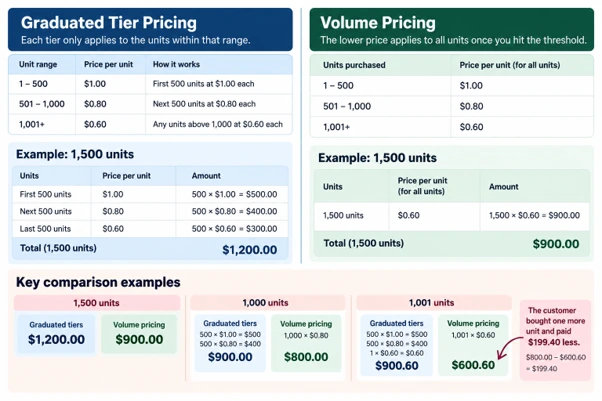
Tier design can inflate your NRR (Net Revenue Retention) forecast. As customers grow into cheaper pricing tiers, their revenue per unit falls. Forecasting expansion at today’s price can therefore overstate ARPU (Average Revenue Per User) or ACV (Annual Contract Value). For example, if we project 1,000 units to be sold, the forecast should calculate 500 units at $1.00 and the next 500 units at $0.80, rather than applying today’s price to all 1,000 units.
Key insight: Retrospective volume discounts can reprice units already billed once a threshold is reached. Finance therefore has to estimate the expected discount upfront and update revenue as the customer’s expected volume changes. Shorter measurement periods can limit that exposure. Discounts on future purchases can also create a material right when they are incremental to what that class of customer would normally receive, requiring part of today’s transaction price to be deferred until the option is exercised or lapses.
A tiered pricing strategy usually layers unit tiers under packaged editions, such as HubSpot’s Starter, Professional, and Enterprise, with freemium as a zero rung justified only by freemium-to-paid conversion. Revenue automation platforms like Zenskar configure graduated, volume, and package tiers on the same metered usage data, so finance can configure either tier type on the same usage data.
The price schedule settles what a customer owes. The contract settles when they pay it, and when you may call it revenue.
How should the contract be structured over time?
The contract determines when you bill, when cash comes in, and when revenue is recognized. The wider the gap between those three, the more reconciliation work it creates for finance at close. Structure the contract around how the customer will adopt the product and when you need the cash.
Use ramps for customers growing into a deal
Ramp pricing works only when pricing increases in a non-cancellable contract while the service stays the same. A non-cancellable three-year subscription billed at $100,000, $200,000, and $300,000 would generally be recognized evenly at $200,000 a year under ASC 606. Year one’s $100,000 of unbilled revenue is a contract asset, which unwinds in year three. If the customer can cancel annually, or later years add services, revenue tracks each year’s billing.
Use prepaid commitments or credits for unpredictable usage
Prepaid commitments and credits give the customer budget certainty and give you cash up front. That cash sits in deferred revenue and is recognized as the customer consumes it, which is the basis of consumption-based revenue recognition. A minimum commitment is usually recognized over the term, with shortfalls invoiced at true-up and overage above it. Credits that expire unused, known as breakage, need a policy agreed in advance. If you can reliably estimate them, recognize them gradually alongside usage, and otherwise wait until use becomes remote.
Use milestones for heavy implementations
Milestones fit deals with heavy implementation, such as a payment at go-live, though revenue still follows the services delivered rather than the milestone dates.
Use bundles for multi-product deals.
The bundle price, including any discount off list price, is spread across products in proportion to their standalone selling prices.
Each structure asks billing and revenue to run on separate clocks. Zenskar keeps them separate by design, decoupling revenue accounting and credits from billing, generating performance obligations from the contract, and applying discounts at the product, bundle, or contract level.
How do you choose the right pricing model for your business?
Choose a pricing model by weighing these four factors and then confirming finance can bill and recognize revenue under it without spreadsheets.
- COGS structure. Compare the cost of serving your heaviest customer with a typical one. If the gap is wide, as with AI inference, charge for usage, credits, or a hybrid so revenue rises with cost. If it is narrow, seats or flat pricing keep billing simple.
- Value metric. Pick a unit the customer already uses to judge value, such as users, transactions, or resolved tickets. Both sides must count it from the same data, or outcome pricing ends in invoice disputes.
- Usage variance. Check how much usage swings between customers and months. High variance makes pure usage revenue hard to forecast and hard to budget, so add a base fee or minimum commitment underneath.
- Sales motion. Product-led buyers purchase without talking to anyone, so pricing must make sense at a glance. Sales-led deals can carry commitments, ramps, and bundles.
The final check is the one most guides skip. Can finance bill and recognize revenue under this model without spreadsheets?
Why is hybrid pricing the default pricing for AI products in 2026?
Hybrid pricing pairs a platform or seat fee with usage above an included allowance, often under a prepaid commitment. It is now the most common structure, used by 37% of companies in Poyar’s survey, up from 25% a year earlier.
For AI products, it settles both problems above. The base fee gives you a revenue floor forecastable from bookings, and usage carries the inference cost. In the seat-based vs usage-based decision, hybrid is the safer first step, because you learn consumption curves before betting the forecast on them.
For a closer look at how AI companies are packaging agents in practice, watch Zenskar’s session on pricing and packaging strategies for AI agents.
How do you change pricing models without disrupting revenue?
A pricing model migration protects revenue when it is staged and timed to renewals. To change pricing models without disrupting revenue, follow these four steps:
- Shadow-bill the new model against a year of historical usage to size revenue at risk by cohort.
- Grandfather existing customers with a firm sunset date.
- Migrate at renewal, not mid-term.
- Run both models in parallel until the sunset date.
A migration plan only works if your systems can support both models at once. Old and new price books need to run side by side, usage data must keep flowing, and revenue must follow the contract, not the invoice. When they cannot, the work falls back on finance and the close absorbs it.
This is the finance test for any pricing model. Can the commercial terms be translated into billing and revenue rules without creating a parallel process for finance? That is what Zenskar is built for. Pricing and contracts can be configured without engineering or workarounds, while metering stays separate from pricing, and revenue accounting from billing. A new tier, ramp, or credit model can therefore change without disrupting everything downstream. iink Payments, for example, moved from a capped fee on every check to tiered subscriptions with usage-based overages, launched the new plans with zero engineering tickets, and shifted 15% of revenue to predictable subscription revenue in its first full month.
Book a demo to see how Zenskar’s AI-native revenue automation can configure your pricing model while keeping every invoice and revenue schedule accurate and audit-ready as your pricing evolves.


By automating recurring billing with Zenskar, our billing cycle – which previously took 7–9 days – now closes in 2 days, saving 16-20 hours/month.

Frequently asked questions
The main pricing models are flat-rate subscription, per-feature, seat-based, tiered, volume, usage-based, credit-based, outcome-based, freemium, and hybrid pricing. Each answers one of three questions, what you charge for, how price scales as customers grow, or how the contract is structured.
The four main pricing methods are cost-plus, competition-based, value-based, and dynamic pricing. Cost-plus adds a margin to cost, competition-based follows the market, value-based reflects customer benefit, and dynamic pricing moves with demand. Methods set how much you charge, while models set how.
Start with your cost to serve and the unit customers use to judge value, then weigh how much usage varies and whether you sell product-led or sales-led. Before approving a model, confirm finance can bill and recognize revenue under it without spreadsheets.
The most common SaaS pricing models are seat-based pricing, packaged good-better-best tiers, usage-based pricing, and hybrid pricing. Hybrid, which combines a subscription or platform fee with usage or credits, is now the most widely used model across B2B software and AI companies.
Usage-based pricing defines what you charge for, which is consumption. Tiered and volume pricing define how the unit price changes as consumption grows. Tiered pricing charges each band at its own rate, while volume pricing charges every unit at the highest band’s rate.



Stay Future-Ready with AI-Native Order-to-Cash
Zenskar scales with you - it's flexible, reliable, and enterprise-ready.
