.svg)
.svg)
.svg)
About iink Payments
Founded in 2017 and headquartered in Tampa, iink Payments is a digital payments network built for the restoration industry, helping contractors and restoration professionals get paid faster after insured property losses by digitizing the endorsement, processing, and disbursement of claim checks.
Rob Brenan is the Head of Finance of iink. He leads the finance function end-to-end. Ken Schweickert is Head of Product, overseeing the product decisions that govern how usage, invoicing, and contracts are implemented day to day.
iink's Pricing Structure Before Zenskar
A Flat Percentage Fee, Capped at a Maximum
For most of its history, iink billed customers a flat percentage of every check it processed, capped once the check got large enough. It was easy to explain, easy to apply, and it scaled cleanly as check volume grew. The model worked. But it was not flexible.
Every change to the percentage, the cap, or a new fee type meant a code change, which meant pulling an engineer off the roadmap to ship a pricing tweak. Rob had wanted to add a subscription component for years, but the engineering cost kept pushing it down the list.
Five Pricing Tiers With Multiple Fee Types
iink's pricing has five tiers, from Basic up to Enterprise, each combining these pieces a little differently:
- A platform fee is paid monthly or annually and includes a set number of check submissions
- Submit more than that in a month, and each additional check is billed individually
- Checks tied to a mortgage company carry a separate fee, a percentage of the check's value capped at a set maximum, under their own product called iink Lender Endorsed
- Annual plans come with a discount and a larger included volume compared to monthly plans
Manual Invoicing and Revenue Recognition Process
Rob and his team had built a reliable process for collecting fees and getting invoices out. Some fees were deducted directly from claim disbursement. Other payments were made through Stripe. Still others were collected into a month-end query and pushed into iink's ERP through a script.
But as Rob and Ken prepared to layer subscriptions and tiered overages on top of an already multi-part fee structure, they realized it was the right moment to bring in a platform that could carry that complexity natively, so pricing could evolve without an engineering ticket attached to it every time.
Evaluating and Choosing a Billing Platform
Evaluation Timeline
The iink team first scoped the idea well before it was ready to commit. The project went quiet for a stretch while the engineering bandwidth shifted to other priorities.
When the team picked the search back up, they came back with more clarity, and a firmer sense of what iink actually needed.
Why iink Chose Zenskar
Pricing decoupled from the product entirely, so tiered subscriptions, overage rates, and new fee types could be configured without a single line of new code, the core reason iink went looking for a new platform in the first place. Near real-time usage tracking through the API, so customers could see their own usage close to the moment it happened, not on a delayed batch sync. And a Stripe-native setup paired with a dedicated implementation engineer working directly with iink's team, rather than a generic onboarding queue. The final decision went through Rob and Ken, with the board briefed along the way.
Implementing Zenskar
Usage Data Integration via API
Ken weighed two ways to get usage data into Zenskar:
- A direct connection to iink's Postgres and Snowflake warehouse,
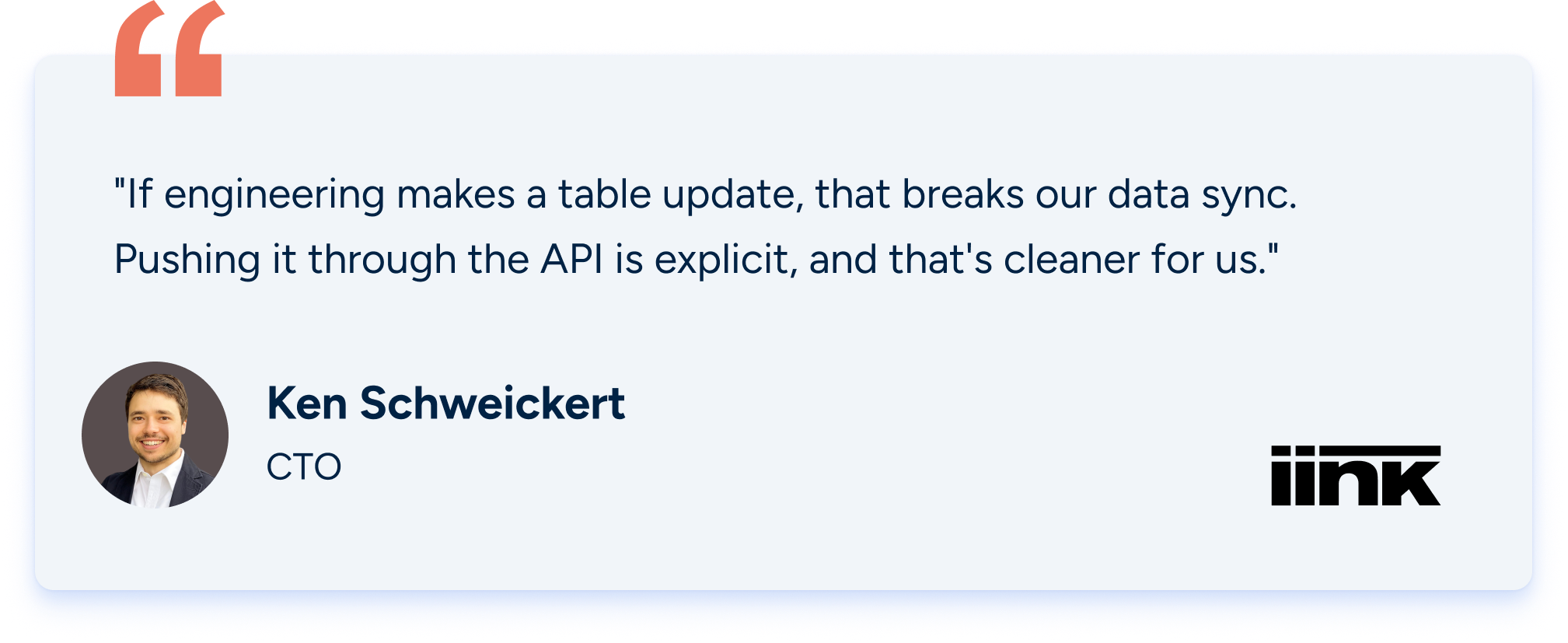
- Or pushing usage events to Zenskar's API directly as they happened.
He chose the API. The choice kept Ken's team in control of exactly what was sent and when, and made it straightforward to validate the data before each billing run.
Migrating Customers on Stripe
iink team kept full control of how its customers were created in Stripe, with Zenskar attaching to each one by Stripe ID rather than creating new records from scratch. The entire existing customer base carried over without a single ID conflict, with auto-charge on invoice send and payment retries wired in from day one.

A Custom Invoicing Endpoint Built for iink
iink’s billing workflow had an edge case that didn't fit the standard product: generating an invoice on demand, tied to a specific usage event rather than a billing calendar. Rather than asking Ken's team to redesign its workflow around the platform, the Zenskar implementation team built a dedicated endpoint to match how iink already worked.

Billing and Revenue Operations Today
Tiered Overages Decoupled From the Codebase
Tiered overages, the thing Rob had wanted for years before he ever found Zenskar, are now fully decoupled from iink's product and data layer. The platform subscription, real-time payment processing, and per-check fees, including iink Lender Endorsed, all run through Zenskar on their own contract structures.
Self-Serve SQL Reporting for Finance
With direct access to the underlying tables, Rob can write his own SQL and answer most finance questions without waiting on anyone.
Manual Billing Exceptions Handled In-House
Outside the standard rollout, both Rob and Ken can build and adjust manually negotiated billing setups directly inside Zenskar, treating it as a tool finance can use on its own rather than a system only engineering can touch.
The Impact
435 Subscriptions Live, Up From Zero
At kickoff, iink had no subscription product running on Zenskar. By the mid-implementation review, 435 subscriptions were live, with roughly 400 already billed successfully.
15% of Revenue Shifted to Predictable, Contracted Subscriptions
In iink's first full month with subscriptions live, 15% of total revenue shifted from transactional processing fees to contracted, predictable subscription revenue, without any change to the underlying per-check fee that had carried the business for years.
That shift came entirely from layering subscriptions on top of an already-running revenue stream, not from raising prices on existing volume.
New Plans Launched With 0 Engineering Tickets
Within weeks of the first launch, Rob and Ken had enough confidence in the new structure to roll out a second batch of plans for newly signed customers, entirely on iink's own schedule.
That's the direct payoff of decoupling pricing from the codebase: a new tier or fee structure ships when finance decides it should, not whenever engineering has room on the roadmap.