You said yes to AI. The numbers are coming out. But when someone asks you to walk through the logic behind an automated result, you hesitate, because you're not sure you can.
That's the Trust Gap. It's not a technology failure. It's the distance between what your system produces and what you're willing to put your name on. It's why the shadow spreadsheet never actually disappears.
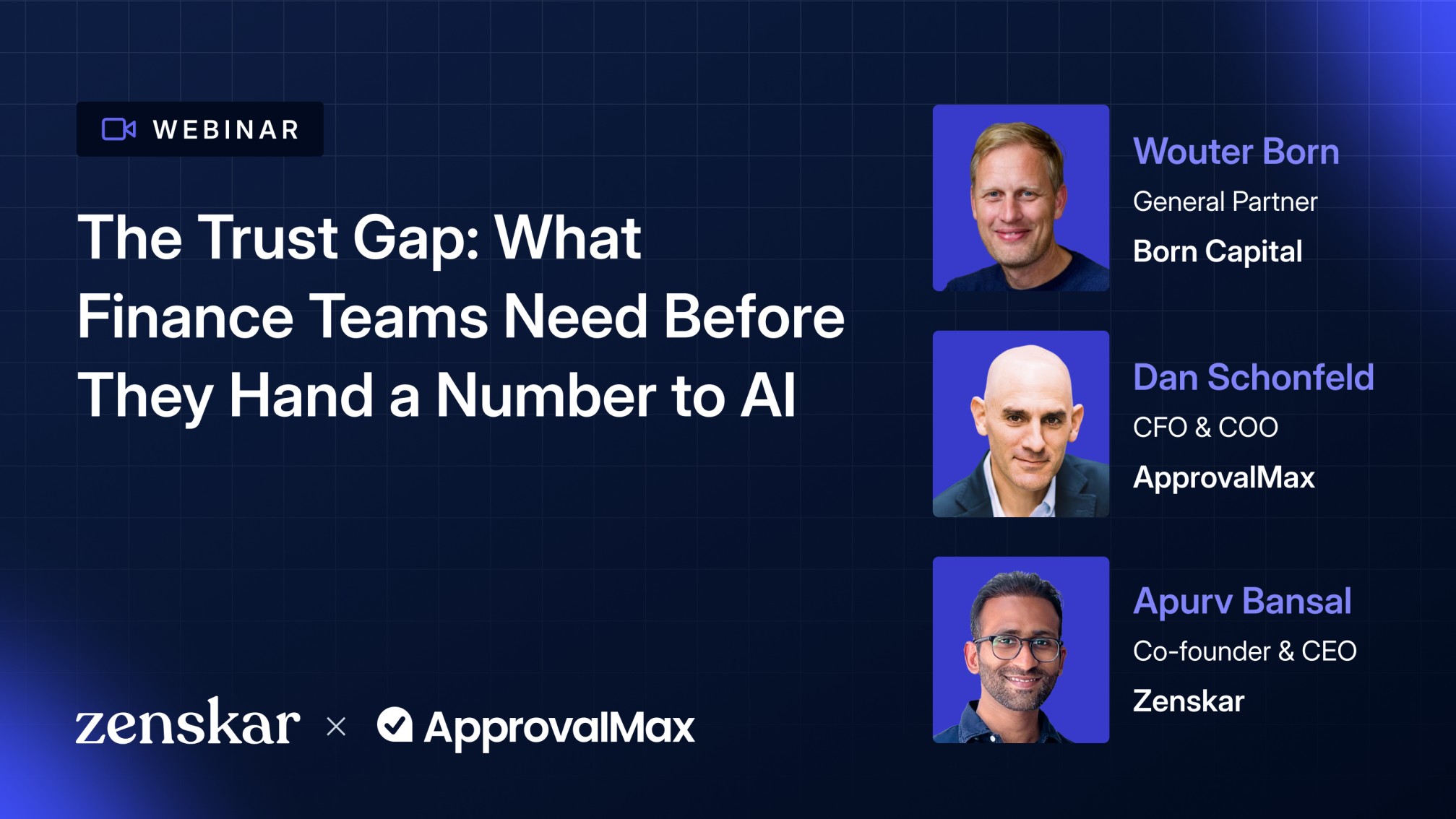
This panel brings together three people who understand that gap from opposite sides: a CFO who signs off on automated outputs every quarter, a market expert who tracks AI adoption across hundreds of finance teams, and the founder who had to build trust into a product that CFOs stake their reputation on. They'll cover the three conditions that separate AI that gets fully adopted from AI that stays stuck in a pilot.
What You'll Learn
- Why AI adoption in finance keeps stalling — and what the real barrier is when the tools aren't the problem
- The three conditions for trusted AI output: clean data architecture, a human checkpoint that actually means something, and results you can explain to an auditor
- How to design review workflows that preserve accountability without turning every sign-off into a bottleneck
- What you need at your fingertips when a board member asks you to walk through the logic behind an automated number
Meet the Panel
Wouter Born
General Partner, Born Capital | Founder, CFOOffice.io LinkedIn
GP at Born Capital, where he has backed 17 CFOTech companies reshaping how finance teams operate — from AI-driven AP automation to autonomous forecasting. He co-founded CXO Software (acquired by insightsoftware) and brings two decades of experience building and investing in the category. His newsletter, CFOOffice.io, is read by more than 11,000 CFOs tracking how AI is redefining the finance function.
Apurv Bansal
Co-founder and CEO, Zenskar LinkedIn
Co-founder and CEO of Zenskar, a Bessemer-backed AI-native revenue automation platform for B2B companies. He built Zenskar to solve the order-to-cash problem at scale and has spent years in direct conversation with CFOs about what it takes to earn their trust in an AI system — not just technically, but operationally.
Dan Schonfeld
CFO and COO, ApprovalMax LinkedIn
CFO and COO at ApprovalMax, with 15+ years scaling SaaS and tech companies from Series A through profitable growth. An MIT-educated operator, he partners with founders and boards on building data-driven finance functions, improving unit economics, and steering companies through funding rounds and strategic exits. His take on what trips up most finance teams: "It's not the numbers. It's explaining the decisions behind them."
Who Should Attend
CFOs, controllers, and finance leaders at B2B companies:
- Automating the close but still running a shadow spreadsheet because something feels unresolved
- Signing off on AI outputs without being fully confident you could explain them if asked
- Caught between pressure to move faster on AI and accountability when something goes wrong
- About to defend automated results to an auditor, board, or investor for the first time
Learning Objectives
- Identify the three conditions required for AI-generated financial outputs to be trusted for executive review and sign-off.
- Evaluate architectural requirements for data integrity in automated finance systems, including data lineage, real-time synchronization, and a single source of truth.
- Recognize effective human-in-the-loop checkpoint designs that preserve accountability without creating operational bottlenecks.
- Discover an auditability framework to assess whether existing AI outputs meet the defensibility standards required for board and auditor review.
- Field of Study: Information Technology
- Program Level: Overview
- CPE Credit: 1.0
- Delivery Method: Group Internet Based
- Prerequisites: None
- Advanced Preparation: None
NASBA Sponsor
Encoursa is registered with the National Association of State Boards of Accountancy (NASBA) as a sponsor of continuing professional education on the National Registry of CPE Sponsors. State boards of accountancy have final authority on the acceptance of individual courses for CPE credit. Complaints regarding registered sponsors may be submitted to the National Registry of CPE Sponsors through its website: NASBAregistry.org.