
Usage ARR

TL;DR
- UARR is the annualized value of recurring revenue a SaaS business earns through customer usage rather than fixed subscription fees.
- Finance teams calculate UARR by normalizing the predictable portion of usage revenue.
- UARR does not replace ARR. In hybrid pricing models, the two sit side by side: ARR captures access, UARR captures activity.
Understanding UARR and its significance for SaaS
As SaaS pricing shifts from seat-based models toward consumption-driven structures, traditional ARR alone no longer captures the full recurring revenue picture.
Customers increasingly pay for outcomes rather than access: workflows executed, API calls made, model runs completed. This revenue fluctuates but follows predictable patterns. UARR captures that recurring usage layer and annualizes it. Without it, a growing share of recurring revenue remains invisible in standard financial reporting.
Rather than replacing ARR, UARR exists alongside it. In hybrid pricing models, the subscription portion of ARR locks in at contract signing. Usage revenue unfolds based on how and when customers engage with the product. UARR is how companies make that usage layer visible and comparable to contracted subscription revenue.
Types of revenue that can fall under UARR
Not all usage revenue qualifies as UARR. Only recurring, repeatable streams that demonstrate predictable behavior belong here. Common examples include API-based billing tied to transactions or inference requests, compute consumption from model runs or data pipelines, contracted minimum usage commitments, recurring overage patterns that repeat consistently across billing periods, and prepaid usage drawdowns that renew on a scheduled basis.
Another practical threshold is if the month-over-month usage variation stays within 20 to 25 percent over the trailing six months, the revenue stream qualifies as UARR. Variation beyond that range should be treated as variable revenue and reported separately until a stable pattern is established.
How to calculate Usage-based ARR
Unlike subscription ARR, which is determined at contract signing, UARR is calculated by identifying the predictable consumption baseline and annualizing it. The challenge is less the mathematics and more the data infrastructure: you need billing systems, usage metering, and contract data that cleanly separate recurring usage from one-off activity.
There is no single standard formula. The most common approaches used by SaaS and cloud companies are:
- Last month's GAAP revenue × 12: best for stable, low-variance monthly usage
- Last quarter's GAAP revenue × 4: most widely used; smooths short-term volatility
- Trailing 12-month revenue × 1: best for slower-growth or seasonal businesses
In all three cases, use realized GAAP actuals, not forecasted usage. Actuals are the only defensible input for investor scrutiny. There is no industry-standard definition. What matters is that your methodology is consistent, documented, and communicated to investors.
The key distinction is that UARR is not a ceiling on what these customers might spend. It is a defensible floor reflecting what they reliably spend, based on actual historical behavior with anomalies removed.
Once a methodology is selected, it must be applied consistently across periods. Any subsequent change in calculation approach constitutes a change in accounting estimate under ASC 250, requiring prospective application and appropriate disclosure. This is a material internal controls point, particularly relevant during investor due diligence or audit review.
UARR vs traditional ARR: Understanding the difference
Traditional ARR captures contracted recurring subscription revenue. UARR captures recurring consumption behavior. The distinction lies in how each type of revenue is generated and how its predictability is established.
Subscription ARR is determined at contract signing. A signed annual contract locks in the subscription portion at the point of sale, giving finance teams high certainty. UARR, by contrast, is determined by behavioral patterns: it can only be calculated retrospectively, by observing actual usage over time and normalizing it into a forward-looking annual value. This tension between what counts as recurring and what is variable is a live debate among SaaS operators:
How to use UARR for revenue forecasting
Forecasting usage revenue requires a different framework than forecasting subscription revenue. Rather than projecting static renewal values, finance teams need to model the behavioral and product-level drivers that shape how much customers consume over time.
UARR enables more precise scenario planning. Instead of asking only "what will our renewals look like next quarter?" teams can ask “if enterprise automation usage grows 20 percent over the next two quarters, what is the projected UARR impact?” If AI feature adoption increases among mid-market accounts, how does UARR scale relative to compute costs? By treating UARR as a separate forecasting stream with its own growth drivers, companies gain visibility into how customer success translates directly into financial growth.
Understanding revenue trends through UARR
Tips for increasing UARR for your SaaS business
Here are some ways to optimize the UARR for your SaaS business:
1. Embed usage into daily workflows
UARR grows when customers move from treating your product as a tool they access to a process they depend on. Focus product and customer success investment on automation enablement, workflow integration, and reducing time-to-value. When usage becomes habitual, recurring consumption stabilizes and expands naturally.
2. Introduce committed usage structures
Committed usage contracts convert behavioral variability into predictable recurring revenue. Monthly minimums, prepaid credit drawdowns, and consumption tiers anchor UARR at a defensible baseline. These structures also give customers a reason to plan usage thoughtfully, which tends to increase both volume and consistency over time.
3. Align pricing to meaningful value drivers
Usage-based pricing works best when the billing unit maps directly to the value the customer receives. This alignment increases willingness to expand usage because customers can see exactly what they are getting in return.
4. Monitor usage analytics as leading indicators
Usage frequency, feature activation rates, and volume growth are all indicators that a customer is deepening engagement and moving toward a higher tier or committed contract. Rising usage suggests expansion is likely; declining usage calls for a value conversation.
Driving growth through UARR
The broader objective of tracking UARR is to identify customers whose usage has stabilized enough to convert into committed contracts or ARR minimums, improving cash flow predictability and strengthening recurring revenue quality. Organizations that operationalize UARR gain more accurate forecasting, cleaner expansion planning, and earlier visibility into at-risk accounts. As SaaS shifts toward consumption-led models, UARR becomes foundational to understanding how value delivery translates into revenue durability, not as a replacement for ARR, but as an essential complement to it.
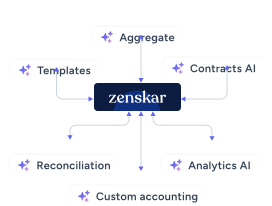
With Zenskar, you can monitor UARR alongside ARR, MRR, NRR, and churn in real time, without spreadsheet dependency. Connect billing, product, and CRM data for a single, unified view of how your customers grow.
Frequently asked questions
We launched our product 4 months faster by switching to Zenskar instead of building an in-house billing and RevRec system.

Meanwhile, read our top resources


Stay Future-Ready with AI-Native Order-to-Cash
Zenskar scales with you - it's flexible, reliable, and enterprise-ready.
