

7 NetSuite SuiteBilling Alternatives & Competitors in 2026
Looking for a NetSuite SuiteBilling alternative? Compare 7 modern billing platforms, including Zenskar, Maxio, Zuora, and more. Break free from NetSuite lock-in.
Introduction
NetSuite SuiteBilling made sense in your early growth phase. It's built right into NetSuite, so there's no middleware to manage. For simple recurring subscriptions, it just works. Your finance team could handle basic billing without bothering engineering, and everything stayed in one system.
But then your business evolved. Sales started closing deals with bespoke contracts. You needed to bill customers based on API calls, storage consumption, or seats with complex overages.
The product team wanted to experiment with different pricing tiers. And suddenly, SuiteBilling couldn't keep up.
Now you're stuck. Every pricing change requires custom scripts and constant engineering support. Your finance team is back to using spreadsheets for revenue recognition. And you're locked into NetSuite whether it helps your team at this scale or not!
This guide walks through seven modern alternatives, Zenskar, Zone Billing, Chargebee, Zuora, Maxio, Stripe Billing, and Sage Intacct, that solve these problems. Some keep you in the NetSuite ecosystem with more power. Others give you complete freedom to choose your own ERP stack.
NetSuite SuiteBilling comparison at a glance

Switch to zero-touch FinOps with Zenskar
Top 7 NetSuite SuiteBilling alternatives and competitors
1. Zenskar vs NetSuite SuiteBilling
Zenskar is an AI-native order-to-cash software designed for finance teams.
Unlike SuiteBilling, which requires engineering for anything non-standard, Zenskar gives your finance team complete control of your billing system and revenue recognition flexibility. You can configure any pricing model through a visual interface, connect to any ERP (NetSuite, QuickBooks, Xero), and automate the entire billing-to-revenue process without writing a single line of code.
Key differences between Zenskar and NetSuite SuiteBilling

Matt Branard

70% faster month-end closing
"We're able to automate revenue recognition accurately for our value-based billing, reducing the manual hours spent by 70%."

Noy Kalansky

Saved 200+ hours of grunt work
"We're saving 200+ hours/quarter on invoicing and receivables management by completely automating our recurring billing."
Pros
- AI automates the entire order-to-cash process with zero manual busywork
- No ERP lock-in—works with NetSuite, QuickBooks, Xero, and others
- Multi-entity multi-currency accounting under one login across
- 24/7 support via Slack, Zoom, and email at no extra cost
- Go live in 2-16 weeks with hands-on implementation support
Cons
- Zenskar does not currently offer quoting capabilities (integrates with third-party CPQ tools)
- No support for non-revenue features like expense management and accounts payable

Source: G2
Vertice closed books 70% faster with Zenskar
2. Zone Billing vs NetSuite SuiteBilling
Zone Billing is a NetSuite-native billing solution designed for businesses that have already committed to Oracle's ERP ecosystem. It offers finance teams deep integration with NetSuite's financial modules and eliminates the middleware complexity that comes with external billing platforms.
For companies that plan to stay on NetSuite long-term, Zone Billing provides more sophisticated billing capabilities than SuiteBilling—including better support for usage-based pricing, hierarchical customer management, and complex tiered pricing models.
However, Zone Billing inherits SuiteBilling's fundamental constraints: you're still locked into NetSuite, engineering is still required for non-standard scenarios, and critical capabilities like true entitlement management and high-volume usage metering remain unavailable.

Source: ZoneBilling
Features
- NetSuite-native billing: Operates entirely within NetSuite with no external integrations required
- Contract-centric pricing: Supports tiered, volume-based, and hybrid pricing tied to customer contracts
- Prepaid billing support: Tracks prepaid quantities and dollar-value drawdowns
- Salesforce integration: Bidirectional sync through API wrapper for contract amendments and renewals
- Revenue recognition: Wraps around NetSuite ARM for ASC 606/IFRS 15 compliance (AR, revenue, unbilled, deferred)
- Power BI dashboards: Pre-built reports for MRR, ARR, upgrades, downgrades, cancellations
- AI assistance: Context-aware help and invoice processing (not workflow automation)
Pros
- NetSuite-native with no sync delays or middleware
- More sophisticated pricing capabilities than SuiteBilling
- Better hierarchical customer and multi-entity support
- Direct integration with NetSuite financial modules
- Pre-built Power BI reports for subscription analytics
Cons
- NetSuite lock-in, cannot use with other ERPs
- Engineering required for usage metering and pricing changes
- No true entitlement management or feature-level access control
- Requires Power BI licenses and expertise for reporting
- No standalone customer self-service portal
- Complex codebase makes troubleshooting difficult
SuiteBilling vs Zone Billing: Feature Comparison
3. Chargebee vs NetSuite SuiteBilling
Chargebee is a subscription billing platform built for simplicity and ease of use. Many growing SaaS companies choose it because the interface is straightforward, setup is quick, and it handles standard recurring billing without requiring a technical team.
However, as businesses introduce usage-based pricing, hybrid models, or custom contract terms, Chargebee's limitations surface quickly.
Common scenarios, such as minimum commitments, platform fees, or prepaid and arrears billing, require custom workarounds. Chargebee's basic entitlements can't easily track real-time usage or manage rollovers, forcing engineering teams to build their own systems. Revenue recognition stops at basic accounts (AR, revenue, unbilled, deferred), leaving finance teams scrambling for Chargebee alternatives.

Source: Chargebee
Features
- Subscription management: Automate trials, upgrades, downgrades, renewals, and cancellations
- Payment gateway integrations: Connects with Stripe, PayPal, Braintree, and other processors
- Multi-currency billing: Support for international billing and localized payment methods
- Automated dunning: Retry workflows to reduce payment failures
- Tax compliance: Avalara integration for automated VAT and sales tax calculations
- Customer self-service portal: Branded portal for subscription management and payment updates
- Basic SaaS metrics: Reports for MRR, ARR, and subscription performance
- 60+ integrations: Connects with major CRMs, ERPs, and accounting tools
Pros
- Simple, intuitive interface for non-technical teams
- Quick implementation—typically live within weeks
- Strong automation for standard subscription workflows
- Good documentation and onboarding resources
- Transparent pricing with no surprise fees
Cons
- Engineering dependency for usage-based pricing and custom scenarios
- No native support for minimum commitments or platform fees
- Entitlements require custom product-level development
- Revenue recognition limited to basic accounts only
- Inflexible proration—can't control what gets prorated
- Customer support slower for non-enterprise tiers
- No native database or warehouse connectors for usage data
SuiteBilling vs Chargebee: Feature Comparison
4. Zuora vs NetSuite SuiteBilling
Zuora is an enterprise-grade subscription and revenue management platform designed for large organizations with complex recurring revenue models. As one of the pioneers in the subscription economy, Zuora offers comprehensive capabilities for subscription billing, revenue recognition, and financial management at scale.
Zuora excels in handling multi-entity operations, deep financial integrations, and complex compliance requirements. The platform supports advanced subscription lifecycle management, offers multiple payment gateway integrations, and provides subscription analytics for enterprise businesses.
However, Zuora's complexity comes with significant trade-offs, forcing users to seek Zuora alternatives. The platform operates billing and revenue recognition as separate products (Zuora Billing + Zuora Revenue), requiring data movement between systems. On top, for most companies outgrowing SuiteBilling, Zuora is overkill, offering enterprise capabilities you may not need at a price point that's hard to justify.

Source: Zuora
Features
- Enterprise-grade billing: Contract-based, milestone, hybrid, and multi-entity pricing models (15+ models with limits)
- Multi-entity operations: Billing and compliance for organizations across different jurisdictions
- Payment gateway integrations: Supports multiple payment processors for global transactions
- Revenue recognition: Zuora Revenue (formerly RevPro) for ASC 606/IFRS 15 compliance (separate product with 3,000 schedule cap)
- Analytics dashboards: Up to 5 dashboards per tenant with real-time financial insights
- Churn management: Predictive analytics and retention workflows
- Enterprise system integrations: Paid add-ons for NetSuite, Salesforce CPQ, and major ERPs (no UI connectors)
- High transaction volumes: Built for enterprise-scale billing operations
Pros
- Enterprise-grade capabilities for complex subscription models
- Multi-entity support with sophisticated compliance automation
- Deep financial integrations with major ERPs and CRMs (via paid add-ons)
- Predictive churn management and retention analytics
- Comprehensive subscription lifecycle management
- Multiple payment gateway support for global operations
- Handles high transaction volumes at scale
Cons
- Implementation takes 6-9 months, with external consultants required
- High total cost—often becomes the largest G&A expense
- Billing and revenue recognition are separate products requiring data movement between systems
- Prepaid credits require workarounds with fictional credit notes
- Complex user interface with a steep learning curve requiring certification
- Limited analytics: max 5 dashboards per tenant with 24-hour data latency,
- No multi-entity analytics
- Invoice customization is limited without engineering workarounds
- CRM/ERP integration are paid add-ons
SuiteBilling vs Zuora: Feature Comparison
5. Maxio vs NetSuite SuiteBilling
Maxio (formerly SaaSOptics + Chargify) combines subscription billing with financial reporting specifically for B2B SaaS companies. The platform was born from merging two legacy systems—Chargify for billing and SaaSOptics for financial operations—to create an integrated solution for subscription businesses.
Maxio offers built-in SaaS metrics, GAAP/IFRS compliant revenue recognition, and integrations with Salesforce, HubSpot, QuickBooks, and NetSuite. The platform appeals to B2B SaaS companies that need sophisticated financial reporting alongside their billing operations.
However, Maxio's two-system architecture creates persistent sync challenges between the legacy Chargify and SaaSOptics components. Pricing is tied to product logic, requiring developer involvement for changes. Usage metering has no native database or warehouse connectors, forcing teams to use APIs or CSV uploads only. Revenue recognition doesn't auto-adjust when billing plans change, requiring manual work. For companies outgrowing SuiteBilling due to usage-based pricing needs, it’s wise to seek Maxio alternatives.
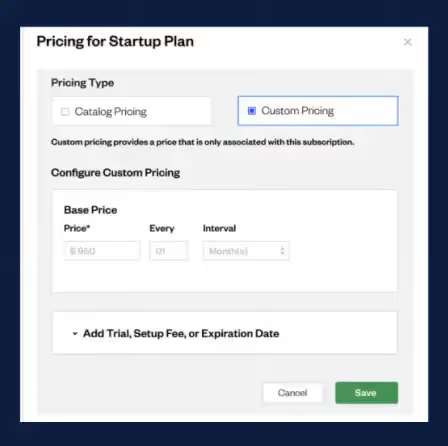
Source: Maxio
Features
- Subscription billing management: Supports fixed, recurring, and simple usage-based pricing models
- Automated revenue recognition: Ensures compliance with ASC 606 and IFRS 15 standards
- Advanced SaaS analytics: Provides cohort analysis, cash flow projections, and churn metrics
- Financial reporting: Generates detailed reports for MRR, ARR, and revenue attribution
- Expense tracking and allocation: Automates expense recognition across departments
- Multi-gateway payment support: Integrates with multiple payment processors
- Two-way CRM/ERP sync: Connects with Salesforce, HubSpot, QuickBooks, NetSuite (paid add-on for HubSpot)
- Built-in finance dashboards: CAC:CLTV ratios, cohort performance, real-time cash forecasts
Pros
- Purpose-built for B2B SaaS with subscription-focused features
- Deep integrations with Salesforce, HubSpot, and major ERPs
- Advanced analytics, including cohort analysis and forecasting
- Automates ASC 606/IFRS 15 compliance for standard subscription models
- Strong financial reporting capabilities
Cons
- Pricing tied to product logic, requires dev work for changes
- No native database or warehouse connectors for usage data (APIs or CSV only)
- No entitlement management capabilities
- Limited real-time usage metering support
- Customers report persistent sync issues with Salesforce, QuickBooks, NetSuite
- Implementation typically takes 6-9 months with consultant help
- APIs are less flexible and developer-friendly than modern platforms
SuiteBilling vs Maxio: Feature Comparison
6. Stripe Billing vs NetSuite SuiteBilling
Stripe Billing is a subscription and invoicing platform that extends Stripe's payment processing infrastructure. Known for its developer-friendly APIs and excellent documentation, Stripe Billing appeals to tech-forward companies that want to build custom billing workflows with code.
Stripe Billing works well for businesses with straightforward subscription models and in-house development resources. The platform offers flexible APIs, supports multiple pricing models, and seamlessly integrates with Stripe's global payment infrastructure.
However, Stripe Billing's linear data model and tight coupling with Stripe Payments create constraints for businesses with complex pricing needs. Developers must hard-code Stripe-specific billing identifiers into internal systems, creating technical debt. The platform is limited to 20 products per subscription (performance limit), locks you into Stripe's payment ecosystem exclusively, and requires engineering bandwidth for setup and ongoing maintenance. Revenue recognition is a separate Stripe Revenue Recognition product. Usage metering requires manual work, and entitlements must be built in-product. Finance teams remain dependent on engineering for simple changes, forcing them to seek Stripe Billing alternatives.

Source: Stripe Billing
Features
- Flexible pricing models: Supports flat-rate, tiered, volume, and usage-based pricing
- Global payment processing: Multi-currency support with 135+ currencies and localized payment methods
- Smart payment retries: Automated dunning management to reduce churn
- Usage metering: Track customer usage in real-time with Stripe's Meters API
- Tax automation: Stripe Tax handles sales tax, VAT, and GST calculations
- Subscription management: Handle upgrades, downgrades, and proration
- Revenue recognition: Stripe Revenue Recognition supports ASC 606/IFRS 15 compliance (separate add-on)
Pros
- Seamless integration with Stripe's payment infrastructure
- Highly customizable through developer-friendly APIs
- Global payment support with 135+ currencies
- Fast, scalable setup for tech-savvy teams (1-2 weeks)
- Transparent pay-as-you-go pricing (0.7% of billing volume)
- Strong security with PCI compliance built in
Cons
- Requires engineering bandwidth for setup and ongoing maintenance
- Limited to 20 products per subscription (performance limit)
- Locks you into Stripe payment ecosystem exclusively
- Revenue recognition requires a separate subscription (Stripe Revenue Recognition)
- Limited invoice customization without custom code
- Limited analytics for financial tracking: focused on payment metrics
- Complex pricing scenarios require workarounds
- Missing ERP integrations—needs custom development for ERP sync
Stripe Billing vs SuiteBilling: Feature Comparison
7. Sage Intacct vs NetSuite SuiteBilling
Unlike specialized billing platforms, Sage Intacct provides a full suite of financial tools, including general ledger, accounts payable, accounts receivable, recurring billing, revenue recognition, and advanced financial reporting.
The platform supports 500+ billing scenarios natively and handles complex corporate structures with automated consolidation.
However, Sage Intacct's broad scope comes with higher costs and complexity. Implementation takes 3-6 months with certified partners at a cost of $35K-$150K (125%-200% of annual subscription fees). If you're already frustrated with NetSuite's limitations beyond just SuiteBilling, Sage Intacct provides a complete ERP alternative with stronger billing, revenue recognition, and financial management built in.
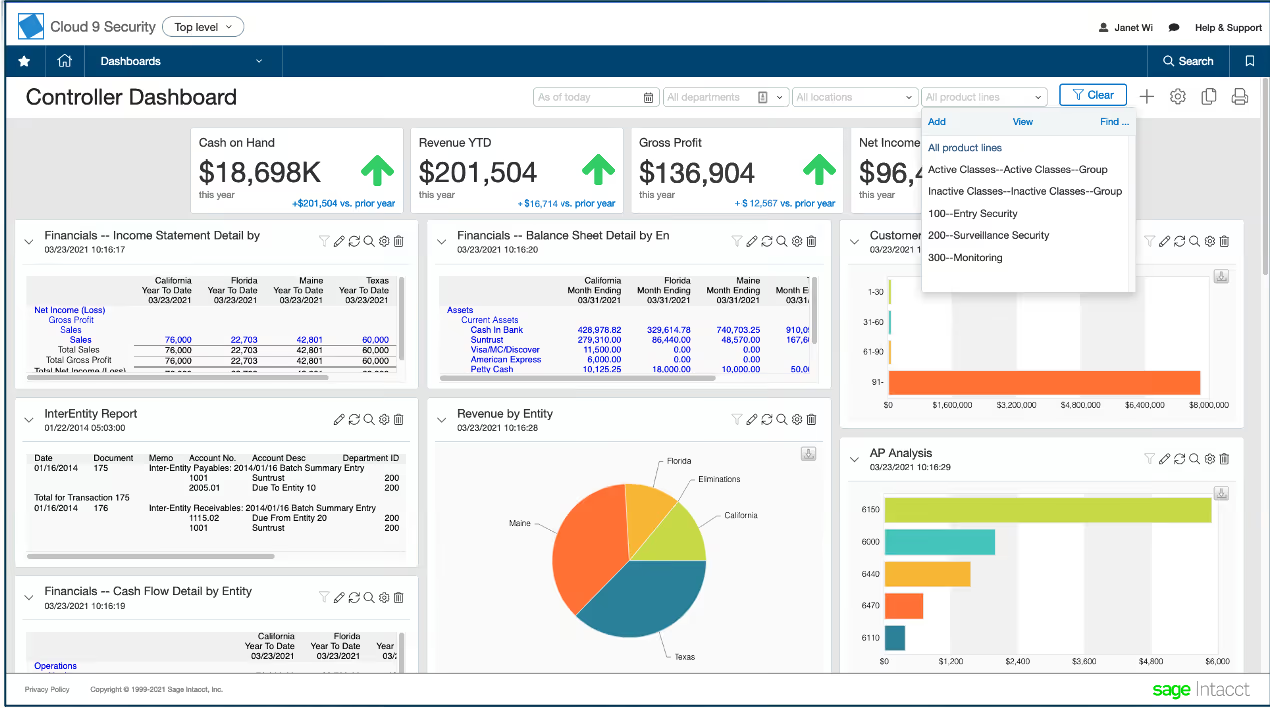
Source: Sage Intacct
Features
- 500+ billing scenarios: SaaS subscriptions, project-based billing, usage-based, and complex recurring models
- Automated revenue recognition: Built-in ASC 606/IFRS 15 compliance with automated workflows and templates
- Advanced financial reporting: Real-time analytics, cash flow management, and forecasting capabilities
- Multi-entity consolidation: Handle complex corporate structures with automated consolidation
- Real-time Salesforce integration: Efficient contract and customer management integration
- Multi-jurisdiction tax handling: Automated tax calculations for global billing operations
- Complete general ledger operations: Full accounting suite with powerful financial controls
- Cloud-based scalability: Flexible APIs for integrations and enterprise scalability
- Third-party billing integration: Automate revenue recognition for invoices from external billing platforms
Pros
- Complete financial suite beyond just billing and revenue recognition
- Scales with growth, ideal for multi-entity operations and complex pricing
- Cloud-based with flexible APIs for seamless integrations
- Implementation typically takes 90 days (~3 months) with certified partners
- Advanced financial reporting with forecasting and cash flow management
- Strong compliance automation for ASC 606/IFRS 15 with automated templates
- Multi-currency and multi-entity support built in
- Supports 500+ billing scenarios natively
Cons
- High implementation cost:
- Requires significant financial and accounting expertise to configure and leverage fully
- Overkill for businesses with simple subscription needs
- You're replacing your entire ERP, not just improving billing
SuiteBilling vs Sage Intacct: Feature Comparison
Key features to evaluate when choosing a NetSuite SuiteBilling alternative
1. Billing & subscription management
- Can it handle the deals your sales team actually closes?
You need a platform that supports subscriptions, usage-based pricing (prepaid and postpaid), hybrid models, and those one-off custom contracts, without you managing on spreadsheets or waiting for engineering.
- Does it work across all your entities?
If you're running multiple business units or billing customers in different countries, you definitely need multi-entity and multi-currency support under one log-in to consolidate everything in one place.
- What happens when customers change their plans mid-month?
Upgrades, downgrades, add-ons, these should prorate automatically. You shouldn't be calculating prorations manually or explaining to customers why their invoice doesn't make sense.
- Can you do prepaid billing without hacks?
If customers buy credits upfront, the platform should track balances, deduct usage automatically, and bill overages when they run out
- How do you get contracts into the system?
Does the tool have an inbuilt CRM integration? Can you upload CSVs or do you have to manually enter every deal?
2. Revenue recognition & compliance
- Does it actually automate rev rec for contract amendment?
When a customer upgrades mid-quarter, does revenue adjust automatically, or are you making manual journal entries?
- Can it handle all your accounts?
Not just AR or deferred revenue, can it also handle journal entries for unbilled revenue, gateway expenses, tax payables, and customer wallet liabilities? If you're still using spreadsheets for any of these, your system isn't complete.
- Does it work for multi-currency operations?
If you bill in euros but report in dollars, does revenue recognition handle exchange rates automatically with real-time conversions?
3. Usage metering & event-based billing
- Can you actually Make billable metrics from your usage data without engineering? The platform should have the ability to easily aggregate user data to make billable metrics. If you're asking engineers to do that, that's a non-starter.
- Does it scale when you need it to?
Some platforms choke at 10,000 events per day. You need something that handles 100,000+ events per second without rate limits or performance issues.
- Does it handle time zones correctly?
When customers in Tokyo, London, and San Francisco all hit limits at "midnight local time," does your billing system get it right? Or do you get angry emails about incorrect charges?
- Can you change how usage is calculated without engineering?
When you want to switch from "per API call" to "per thousand API calls" or add tiered volume discounts, can finance make that change? Or is this a sprint for the dev team?
4. Entitlement management
- Can you control what customers can access based on their plan?
When someone's on the "Starter" plan, can you automatically block them from enterprise features? Or is your product team building this from scratch?
- Does it track prepaid credits automatically?
When customers buy $10,000 in credits, does the platform deduct usage in real-time, show the remaining balance, and alert them before they run out? Or are you tracking these in spreadsheets?
- What happens when customers hit their limits?
Can you set hard limits that block access, or soft limits that allow overages and bills automatically? Your product and billing systems should talk to each other.
- Can you handle credit rollovers and expirations?
Some customers get rollover credits. Some lose them at month-end. Some get annual resets. Can you configure all of this, or are you managing it manually?
5. Invoicing & payment collection
- Can you brand invoices and customize what customers see?
You should be able to customize logos, colors, what line items appear, and how usage is displayed, without asking design or dev teams.
- Does it handle global tax compliance?
VAT, GST, sales tax across different jurisdictions should be automated, either natively or through integration. You shouldn't have to manually calculate tax on every invoice.
- What about customers who don't pay?
Smart dunning workflows should be in place to retry failed payments, send escalating reminders, and pause service if necessary. You shouldn't have to manually chase down every failed payment.
6. Reporting & analytics
- Can you build reports yourself, or do you need the BI team?
When your CFO asks, "What's our ARR by product line?" on a Friday afternoon, can you pull that report in 5 minutes? Or do you need to open a ticket with analytics?
- Can you drill down into the details?
High-level numbers are great, but when ARR dips, you need to drill down by customer, product, region, or sales rep to understand why.
- How current is the data?
If your dashboards update overnight or weekly, they're not helping you make real-time decisions. You need data that reflects what happened this morning.
7. Integrations & data sync
- Does it connect to your existing tools?
Your billing tool should have connectors built in for connecting with CRM (Salesforce, HubSpot), ERP (NetSuite, QuickBooks, Xero), payment processors, and data warehouse.
- Can you connect to multiple ERPs?
If you're running different entities on different systems, your billing platform should easily connect with all your ERPs and CRMs for different entities and consolidate in one place.
- Are integrations actually reliable?
"We integrate with Salesforce" doesn't mean much if the sync breaks every other week and you're constantly fixing it. Reliability matters more than feature lists.
8. Implementation & migration
- How long until you're actually live?
If implementation takes 6-9 months, that's six months you're stuck with your current problems. You need something that goes live in weeks to a month, not a year.
- Who does the work?
Some platforms dump everything on you ("self-serve implementation"). Others charge $100K for consultants. The best ones provide hands-on support that feels like an extension of your team.
- How much engineering time does this take?
If developers are tied up for months building integrations and custom scripts, implementation isn't really "fast." Finance should lead implementation, not engineering.
9. Customer support & reliability
- Can you actually reach someone when things break?
When billing fails or an error occurs, do you get a person on Slack or Zoom in minutes? Or do you open a ticket and wait?
- Is support included, or an expensive add-on?
Some platforms charge extra for real support. Others include 24/7 access to dedicated account managers as standard. Know what you're getting. - Is your data secure?
SOC 2, GDPR compliance, role-based access controls, encryption—these aren't optional for financial systems. Ensure your vendor prioritizes security.
Ready to move beyond NetSuite SuiteBilling?
NetSuite SuiteBilling made sense when your needs were simple and staying within NetSuite seemed like the path of least resistance. But your business evolved, complex pricing models, usage-based billing, multi-entity operations, and the platform couldn't keep up.
You don't have to accept NetSuite lock-in. You don't have to wait for engineering tickets every time sales negotiate a custom deal.
Modern billing platforms like Zenskar eliminate these constraints, providing you with the flexibility to grow without rebuilding your stack every few years.
Unlike SuiteBilling's NetSuite lock-in, Zenskar gives you:
- Multi-ERP freedom with seamless bi-directional sync
- No-code pricing configuration for any model without engineering tickets
- Native entitlements so your product team builds features, not billing infrastructure
- Unified revenue recognition handling all accounts with ASC 606/IFRS 15 compliance
- Real-time analytics without Power BI licenses or external BI tools
- AI automation that actually eliminates work, not just assists with it
- Implementation in 2-16 weeks with hands-on support
Book a demo with Zenskar to see how we automate billing and revenue recognition for companies outgrowing SuiteBilling's limitations.
Or take an interactive product tour to explore Zenskar yourself, no meeting required.
Your business is too important to be held back by billing constraints. Let's fix that.
Frequently asked questions
SuiteBilling works well early on for standard recurring subscriptions. The challenge comes as businesses grow and pricing gets more complex. Custom contracts, usage-based billing, and prepaid credits all require engineering involvement for changes that finance teams should handle independently. It's less about SuiteBilling being a bad product and more about businesses outgrowing what it was designed to do.
Yes. Zenskar connects directly with NetSuite via bi-directional sync, so your ERP stays in place. The difference is you're no longer confined to it. Zenskar also integrates with QuickBooks, Xero, and others, so if your ERP strategy changes down the line, your billing infrastructure moves with you.
SuiteBilling relies on a separate NetSuite ARM module that requires significant manual setup. Zenskar automates journal entries across every account including AR, deferred revenue, unbilled revenue, gateway expenses, and tax payables, all ASC 606 and IFRS 15 compliant. When a customer modifies their contract mid-quarter, revenue adjusts automatically with no manual intervention needed.
Focus on three things: native connectors, event processing capacity, and whether finance can make changes without engineering. Zenskar offers 200+ native connectors, processes 100,000+ events per second, and lets finance teams define billable metrics through a visual interface with no code required.
With Zenskar, implementations run 2 to 16 weeks with hands-on support, and engineering involvement is minimal since finance leads the process. That compares favorably to SuiteBilling's lengthy implementations or enterprise alternatives like Zuora that typically require 6 to 9 months and expensive external consultants.
Grow your subscriptions without limits
Don't let another dollar slip through the cracks.
