
Compute-Adjusted Gross Margin
.avif)
TL;DR
- Compute-Adjusted Gross Margin is gross margin calculated after separating AI compute costs (one-time costs to build the model) and inference costs (ongoing utility costs to run it) from the rest of COGS.
- In AI products, the cost of serving a customer is tied to how much they use the product. Standard gross margin does not capture this.
- It is not a GAAP metric. It is an analytical lens that finance teams and investors use to understand the true margin structure of an AI-enabled business.
- A company can show strong gross margins, but high compute costs can compress real profitability. This metric makes that visible early.
Understanding Compute-Adjusted Gross Margin and its significance for SaaS
Standard gross margin measures revenue remaining after deducting the cost of goods sold. For traditional SaaS, COGS is predictable once a customer is provisioned: hosting, support, and a small infrastructure overhead. The cost of serving one more customer on the same plan is minimal.
AI changes this. When a product is powered by a large language model or any inference layer, every customer interaction carries a cost. Each prompt sent, each response generated, and each agent task completed consumes compute billed by the token, the API call, or the GPU hour. The more a customer uses the product, the more it costs to serve them.
This means two customers on identical plans can generate very different costs. A power user running complex multi-step queries costs significantly more to serve than a light user. For example, two customers each pay $1,000/month. One generates $50 in compute costs, while a power user generates $400. In a flat-rate pricing model, that difference is not visible in ARR but directly impacts margins. Compute-Adjusted Gross Margin helps finance teams uncover this hidden variation and understand the true cost of serving each customer.
How it is calculated
Gross Margin = (Revenue minus COGS) / Revenue x 100
Compute-Adjusted Gross Margin = (Revenue minus Non-Compute COGS) / Revenue x 100
Compute Margin Drag = AI Compute and Inference Costs / Revenue x 100
Running both figures alongside each other shows what the margin looks like before and after AI delivery costs. The gap between them is the margin consumed specifically by compute.
The compute COGS line should include model inference API fees, GPU or TPU compute, vector database and embedding costs, and model licensing fees. What stays in standard COGS is the hosting, infrastructure, customer support, implementation, and non-inference storage.
Why does this metric require a different reading than traditional gross margin
In traditional SaaS, gross margin today reliably predicts gross margin tomorrow. Infrastructure costs do not shift dramatically as usage grows. In AI products, this relationship breaks down. Compute costs scale directly with usage, and usage is not uniform across customers or predictable at the time of contract.
A customer who starts as a light user and becomes a power user over six months will cost progressively more to serve, with no automatic mechanism to adjust revenue to match. If pricing does not account for this, margin erodes silently as the most engaged customers become the most expensive to support.
What drives compute margin compression
Tips for managing Compute-Adjusted Gross Margin
The goal is not to eliminate compute costs but to keep pricing, infrastructure, and product decisions aligned with margin targets as the company scales.
1. Make compute visible in COGS first
Separate inference and compute costs into a dedicated COGS sub-line, tracked per customer and per product. Finance and engineering need shared visibility into cost to serve per account. Without this, margin compression is only identified after it has already accumulated.
2. Align pricing to usage intensity
Flat-rate pricing is the most common driver of AI products' margin erosion. Consumption tiers, credit-based systems, and usage caps ensure that revenue scales in proportion to delivery costs. The goal is not to penalize heavy users but to ensure the pricing model reflects the actual cost of serving them.
3. Optimize the model stack
Caching frequent responses, fine-tuning smaller models for high-volume tasks, and implementing routing logic that matches model cost to task complexity are the infrastructure levers with the most direct impact on compute margin.
4. Track trajectory, not just the current figure
A compressed compute-adjusted gross margin in an early-stage AI company is not automatically a red flag. Model costs are falling as the infrastructure market matures. A company with a clear plan to route simpler queries to cheaper models, cache frequent responses, and fine-tune smaller models for high-volume tasks may be on a healthy trajectory even if the current figure looks low. The direction of travel matters as much as the number itself.
Driving growth through Compute-Adjusted Gross Margin
Compute-Adjusted Gross Margin is becoming an important lens in investor due diligence for AI-enabled SaaS companies. It surfaces the gap between headline gross margin and the real economics of AI delivery. Finance teams that track it have earlier warning of margin pressure and clearer inputs for pricing and infrastructure decisions.
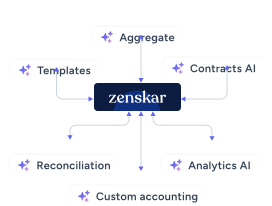
With Zenskar, teams can connect usage metering, billing, and cost data to track compute costs per customer and per product in real time, giving a unified view of how AI infrastructure costs are moving across the base.
See how Zenskar helps finance teams track compute costs and gross margin in real time.
- Connect billing, metering, and cost data for a unified view of gross margin and AI infrastructure spend.
- Improve forecast accuracy with real-time usage and contract visibility
Frequently asked questions
We launched our product 4 months faster by switching to Zenskar instead of building an in-house billing and RevRec system.

Meanwhile, read our top resources

Stay Future-Ready with AI-Native Order-to-Cash
Zenskar scales with you - it's flexible, reliable, and enterprise-ready.
