
ARR per FTE

TL;DR
- ARR per FTE (Annual Recurring Revenue per Full-Time Equivalent) is a direct indicator of workforce productivity and operational efficiency.
- The formula is straightforward: ARR / total headcount (FTEs). A rising ratio means the business is generating more revenue without proportionally growing its team.
- The "AI-adjusted" framing is an emerging interpretive lens. As AI tools reduce the headcount required for engineering, support, and operations, finance teams are increasingly asking how much of any ARR per FTE improvement is structural and sustainable versus a temporary effect of workforce reduction.
- Investors use this metric to compare efficiency across companies, and increasingly to benchmark traditional SaaS businesses against leaner, AI-native ones.
Understanding ARR per FTE and its significance for SaaS
ARR per FTE has always been a proxy for efficiency, but AI is changing what that efficiency actually means. ARR per FTE measures a SaaS company's operational efficiency by calculating the recurring revenue generated per employee. The higher the ratio, the more effectively the company is converting its human resources into sustainable recurring revenue.
The metric is most meaningful when tracked as a trend over time rather than as a point-in-time snapshot. A company where ARR is growing faster than headcount is demonstrating operating leverage. The business is scaling without a proportional increase in people costs. In practice, ARR per FTE improvements are often driven by AI adoption in engineering and support functions, where automation reduces headcount needs while sustaining or accelerating output.
ARR per FTE is one of the few metrics among the core SaaS efficiency indicators that has seen significant and consistent improvement over the last three years. The reason is a combination of two forces: deliberate headcount discipline and the growing use of AI tools to automate work that previously required dedicated staff.
This is where the "AI-adjusted" framing becomes relevant. ARR per FTE may rise on the back of smaller, leaner teams, but not all of that productivity gain will be sustainable. AI-native businesses often operate with compressed gross margins due to high infrastructure costs, so while they may appear highly productive by this metric, the contribution margin from each unit of ARR may be lower. Reading ARR per FTE without that context can be misleading. The AI-adjusted lens prompts the question: is this productivity gain structural and margin-accretive, or is it masking cost shifts elsewhere?
How the ratio is calculated
ARR per FTE = Annual Recurring Revenue / Total Full-Time Equivalent Headcount
FTE counts all full-time employees and normalizes part-time staff proportionally, which means a half-time contractor counts as 0.5 FTE. Contract and fractional workers may or may not be included depending on how the company defines its workforce; consistency in methodology matters more than which approach is chosen.
The ratio should be calculated at a point in time, typically the end of a quarter, and tracked across periods to observe the trend.
What the AI-adjusted lens adds
The standard ARR per FTE calculation is a clean, objective ratio. The AI-adjusted framing is an interpretive layer on top of it. It asks three questions that the raw number does not answer on its own.
Is the productivity gain from AI tools or from headcount reduction?
Engineering, customer success, and support see the highest AI-attributable headcount reductions. Understanding which functions are driving the ARR per FTE improvement helps assess whether it will compound over time or plateau.
Is ARR per FTE rising because ARR is growing, or because headcount is shrinking?
A rising ratio driven by ARR growth is a stronger signal than one driven purely by layoffs or attrition. Both can improve the number, but only the former reflects genuine operating leverage.
How does the ratio hold up on a gross-margin-adjusted basis?
Gross-Margin-Adjusted ARR per FTE = ARR × Gross Margin % / FTE.
A company with $300K ARR per FTE at 60% gross margin produces $180K of margin-adjusted productivity per person. One with $200K ARR per FTE at 80% margins produces $160K. The first looks more productive on the surface; the second is closer in practice, and the gap narrows further if the first carries rising infrastructure costs. This formula turns a conceptual caution into a trackable, reportable metric.
Will a shrinking FTE count flatter the metric going forward?
As AI agents begin replacing roles in support, QA, and operations, headcount may decline without any change in revenue or genuine productivity improvement. ARR per FTE rises automatically when the denominator shrinks. Finance teams should track whether FTE reductions are offset by agent-related infrastructure costs and whether the work those roles performed is genuinely being absorbed or simply going undone.
ARR per FTE vs other efficiency metrics
ARR per FTE is sometimes conflated with related metrics. The distinctions matter:
The key distinction between the three is that a company can score well on the Rule of 40 or the Magic Number while having poor ARR per FTE if growth is driven by a large, expensive team. The Rule of 40 does not isolate the cost or contribution of individual functions, and the magic number does not account for non-GTM headcount or costs.
Tips for improving ARR per FTE
1. Grow ARR faster than headcount
The most sustainable way to improve this ratio is to increase ARR without proportionally adding people. This means investing in product-led growth motions, strong NRR, and pricing architecture that allows revenue to expand through customer behavior, not just through more sales hires.
2. Apply AI to non-differentiated work first
Use AI to automate repetitive tasks and build internal tools before adding headcount. Identifying which functions carry the most undifferentiated work is the starting point for sustainable improvement.
3. Track it by function, not just company-wide
A company-level number masks variation across departments. Track the ratio by function to see where leverage is concentrated and where investment is diluting it.
4. Read it alongside gross margin
An ARR per FTE improvement that coincides with a gross margin decline deserves scrutiny, not celebration. The goal is revenue per employee in SaaS, which is also margin-accretive, not revenue growth funded by infrastructure costs that scale faster than the business.
Driving growth through ARR per FTE (AI-Adjusted)
ARR per FTE is becoming standard in investor due diligence as AI-native companies set a new productivity baseline that traditional SaaS businesses are increasingly measured against.
For finance teams, the practical value of tracking this metric lies in its clarity: it surfaces whether the business is building operating leverage over time, and it forces honest conversation about whether headcount decisions are strategic or reactive.
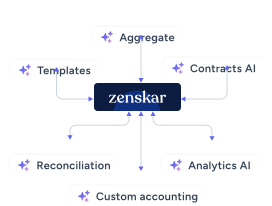
With Zenskar, finance teams can connect billing, revenue, and operational data to track efficiency metrics like ARR per FTE alongside ARR, NRR, and gross margin, in real time, without manual data pulls.
See how Zenskar helps finance teams track revenue efficiency in real time
Connect billing, product, and CRM data for a unified view of ARR and operational performance.
Frequently asked questions
We launched our product 4 months faster by switching to Zenskar instead of building an in-house billing and RevRec system.

Meanwhile, read our top resources

Stay Future-Ready with AI-Native Order-to-Cash
Zenskar scales with you - it's flexible, reliable, and enterprise-ready.
