
AI Credit Bundle

TL;DR
- An AI Credit Bundle is a structured pricing model that packages AI feature access into defined credit allocations, giving SaaS companies a controlled layer between raw infrastructure costs and customer-facing pricing.
- Credit consumption is calculated by mapping each AI action to a standardised credit cost, then tracking drawdown against the customer's allocated bundle to measure usage, overage, and remaining capacity.
- AI Credit Bundles directly influence ARR, deferred revenue, and gross margin by converting unpredictable AI infrastructure costs into structured, forecastable revenue streams with clear overage upside.
- Finance and revenue teams use AI Credit Bundles to protect gross margin from heavy users, improve cash flow through prepaid credit pools, and build expansion motions around consumption growth rather than seat count.
H2: How to use AI Credit Bundles in financial forecasting
AI Credit Bundles shift forecasting from a seat-count exercise to a consumption-modelling discipline. Because revenue is tied to credit drawdown rather than fixed subscriptions, finance teams must build scenarios around usage patterns, prepaid credit utilisation, and breakage rates.
With Gartner projecting that by 2026 more than 80% of enterprises will have deployed AI-enabled applications in production, AI usage is no longer a pilot-stage variable. It is a core revenue driver that demands the same forecasting rigour applied to ARR or NRR.
For example, if 30% of prepaid annual credits go unused across enterprise accounts, finance teams face two simultaneous challenges: recognising breakage revenue accurately under ASC 606 and repackaging bundles to reduce unused allocation without triggering churn. Modelling that scenario in advance gives leadership a decision framework rather than a reactive response at year-end close.
What do AI credit bundles actually mean?
An AI credit bundle is not marketing fluff. It is a financial abstraction layer between:
- Raw AI infrastructure cost (tokens, inference, GPU time).
- Customer-facing pricing.
Here’s the practical structure:
1 credit = standardized cost unit (e.g., 1,000 tokens OR weighted usage blend)
Customers buy:
- 10,000 credits/month.
- 100,000 annual credits.
- Overage packs at premium pricing.
Every AI feature draws down credits.
The key difference from pure usage-based billing: You control the economic conversion.
Why does seat-based pricing break down for AI workloads?
At $20-$100M ARR, a company’s pricing probably looks like this:
Here’s the structural problem: AI cost does not scale with seats.
It scales with:
- Query frequency.
- Data volume.
- Model complexity.
- User behavior intensity.
One enterprise customer with 50 heavy AI users can cost more than 200 light users elsewhere.
Industry context reinforces this risk:
- GPU-heavy AI inference can cost 5x-10× more than traditional compute workloads (industry infra reports).
- McKinsey estimates generative AI could create $2.6-4.4T in annual value - meaning adoption will accelerate, not slow down.
Translation: AI usage will grow faster than your pricing model unless you redesign it.
What is the CFO math behind AI credit bundles?
Let’s walk through a simplified example.
Assume:
- AI cost per 1,000 tokens = $0.02 blended
- Average AI feature interaction = 5,000 tokens
- True cost per interaction = $0.10
Now assume an enterprise customer performs:
- 20,000 interactions/month.
- Monthly AI cost = $2,000
If AI is “included” in a $5,000/month plan, and infrastructure is $2,000 of that, companies are burning 40% of revenue on AI alone.
Now introduce AI credit bundles.
Step 1: Create Credit Abstraction:
Define:
1 credit = 1 AI interaction (internally costing $0.10)
Step 2: Apply Target Margin:
If companies target 75% gross margin:
Required price per credit = $0.40
Now a company’s 20,000 interactions customer must buy:
20,000 credits × $0.40 = $8,000
Instead of a hidden cost inside a $5,000 plan.
What AI credit bundle structures work best in practice?
In practice, companies have seen three models work at scale.
1. Monthly Included Credits + Overage
Example:
- Enterprise includes 10,000 AI credits
- Overage = $0.50 per credit
Why this works:
- Predictable base ARR
- Upside from power users
- Clear consumption visibility
Finance benefit: stable floor, elastic ceiling.
2. Annual Prepaid Credit Pools
Example:
- 250,000 credits annually
- Paid upfront
- 12-month expiry
Why this works:
- Improves cash flow
- Encourages enterprise commitment
- Reduces monthly volatility
Finance benefit: working capital advantage.
3. Hybrid Subscription + Credit Packs
Example:
- $4,000 base subscription
- AI credit packs sold separately
Why this works:
- Separates core SaaS from AI compute economics
- Cleaner margin tracking
- Clearer expansion path
This model is especially effective for AI-heavy SaaS companies.
How do AI credit bundles impact revenue recognition under ASC 606?
This is where finance must lead. AI credits typically represent a stand-ready obligation under ASC 606.
Revenue treatment:
- Recognize revenue as credits are consumed.
- Unused credits sit as deferred revenue.
- Breakage can be recognized proportionally if supported by historical patterns.
If companies don’t:
- Track consumption accurately.
- Define expiry clearly.
- Document policy rigorously.
They’re creating audit risk.
Billing infrastructure matters here.
Platforms like Stripe Billing, Chargebee, and Zuora can support credit-based pricing mechanics but only if configured correctly with metering logic.
The system must:
- Track real-time usage.
- Deduct credits automatically.
- Produce revenue reports aligned with consumption.
Otherwise, companies are reconciling spreadsheets manually. That’s not scalable at $50M ARR.
How do AI credit bundles compare to pure usage-based billing?
Let’s compare directly.
Pure usage models work at hyperscale (think cloud providers).
For mid-market SaaS companies, volatility is risky.
Credit bundles add guardrails.
Where do most CFOs get AI pricing wrong?
After talking to several finance leaders, the same mistakes show up repeatedly.
1. Underestimating usage acceleration:
Early AI usage is misleading. Once customers operationalize AI, consumption can grow exponentially, quickly straining margins if pricing wasn’t built for scale.
2. Blending AI cost into core COGS:
When AI costs are mixed into general infrastructure spend, margin volatility becomes invisible. Separating AI COGS ensures clearer unit economics and better financial control.
3. Overcomplicating credit logic:
If pricing requires a long explanation, customers lose confidence. Simple, transparent credit models improve sales clarity and reduce billing friction.
4. Ignoring customer psychology:
Enterprise buyers prioritize predictability. Structured credit pools feel safer and easier to budget than fluctuating, usage-based invoices.
Getting AI pricing right isn’t about complexity, it’s about forecasting scale realistically, protecting margin visibility, keeping pricing simple, and aligning with how enterprise buyers actually think and budget.
What implementation roadmap should $20-$100M SaaS companies follow?
If implementing AI credit bundles tomorrow, the following sequence would ensure a structured and margin-conscious rollout:
Phase 1: Cost Modeling (2–3 weeks):
- Map every AI feature to infrastructure cost.
- Model heavy-user scenario (95th percentile usage).
- Determine required margin threshold.
Phase 2: Credit Abstraction Design:
- Decide credit conversion logic.
- Weight expensive workloads higher.
- Test price sensitivity with CRO.
Phase 3: Billing System Alignment:
- Enable metered tracking.
- Configure credit drawdown logic.
- Validate revenue reporting output.
Phase 4: Sales Narrative:
- Position credits as “AI capacity.”
- Emphasize control and flexibility.
- Avoid technical token language.
Executed in this order, AI credit bundles move from a risky experiment to a controlled, margin-protective growth lever balancing cost visibility, operational simplicity, and enterprise-ready predictability.
When should you definitely move to AI credit bundles?
Companies should strongly consider AI credit bundles if:
- AI infra cost >7-10% of revenue.
- Heavy users distort margin.
- AI usage growth >25% QoQ.
- You’re expanding AI features rapidly.
- The board is asking margin questions.
At $20-$100M ARR, small margin erosion compounds quickly. A 3-point drop in gross margin on $60M ARR = $1.8M lost contribution. That funds a lot of engineering.
Why are AI credit bundles a control system rather than a pricing tweak?
AI credit bundles bring structure to AI monetization. As workloads grow, variable infrastructure costs can quietly pressure margins if pricing doesn’t evolve. For CFOs in the $20-$100M range, that risk is real.
Credit-based pricing helps you:
- Align revenue with AI consumption.
- Protect gross margin from heavy users.
- Improve cash flow through prepaid credits.
- Gain forecasting visibility and expansion signals.
But strategy must translate into execution. You need reliable usage tracking, automated credit drawdowns, and clean revenue reporting.
See how Zenskar helps you track AI Credit Bundles in real time
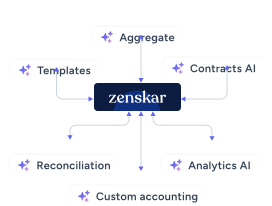
Zenskar helps finance teams operationalize AI credit bundles with structured usage-based billing and reporting discipline.
Frequently asked questions
We launched our product 4 months faster by switching to Zenskar instead of building an in-house billing and RevRec system.

Meanwhile, read our top resources


Stay Future-Ready with AI-Native Order-to-Cash
Zenskar scales with you - it's flexible, reliable, and enterprise-ready.
