
AI Attach Rate

TL;DR
- AI Attach Rate is the percentage of active customers or users who have adopted and are actively using one or more AI-powered features within a product.
- It signals whether AI investment is generating real usage, not just shipped features. A company can have AI in its product and still have a low attach rate.
- The median AI attach rate for vertical SaaS more than doubled from 22% in 2024 to 59% in 2025. AI-enabled vendors are growing faster and show higher NRR than non-AI peers.
- Finance teams track it to understand whether AI adoption is translating into higher ACV, stronger retention, and expansion revenue.
Understanding AI Attach Rate and its significance for SaaS
AI Attach Rate measures the share of active accounts or users who have adopted at least one AI-powered feature in a product, expressed as a percentage. It is tracked over time to understand whether AI capabilities are being used at scale or sitting underused within the installed base.
The metric matters because shipping AI and having customers actually use it are two different outcomes. A rising AI Attach Rate is the earliest signal that AI investment is generating commercial traction. A flat rate, despite continued product investment, indicates a gap in the adoption journey between feature availability and customer value.
It sits at the intersection of product and revenue. As a product signal, it gives you insight into the AI feature adoption rate. As a revenue signal, it tells you whether that investment is generating the expansion, retention, and ACV outcomes that justify it. That dual nature is why finance and GTM teams have started tracking it alongside AI ARR and NRR, not just product teams.
How the AI Attach Rate is calculated
AI Attach Rate = Accounts (or Users) Actively Using AI Features / Total Active Accounts (or Users) x 100
Two definitional choices have a significant effect on the output. First, the denominator: some teams calculate against all contracted accounts; others use only active accounts. Both are valid but produce different numbers. Second, "actively using" needs a deliberate threshold. A single session does not constitute attachment. Most teams define it as engagement with an AI feature a minimum number of times within a monthly or weekly window. The definition should be documented and applied consistently before the metric is reported.
Why AI Attach Rate matters to revenue teams
Attached customers tend to behave differently from unattached ones. When AI usage is embedded in a customer's workflow, switching costs rise, and the value case for renewal and expansion strengthens. This is why AI Attach Rate is increasingly used as a leading indicator for NRR: a high and rising attach rate within an account typically precedes expansion; a declining rate can flag disengagement before it appears in churn or contraction figures.
For companies that price AI as a paid add-on or separate tier, the attach rate is also a direct input into ARR expansion modeling. If attached accounts consistently generate a higher ACV than unattached ones, then the rate at which accounts move into attachment becomes a component of forecast modeling, not just a product dashboard number.
What affects AI Attach Rate
How does AI fare in the market today? Here are some surprising results of AI success rates:
Tips for improving AI Attach Rate
Improving AI Attach Rate is both a product problem and a customer success problem. The most effective approaches address the product experience and the human touchpoints around it simultaneously.
1. Define attachment before optimizing for it
Without a clear, agreed threshold for what counts as attached, the metric cannot be trusted or actioned. Define the minimum usage frequency, the time window, and the denominator before reporting the number. Apply that definition consistently across product, CS, and finance.
2. Build AI activation into the onboarding flow
The highest-leverage moment for AI attachment is the first few weeks of a customer's lifecycle. Integrate AI feature activation into the onboarding checklist as part of the core success path, not as an optional advanced step. Customers who experience a clear AI outcome early are significantly more likely to continue using it.
3. Use product analytics to identify where attachment breaks
Low attach rates have specific root causes. Analyze where customers drop off in the AI activation journey: are they not reaching the feature, reaching it but not completing setup, or completing setup but not returning? Each failure point has a different fix, and only usage data reveals which one applies.
4. Align customer success incentives to AI adoption
CS teams measured only on retention will treat AI adoption as secondary. Teams with explicit AI Attach Rate targets within their accounts will prioritize the conversations and interventions that move it. This is particularly important because introducing AI features often increases CS complexity, requiring more active support during the adoption phase.
5. Align attach rate targets with revenue expansion models
Set attach rate targets by working backward from your AI ARR expansion plan, and build a monthly cohort report connecting attach rate movement to ACV and NRR outcomes. In practice, this means modeling how changes in attach rate within a cohort translate into incremental ACV, based on observed differences between attached and unattached accounts. Review this linkage on a monthly cadence, with cohort-level reporting that ties attach rate shifts directly to expansion and retention performance.
Driving growth through AI Attach Rate
AI Attach Rate is one of the earliest available signals of whether a company's AI investment is generating commercial traction. A rising rate, segmented by tier and product line, shows AI capabilities are becoming embedded in how customers work. Tracking it alongside AI ARR and NRR turns it from a product health metric into a revenue forecasting input.
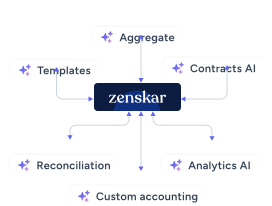
With Zenskar, finance teams can connect product usage data, billing, and contract information to track AI Attach Rate with AI ARR, NRR, and expansion metrics in real time, giving a single view of how AI adoption is translating into revenue outcomes.
See how Zenskar helps you connect AI adoption to revenue performance.
Track AI Attach Rate alongside ARR, NRR, and expansion metrics in one place.
Frequently asked questions
We launched our product 4 months faster by switching to Zenskar instead of building an in-house billing and RevRec system.

Meanwhile, read our top resources


Stay Future-Ready with AI-Native Order-to-Cash
Zenskar scales with you - it's flexible, reliable, and enterprise-ready.
