.svg)
About Posh
Posh builds conversational AI for banking and financial services, including voice assistants, chatbots, help centers, and internal knowledge bases, helping credit unions and banks modernize customer support.
Shadid Talukder runs strategic finance at Posh. He approaches software the same way he approaches finance, methodically. He gets into sandboxes, presses solutions engineers with hard product questions, and does not commit until he is confident something will hold up under real operating conditions.
The Complexity Behind Enterprise AI Contracts
Selling multiple products with different go-live dates
Posh typically sells four to five products on a single order form to each client. Each product has its own service start date because, in enterprise software, different products go live at different times under the same contract. A client might sign in January with one product live in March, another in May, and a third not until later in the year.
Three-year contracts that evolve over the life of the deal
Posh's contracts are long, typically three years, and they change. Amendments are common as clients add products, adjust terms, or shift billing triggers over time. The finance team is always managing a live, evolving picture across the entire portfolio, not a static set of contracts.
Unique service periods per product within a single order form
The detail that makes Posh's structure genuinely complex: each product on the same order form can carry its own service period. Billing start dates vary by product, not by contract. Any platform that applies uniform dates across a contract breaks the moment a real Posh deal lands in it.
How Posh Managed It, And Where They Needed More
A process built for early-stage scale
From 2022 through 2024, Posh's finance team managed all of this through spreadsheets. Each month, Shadid's team pulled the Salesforce close-won report, logged every contract change, and updated a master template. It was a process that worked well when Posh's deals were relatively uniform. As the business grew and commercial variety increased, the team recognized they needed tooling that could keep pace.
The case against Salesforce-dependent tools
Shadid evaluated alternatives as early as 2022, including established players like Maxio and Chargebee. Pricing was a barrier at the time, but a deeper concern surfaced quickly: many leading tools were built on deep Salesforce integrations. Finance does not own Salesforce, and Shadid had spoken to enough peers who had tried that path to know where it consistently led, ripped out within a year when the complexity became unmanageable.
The Market Had Options, But None for an Operator Running a Lean Team
Shadid ran one of the more thorough evaluations in this category. He demoed every major player, got into sandboxes, spoke directly to solutions engineers, and applied a consistent test: would this hold up when an actual operator is using it under pressure?
Two alternatives made it to the final stage. One was built primarily for C-suite buyers who wanted to hand the revenue operations function off entirely; its AI did the work, but left the finance operator with no way to intervene when something went wrong.
The other had genuine depth but required an administrative overhead that was impractical for a lean team.
What Zenskar offered that others didn't
After evaluating the full landscape, Shadid found Zenskar was the only platform that delivered across every dimension his team needed:
- Handles an infinite variety of billing frequencies and commercial structures
- Manages unique service period dates per product within a single contract
- Automates multi-year invoice scheduling across the full contract term
- AI agent that accelerates operations without locking operators out of the system
- Clean QuickBooks integration with no Salesforce dependency
- An operator-grade design that a lean finance team can move quickly in

Implementation
Contract ingestion and setup
Posh's contracts were stored as PDFs. Zenskar's AI-based contract parser extracted product information, pricing, terms, and payment schedules automatically, removing the need for manual data entry at the setup stage. Zenskar's implementation team worked alongside Posh throughout, handling initial configuration, product-level billing terms, and historical data import.
Connecting to QuickBooks
Zenskar was set up as a subledger connected to QuickBooks, giving the team a checkpoint to verify revenue entries before they move downstream. Posh has a large product catalog, and mapping multiple Zenskar products to consolidated QuickBooks line items required some configuration work — a growing pain the teams worked through as the setup matured.
A partnership, not just a deployment
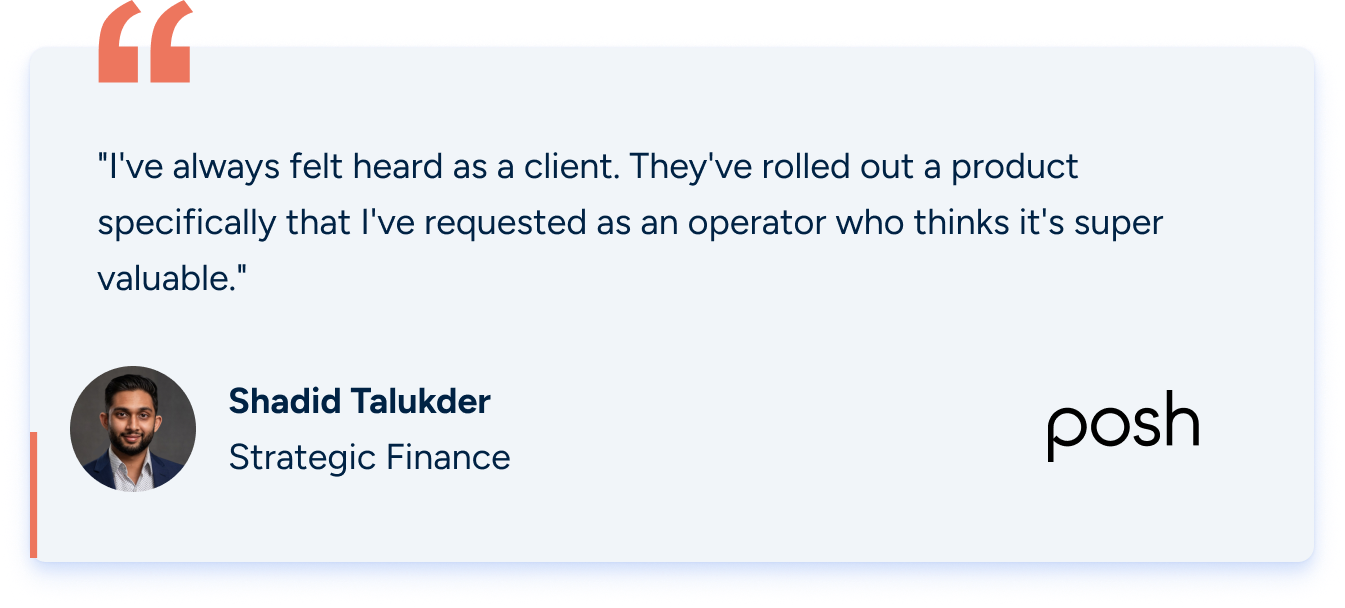
One thing Shadid called out specifically was how the relationship with Zenskar's team felt throughout: he had always felt heard as a customer, with product built directly in response to what he asked for as an operator, including one-off invoices with complex line items and the AI agents rollout.
What Zenskar Made Possible
Invoices out on day 1 & 2, every month
The monthly invoicing cycle at Posh now works in two steps: one day of change management in Zenskar, followed by a batch draft and a single send. For Posh, this matters more than at most companies. Their clients are financial institutions, organized, predictable payers who settle quickly. Every day an invoice goes out earlier is a day closer to cash.
3-year contracts automated across the full term
Once a contract is set up, Zenskar schedules year two and year three invoices automatically. No manual renewal tracking, no risk of a future billing falling through.

An AI agent that saves clicks without removing judgment
Shadid uses Zenskar's AI agent as part of his regular workflow — instructing it to add products, set billing frequencies, and apply pricing through text commands. The agent executes. If anything needs adjusting, two clicks correct it. The operator's ability to intervene is always there. Shadid's roadmap goes further: he is working toward turning the entire monthly review process into sequential text commands, removing manual clicking from routine operations almost entirely.

A lean team that did not have to grow to keep pace
Posh's finance function has not added headcount as the contract portfolio grew in complexity. The platform absorbs the operational weight that would otherwise require additional staff.