About IDfy & Sonali
IDfy is one of India's leading identity verification and risk intelligence companies. Founded in 2011, IDfy serves banks, fintechs, and enterprises across six product lines: background verification, video KYC, API-based identity checks, risk AI, crime check, and financial services verification.
And Sonali Shringarpure leads finance and revenue operations at IDfy. She owns the end-to-end revenue process at IDfy: contracts in, usage tracked, invoices out, credits managed, clients reconciled.
When every client has a different version of your pricing
Most companies have a pricing page. IDfy has a pricing negotiation for every client they sign.
Background verification does not bill the way most products do
A candidate profile might involve five separate checks: employment history, qualifications, address, criminal record, and passport. The invoice does not go out when each check finishes. It goes out only when all checks on that profile are complete.
The rules change by client, and by situation
If a check is canceled within 24 hours of initiation, most clients are not charged. After 24 hours, they are, either fully or at a negotiated partial rate. If IDfy takes longer than the agreed turnaround time, a penalty is deducted from that month's invoice. Finish ahead of schedule, and a reward percentage is added back. Some contracts also include flag-based rules: if a profile is tagged red, amber, or green internally, the commercial treatment changes accordingly.
Video KYC works on an entirely different model
The vKYC product bills on bundles. Call duration converts into units, with every five minutes counting as one bundle. API events during the video session are billed separately and then combined with the bundle charge into a single per-profile line item. Clients need to see the full breakdown: minutes, bundles, API count, and rate.
Then add prepaid, postpaid, enterprise hierarchies, and international entities
Some clients pay upfront and draw down credits as they consume IDfy's services. Others are invoiced at month-end. Enterprise groups like HDFC span multiple subsidiaries, each requiring their own invoice but sometimes requiring consolidated parent-level visibility. IDfy's operations in the Philippines and Indonesia add currency and entity complexity on top.
This is the environment Sonali's team was managing every month before Zenskar.
The challenge: 7-8 people every month doing what a system should do
IDfy had built an internal system that handled the complexity. It was functional. But functional is not the same as scalable.
The validation burden was consuming the team
Seven or eight people on the finance team spent most of their time each month on validation alone. Engineers from each of the six product pods got pulled in regularly when edge cases arose. The data team was building additional tooling in parallel just to keep up.
Every usage report was built by hand
IDfy's clients had been receiving detailed per-profile breakdowns for years: every check, every cancellation, every bundle, every rate, in a consistent format they relied on to reconcile their own accounts. Producing those reports meant Sonali's team pulled raw data, applied rates manually, formatted everything to spec, and sent it alongside every invoice. Every month. For every client.
The goal Sonali set
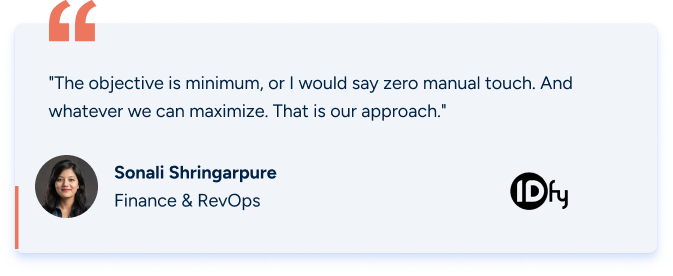
She was not looking for a marginal improvement. She wanted the manual work to disappear entirely.
A thorough evaluation, with no shortcuts taken
Sonali tested Zenskar's sandbox herself, brought in her data and engineering leads at each stage, and ran parallel conversations with Microsoft Dynamics (IDfy's ERP) and her own internal data team about whether the same capability could be built natively.
What changed the decision
The internal build made sense as long as no credible external option existed. The moment they found Zenskar, the calculus shifted. Sonali put it directly to her tech team: "If there is a readily available tool and it is integrated and it scales, then why are you putting in effort?"
Implementation: getting every contract into one system without rebuilding the architecture
Getting the data in
IDfy's pipelines ran on Apache Beam batch jobs writing to cloud storage. Their security posture meant no pull-based integrations and no third-party database access. Zenskar ingested usage via a cloud storage transfer: IDfy wrote flat files on a set cadence, Zenskar picked them up, matched them to customer profiles, and applied the relevant contract logic.
Every commercial term, configured once and maintained in one place
Volume tiers, minimum commitments, cancellation rules, penalty and reward slabs, flag-based billing logic, and package rates were all configured inside Zenskar's contract layer. New clients and amended rate cards can be added without touching the underlying data architecture. When IDfy signs a new enterprise client with unusual terms, the configuration is an hours-long exercise, not a development sprint.
Prepaid credit management, automated
For prepaid clients, credit wallets with automated deduction tracking replaced the manual top-up cycle. When a client approaches their limit, Sonali's operations team receives a threshold alert. No more manual monitoring, no more reactive scrambles when a client runs low.
What changed for Sonali and her clients
150 hours of manual work eliminated from the billing cycle
Sonali's team no longer spends the first week of every month in validation mode. Approximately 150 hours of manual work have been eliminated from each billing cycle, work that previously required seven or eight people, plus engineers pulled in from each product pod. Those engineers now stay focused on their product work. The finance team focuses on finance.
Billing cycle down from over a week to one or two
For IDfy, that compression is not just an operational win. It means collections start sooner, and the cash flow impact is felt every single month.
1,000+ usage reports, now generated automatically
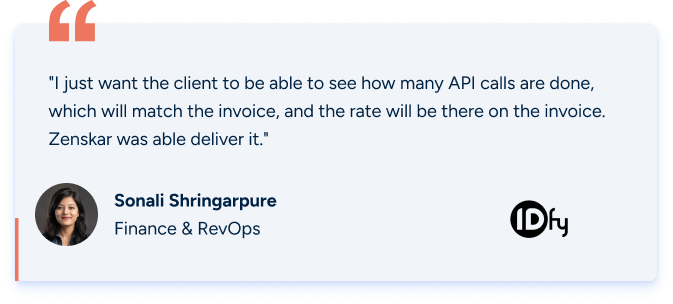
This was the condition Sonali held firm on throughout the evaluation: clients had to keep receiving the same detailed per-profile breakdowns they were used to, in the same format, with charged and uncharged profiles clearly separated so clients could reconcile on their side without coming back to IDfy with questions.
Zenskar configured those reports to accompany each invoice automatically. Clients still see exactly what they have always seen. The only difference is that no one on Sonali's team is building them by hand anymore.
International and enterprise billing, consolidated
The Philippines and Indonesia entities are now invoiced from the same platform, with multi-currency handling built in. Enterprise groups are managed through parent-child hierarchies without manual splitting. Six product pods that used to be pulled into billing operations monthly now run independently of it.
The biggest shift: revenue operations as a growth lever
The hours saved and the faster billing cycle matter. But the shift Sonali comes back to is bigger than efficiency.
Before Zenskar, understanding how a client relationship was growing, which product lines were performing, or where revenue was moving meant someone had to go and find the data first. It lived across spreadsheets that required manual extraction before any analysis could begin.
Now it is in one place, current, and accessible without anyone having to go looking.
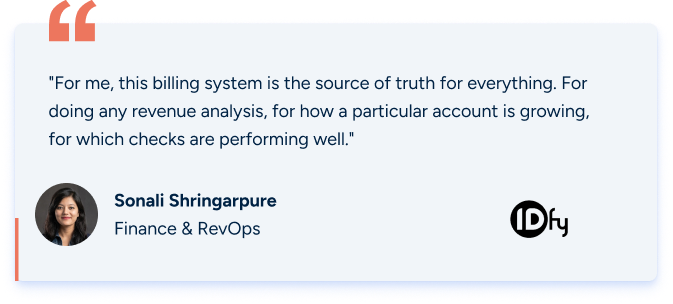
The finance team is no longer the bottleneck when leadership needs answers. That shift, from reactive to visible, is what Sonali had been building toward.
.png)